
Key takeaways
- Find the best kids scooter for a 2 year old: seated 3-in-1 models, low handlebars and stable 3-wheel decks that keep first rides slow and supervised.
What's inside
As an Amazon Associate I earn from qualifying purchases. This post may contain affiliate links at no extra cost to you.
At two, the real decision is not which scooter looks cutest in photos. It is whether your child can get on, stay upright at walking pace, and get off again without help every ten seconds. A toddler this young is still building balance, so the safest starting point is a three-wheel scooter that stands up on its own, ideally with a seat for the first weeks, a low deck close to the ground, and handlebars short enough that small arms are not reaching upward just to hold on.
This guide is for parents of two-year-olds who are walking confidently but have never ridden anything with wheels they steer themselves. Every pick below was chosen from its Amazon listing title and specifications: the stated age range, whether a seat is included, the lowest handlebar setting, the wheel layout, and the listed weight limit. Nothing here assumes speed, hills, or riding away from an adult.
Quick Picks
As an Amazon Associate we earn from qualifying purchases
| Product | Best for | Key spec from title |
|---|---|---|
| Micro Kickboard Mini 3in1 Deluxe | Starting seated, then standing in stages | 3 riding options for ages 1-5 |
| Lascoota 2-in-1 Kids Scooter with Seat | A removable seat and four bar heights | Ages 3-12 listing, up to 100 lbs in title variants |
| Micro Kickboard Mini Deluxe | A confident 2-year-old ready to stand | Ages 2-5, children up to 110 lbs |
| Globber Go Up Sporty | Ride-on, walking bike and scooter in one | 3-in-1 for toddlers, 3-wheel design |
| SKIDEE Kick Scooter Y200 | A foldable seat for stop-and-rest riding | Ages 3-5 title, removable seat, LED wheels |
How to Choose
Seat-to-Stand Stages Come First
A two-year-old rarely starts by standing and pushing. Most begin seated, scooting along with both feet on the ground, and only stand once that motion feels ordinary. A 3-in-1 or 2-in-1 model follows that sequence instead of forcing it: ride-on mode first, then a low standing deck once balance improves. Check how the seat attaches before you buy. A seat that removes with a button or a single durable screw will actually get swapped as your child changes; a seat that needs tools and twenty minutes tends to stay in whichever mode it was left in, long after your toddler has outgrown that stage.
Measure the Lowest Handlebar Height Against Your Child
Age labels are a rough guide, but handlebar height decides whether a scooter fits today. Stand your child barefoot on a flat floor and note roughly where their hands rest when arms hang relaxed, somewhere between waist and chest. The lowest bar setting should sit near that zone, not at chin height. If the bar is too tall, a toddler pushes it away instead of steering and leans backward to reach, which shifts weight the wrong way. Models differ a lot here: some toddler bars start very low for seated riding, while others assume a standing preschooler. Compare the lowest listed setting, not the maximum.
Three Wheels and a Low, Wide Deck Do the Balancing
For this age, stability should come from the scooter, not from your child. Two wheels in front and one at the back, or the reverse, keeps the scooter upright when it is parked and when it rolls slowly, so a toddler can climb on without it tipping away. A low deck matters just as much: the smaller the step up, the less a short leg has to lift, and the easier it is to put a foot down quickly. A wide, anti-slip deck surface gives both feet room in seated mode and gives a new stander space to shuffle while finding a comfortable stance.
Keep Speed Low and Braking Simple
At two, stopping is mostly done with feet on the ground, so the riding environment matters more than any brake specification. Choose flat, smooth, enclosed surfaces: a patio, a quiet cul-de-sac with an adult at the end, or an empty playground area away from slopes and driveways. A rear brake is still worth having because it teaches the idea of pressing to slow down and gives an older sibling-free way to stop on gentle ground, but do not rely on it yet. Fit a properly sized toddler helmet from the very first seated ride, keep sessions short, and stay within arm’s reach until standing and stopping are both automatic.
The 5 Best Options
Micro Kickboard Mini 3in1 Deluxe

This is the most stage-aware option for a child who is barely two. Its three riding options let a toddler begin seated with feet on the ground, move to a seated position with a shorter bar, and only later stand at the full T-bar. That progression matches how balance actually develops at this age, instead of asking for standing balance on day one. Because the listing covers ages from twelve months to five years, the same scooter can stay in the hallway through several growth spurts, provided you check the seat and bar height against your child at each stage change rather than assuming the next mode fits.
Specs
- Brand: Micro Kickboard
- Model name: Mini 3in1 Deluxe (MMD015)
- Age range from listing: ages 1-5, described for toddlers from 12 months
- Riding options: 3 stages, seated and standing
- Steering: lean-to-steer, three-wheeled
- Color shown on verified listing: Red
Best for: A young two-year-old who needs to start fully seated.
Watch out for: Confirm which color and stage configuration the specific listing includes before ordering.
ASIN: B01DPZ805I
Lascoota 2-in-1 Kids Scooter with Seat

The Lascoota suits a two-year-old who is tall for their age or who has an older sibling’s scooter to imitate and wants to stand sooner. The removable seat means the first weeks can still be seated, and the listing describes the seat coming off with a durable screw once standing takes over. Four handlebar height settings give more adjustment steps than most toddler models, which helps when a child grows in sudden jumps. The extra-wide deck with an anti-slip surface gives a new stander room for both feet side by side, and the light-up wheels make the scooter easier for an adult to track in a busy park.
Specs
- Brand: Lascoota
- Age range from listing title: ages 3-12, up to 100 lbs in title variants
- Weight limit on verified listing: 110 pounds
- Number of wheels: 3
- Wheel size: 120 millimeters, polyurethane, LED light-up
- Frame material: Aluminum
- Brake style: Rear braking
- Handle height: 34 inches at maximum setting
- Special features from listing: adjustable handlebar height, light up wheels, non slip deck, wide platform
Best for: A taller two-year-old who will move from seat to standing quickly.
Watch out for: The listing age range starts at three, so check seat and lowest bar height against your two-year-old carefully.
ASIN: B078RV6XDF
Micro Kickboard Mini Deluxe

Some two-year-olds skip the seat entirely: they have been climbing everything in the house for months and want to stand from the first ride. The Mini Deluxe is built for that child. Its three-wheel lean-to-steer design stays upright on its own, the adjustable T-bar can be set low for a small stander, and the listing is aimed squarely at ages two to five rather than older children. Steering by leaning, instead of turning a bar, keeps hands still and weight centered, which suits a toddler whose first instinct is to twist the grips. Keep rides flat and supervised; this model assumes standing from the start.
Specs
- Brand: Micro Kickboard
- Age range from listing: ages 2-5
- Weight limit from listing: up to 110 lbs
- Number of wheels: 3
- Steering: lean-to-steer design
- Handlebar: adjustable T-bar
- Wheels: smooth ride PU wheels
- Design: Swiss-designed
Best for: A confident, climbing two-year-old ready to stand and push.
Watch out for: There is no seat, so a child who still needs seated practice is better served by the 3in1 above.
ASIN: B07CNDH24K
Globber Go Up Sporty

Globber’s Go Up Sporty takes a slightly different route through the toddler stages: ride-on mode, then a walking bike mode without the seat post arrangement of a scooter, and finally a standing scooter. That middle walking-bike stage is genuinely useful for a two-year-old, because it practices seated balance and foot pushing without any steering bar to manage. The listing describes switching modes with a push of a button, and two seat heights on the related Lights version, so adjustments stay quick. For families who might otherwise buy a separate ride-on toy this year and a scooter next year, one convertible frame covers both purchases.
Specs
- Brand: Globber
- Model name: Go Up Sporty 3 in 1, model 451-110
- Modes: ride-on, walking bike, and scooter
- Age guidance from listing: 15 months to 6 years in product description, aged 3+ in title
- Number of wheels: 3
- Weight limit from listing: 50 kilograms
- Seat: adjustable seat heights described on the listing
- Included components from listing: Globber Evo 4 In 1 V2 451-110-2, Deep Pink listing
Best for: Parents who want one ride-on that converts instead of two separate toys.
Watch out for: Mode-specific limits differ; follow the listing guidance for the seated modes rather than the standing weight limit.
ASIN: B01MG25JIB
SKIDEE Kick Scooter Y200
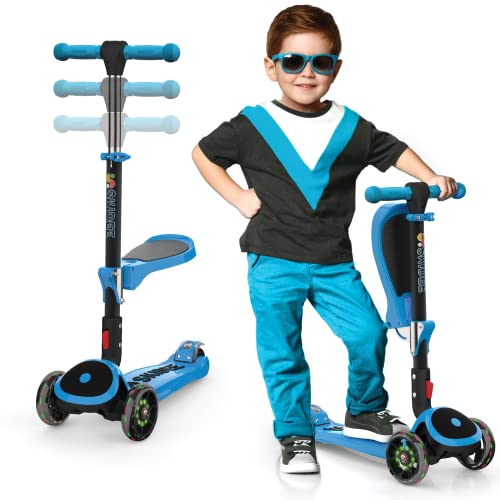
The Skidee Y200 folds its seat up or down rather than removing it completely, which changes how a two-year-old’s ride actually goes: when little legs tire halfway around the block, the seat drops and the ride continues seated instead of ending in a carry-home negotiation. The listing describes a wide standing board with room for both feet in either mode, lean-to-turn steering, and three wheels to keep the scooter upright. LED light-up wheels are motion-activated with no batteries required according to the listing, which also helps adults keep the scooter in view. It folds for storage, useful in a small hallway or car trunk.
Specs
- Brand: SKIDEE
- Model name: SP2, style Y200
- Age range from listing title: ages 3-5, description states ages 2-12
- Weight limit on verified listing: 130 pounds
- Number of wheels: 3
- Special features from listing: adjustable handlebar height, light up wheels, seat
- Wheel material: Polyurethane
- Brake style: Rear braking
- Item weight from listing: 10 lbs in description, foldable
Best for: Toddlers who alternate between sitting and standing within a single ride.
Watch out for: The title age range starts at three; measure your two-year-old against the seat and bar before relying on seated mode.
ASIN: B07JBB6YJQ
Which One Fits Your Situation
Your Child Has Just Turned Two and Never Ridden Anything
Start with the Micro Mini 3in1 Deluxe or the Globber Go Up Sporty. Both begin as seated ride-ons, so the first skill is simply pushing along with feet on flat ground while an adult walks beside them. A helmet, a flat patio, and short sessions matter more at this point than which brand you choose, so pick the one whose seat height lets your child’s feet rest flat on the floor.
Your Two-Year-Old Is Tall and Already Trying to Stand
Look at the Lascoota 2-in-1 or the SKIDEE Y200. Each keeps a seat available for tired moments but is ready for standing practice, and both list wide decks that tolerate the foot shuffling new standers do. Set the handlebar to its lowest position first, and only raise it when your child’s hands sit comfortably below chest height while standing on the deck in socks at home.
Your Child Refuses Any Seat and Wants to Stand Like Older Kids
The Micro Mini Deluxe is the honest match. It has no seat to argue about, its lean-to-steer front end stays stable at toddler pace, and its stated age range begins at two. Supervision does the safety work here: ride on flat ground, stay close enough to catch a wobble, and end the session when pushing turns into running with the scooter, which is when most toddler falls happen.
Space at Home Is Tight and the Scooter Must Be Stored Away
The SKIDEE Y200 folds, and its seat folds with it, so it can live in a closet or car trunk between rides. The Lascoota’s removable seat also reduces bulk once your child stands full-time. Whichever you choose, store it indoors with the brake and wheels checked quickly before each ride; a ten-second adult check of the bar clamp and seat fitting prevents most wobble-related surprises.
Common Mistakes
- Buying by age label alone, without checking the lowest handlebar and seat height against your child’s actual leg length and reach.
- Starting on a slope or a driveway that angles toward the street, where a seated toddler can roll faster than an adult expects.
- Skipping the helmet for seated rides because they look slow; a tip sideways from a seat still puts a head near hard ground.
- Removing the seat permanently the first time a child stands, instead of keeping it available for tired or cautious days.
- Letting a two-year-old ride where older children are scooting or cycling at speed, instead of choosing a quiet, flat, enclosed space.
Frequently Asked Questions
Does a 2-year-old need a seat on their first scooter?
Most do at first, even if only for a few weeks. Seated riding lets a toddler learn pushing, stopping with their feet, and basic direction without also balancing standing up. A removable or foldable seat, like those on the Lascoota and SKIDEE above, means the seat can disappear once standing feels easy, rather than forcing a second purchase.
What handlebar height suits a 2-year-old?
The grips should sit roughly between your child’s waist and chest when they stand on the deck in flat shoes. If the lowest setting leaves the bar near the chin, the scooter is too big for now, whatever the age label says. Set the bar at its lowest position for the first rides and raise it only as your child grows into the next setting.
Are three wheels really safer than two at this age?
A three-wheel scooter stands upright by itself and does not tip sideways at a standstill, which removes the most common toddler problem: falling while simply getting on. It does not remove the need for supervision, a helmet, or flat ground. Two-wheel scooters require continuous balance that most two-year-olds have not developed yet, so save them for much later.
Where should a 2-year-old ride a scooter?
Choose flat, smooth, enclosed ground: a patio, a fenced playground surface, or a quiet path with no slope toward traffic, water, or steps. Stay within arm’s reach, keep speeds at walking pace, and stop for the day when your child is tired, because tired toddlers push harder, steer less, and fall more. A fitted toddler helmet belongs on every ride, seated or standing.
Related guides
More from Amazon
Programs that pair well with the guide above. Offers and eligibility are set by Amazon and may change.
Free shipping on eligible items, Prime Video and more. Eligible new members can start with a free trial.
Start a Prime free trialAudiobooks and podcasts to listen to on the go. Eligible new members can start with a free trial.
Try Audible freeAd-free music streaming. Eligible new subscribers can start with a free trial.
Try Music Unlimited freeA free business account with business pricing and bulk-buying tools for work, shop or home office.
Create a business accountAs an Amazon Associate we earn from qualifying purchases.










Write Your Review
No reviews yet. Be the first to share your experience!