
Key takeaways
- Compare compact tube and hybrid tube headphone amplifiers for desktop listening, with tube types, headphone jacks, gain and impedance ranges explained.
What's inside
As an Amazon Associate I earn from qualifying purchases. This post may contain affiliate links at no extra cost to you.
Adding a tube amplifier to a computer desk is mostly a decision about fit: the box has to sit beside a monitor without crowding the keyboard, drive the headphones you already own, and accept the analog output of the source you already use. Buyers also choose between a full tube design and a hybrid, where tubes shape the signal and transistors supply the output current, and that choice affects size, heat, and which headphone impedances suit the amplifier best.
This guide is for desk listeners upgrading from a computer headphone jack, headphone owners with higher-impedance models that need more drive, and listeners who want tone controls or balanced jacks in a compact unit. Every product below was chosen from the names and specifications printed on its Amazon product page, and only tube or hybrid tube headphone amplifiers are included.
Quick Picks
As an Amazon Associate we earn from qualifying purchases.
| Product | Best for | Key spec from title |
|---|---|---|
| Nobsound P32 Tube Headphone Amplifier | A small first tube amp for a crowded desk | 1000mW output |
| Douk Audio E2 Tube Headphone Amplifier | Balanced headphone cables and two desk sources | XLR, 4.4mm and 6.35mm headphone jacks |
| Douk Audio U10 Mini Tube Headphone Amplifier | The smallest footprint with both common headphone jacks | RCA and AUX jacks |
| Fosi Audio P3 Tube Preamp Headphone Amplifier | Wireless listening plus bass and treble adjustment | Bluetooth aptX HD with bass and treble tone controls |
| Little Dot MK II Tube Headphone Amplifier | A full tube circuit for high-impedance headphones | Two 6J1 driver tubes and two 6N6 power tubes |
How to Choose
Full Tube or Hybrid Tube Circuit
The circuit type is the first filter. A full tube amplifier such as the Little Dot MK II uses tubes for both the driver and power stages, which gives the classic tube presentation but usually means a larger chassis, more heat, and output that suits higher-impedance headphones best. A hybrid pairs tubes in the preamp stage with a transistor output stage, as the P32, U10, and E2 do here. Hybrids are typically smaller, run cooler on a desk, and deliver more current into low-impedance headphones, which is why most compact desktop models use that layout.
Headphone Impedance and Output Power
Match the amplifier to the headphones rather than chasing the biggest power figure. Every listing here states a supported impedance range, from the P3 at 16 to 300 ohms up to several models covering 600 ohms, and power is quoted at a specific load, often 32 ohms. High-impedance dynamic headphones need voltage swing more than raw current, while low-impedance and planar models draw more current. Check that your headphones fall inside the stated range and that the quoted output at a similar load leaves headroom above your normal listening level.
Inputs for a Computer Desk Source
Most tube headphone amplifiers are analog devices, so plan the connection from your computer before buying. The common pattern is a stereo RCA input, sometimes joined by a 3.5mm AUX input, fed from a DAC, an audio interface, or a computer line output. None of the wired models here converts digital audio itself, so a USB source still needs a DAC somewhere in the chain. The P3 is the exception in this group, adding Bluetooth reception for a phone or computer. Count your sources too: the E2 accepts two RCA inputs, while the others accept one or two analog feeds.
Gain Settings, Jacks, and Desk Footprint
Small controls decide daily comfort. A gain switch, fitted to the E2, lets one amplifier serve both efficient and demanding headphones without keeping the volume knob at the very bottom of its travel. Check which headphone jacks are built in: 3.5mm and 6.35mm single-ended jacks cover most cables, while the E2 adds 4.4mm and four-pin XLR balanced outputs. Finally, measure the desk space. The P32 and U10 are palm-sized boxes, the P3 and E2 are mid-sized, and the MK II is a full-width component that needs clear space around its four exposed tubes.
The 5 Best Options
Nobsound P32 Tube Headphone Amplifier
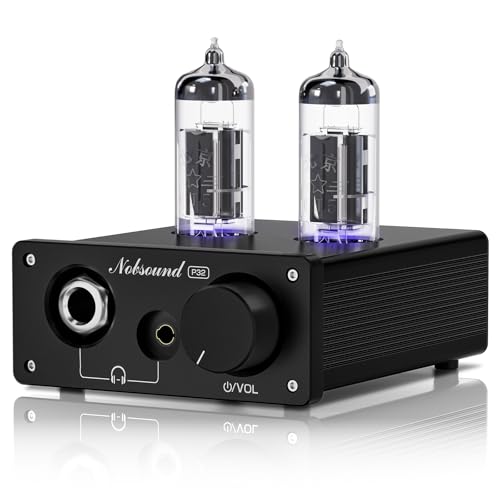
The P32 is the easiest starting point in this group for a computer desk. Its listing describes a mini desktop amplifier with two 6J5 tubes, a stated output of at least 1000mW at 32 ohms, and support for headphones from 24 to 600 ohms, which covers most wired models a desk listener is likely to own. Both 3.5mm and 6.35mm headphone jacks are built in, and stereo RCA plus 3.5mm AUX inputs accept a DAC or a computer line output. The tubes and the two NE5532 op-amps are pluggable, so the sound can be adjusted later without replacing the amplifier.
Specs
- Tubes: 2 x 6J5 vacuum tubes, pluggable socket
- Replacement tubes listed: 6J1, 5654, 6AK5, EF95 and others
- Op-amps: 2 x pluggable NE5532 dual op-amps
- Audio input: Stereo RCA, 3.5mm AUX
- Audio output: 3.5mm and 6.35mm headphone jacks
- Output power: At least 1000mW at 32 ohms
- Matched headphone impedance: 24 to 600 ohms
- Frequency response: 20Hz to 30kHz
- Signal-to-noise ratio: At least 110dB
- Power input: DC 5V, at least 2A, adapter included in the packing list
- Dimensions: 78 x 82 x 32mm
- Net weight: 220g
Best for: Desk listeners who want a first tube amplifier that takes very little space.
Watch out for: The listing warns against connecting the RCA and AUX inputs at the same time, and it specifies the supplied DC 5V adapter for correct performance.
ASIN: B0FDB1LXQN
Douk Audio E2 Tube Headphone Amplifier

The E2 is the step-up choice for listeners whose headphones use balanced cables or who keep two sources on the desk. Its manual lists 4.4mm and four-pin XLR balanced headphone outputs alongside a 6.35mm jack, two groups of stereo RCA inputs, and a stereo RCA output, so it can work as a headphone amplifier, a preamplifier, or both at once. Two German Valvo ECF801 tubes run in the tube stage, gain switches between a low setting rated at 0.55W and a high setting rated at 2W, and the supported headphone range runs from 16 to 600 ohms.
Specs
- Tubes: 2 x German Valvo ECF801 vacuum tubes, pluggable sockets
- Audio input: 2 groups of stereo RCA
- Audio output: Stereo RCA, 4-pin XLR, 4.4mm and 6.35mm headphone jacks
- Headphone output power: Low gain 0.55W, high gain 2W
- Matched headphone impedance: 16 to 600 ohms
- Frequency response: 20Hz to 20kHz
- Signal-to-noise ratio: At least 110dB
- Op-amps: NE5532 and LME49720, the LME49720 is pluggable
- Working voltage: DC 15V, at least 3A, adapter included in the packing list
- Included adapter: 6.35mm to 3.5mm headphone adapter
Best for: Listeners with balanced headphone cables and two analog sources on one desk.
Watch out for: The maker notes that two square WIMA capacitors inside are used parts fitted because of scarcity, and the unit needs a DC 15V supply of at least 3A, so use the supplied adapter.
ASIN: B0F8RBZLJL
Douk Audio U10 Mini Tube Headphone Amplifier

The U10 suits the tightest desks in this group. Douk Audio lists it as a mini tube headphone amplifier with two 6A2 tubes, dual headphone outputs in 3.5mm and 6.35mm sizes, and a stated 1100mW of output for headphones from 18 to 600 ohms. A boost circuit raises the internal working voltage to 24V from the 5V DC supply, and the box contents include a USB to DC cable, which makes powering it around a computer straightforward. Stereo RCA and 3.5mm AUX inputs cover a DAC or a direct computer connection, and the tubes and op-amps are pluggable for later changes.
Specs
- Tubes: 2 x 6A2 vacuum tubes, pluggable sockets
- Replacement tubes listed: 6J1, 5654, EF95 and others
- Audio input: Stereo RCA, 3.5mm AUX
- Audio output: 3.5mm and 6.35mm headphone jacks
- Output power: 1100mW
- Suitable headphone impedance: 18 to 600 ohms
- Power: DC 5V, at least 2A, through the included USB to DC cable
- Box contents: U10 amplifier, 2 x 6A2 tubes, USB to DC cable, acrylic board, user manual
Best for: Very small desks where the amplifier must fit beside a monitor stand.
Watch out for: No power adapter is included, and the listing states the U10 will not work normally if the 5V supply delivers less than 2A, so check your power source before ordering.
ASIN: B0C1MT8DG8
Fosi Audio P3 Tube Preamp Headphone Amplifier

The P3 is the pick for listeners who split time between wired and wireless sources at the desk. Its page describes a tube preamplifier and headphone amplifier with two 5654W tubes working at up to 54V, Bluetooth 5.1 reception with aptX HD and aptX LL support, and bass and treble tone controls on the front panel. Wired connections are an RCA input with RCA and AUX outputs, and the headphone output is a single 3.5mm jack on the front. The stated headphone range is 16 to 300 ohms, narrower than the others here, so check demanding high-impedance models against the listed output figures first.
Specs
- Tubes: 2 x 5654W vacuum tubes
- Tube working voltage: Up to 54V
- Bluetooth: Version 5.1, Qualcomm QCC3031 chip, SBC, AAC, aptX, aptX HD and aptX LL codecs
- Inputs: Bluetooth, RCA
- Outputs: RCA, AUX out, 3.5mm headphone jack
- Headphone impedance: 16 to 300 ohms
- Headphone output: 250mW at 16 ohms, 150mW at 32 ohms, 20mW at 300 ohms
- Signal-to-noise ratio: At least 103dB
- Frequency response: 20Hz to 20kHz
- Tone controls: Bass and treble knobs on the front panel
- Power supply: 12V, 1.5A, included in the package contents
Best for: Desk listeners who want Bluetooth from a phone plus tone controls for wired listening.
Watch out for: Plugging in headphones switches the signal away from the RCA and AUX outputs, and the headphone output is 3.5mm only, so a 6.35mm plug needs an adapter.
ASIN: B0CJBKWF43
Little Dot MK II Tube Headphone Amplifier
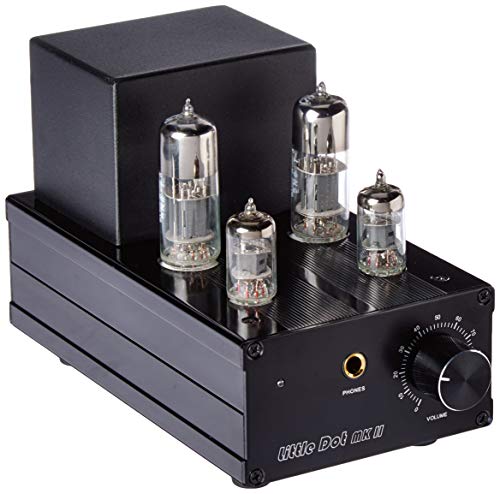
The MK II is the traditional choice in this group: a full tube amplifier rather than a hybrid. Its listing describes an SEPP output-transformerless circuit running in Class A, with two 6J1 driver tubes and two 6N6 power tubes, gold-plated RCA inputs, a quarter-inch headphone output, and a preamplifier output for feeding another amplifier. Gain is set by internal switches at 3, 5, or 10 times, and the stated headphone range is 32 to 600 ohms, which suits the higher-impedance dynamic headphones that full tube designs are bought for. It is the largest unit here, so it fits a dedicated listening corner of the desk better than a crowded workstation.
Specs
- Circuit: SEPP output-transformerless, Class A
- Driver tubes: 2 x 6J1
- Power tubes: 2 x 6N6
- Input: Gold-plated unbalanced RCA jacks
- Output: Quarter-inch gold-plated stereo headphone jack, preamplifier RCA output
- Output power: Up to 300mW into 300 ohms
- Frequency response: 20Hz to 50kHz
- Suitable headphone impedance: 32 to 600 ohms
- Preamplifier gain: 3, 5, or 10 times, set by internal gain switches
- Input impedance: 50K ohms
- Dimensions: 8.66 x 4.33 x 4.21 inches
Best for: Listeners with high-impedance headphones who want a full tube circuit and tube rolling options.
Watch out for: Gain changes require opening the unit to reach the internal switches, and the four exposed tubes need clearance and ventilation space on the desk.
ASIN: B00A2QMAI2
Which One Fits Your Situation
A First Tube Amp Beside a Work Computer
Start with the Nobsound P32. It is the smallest and simplest unit here, its RCA and AUX inputs accept the line output of a typical desk DAC or computer, and both common headphone jacks are built in. The stated 24 to 600 ohm range covers most wired headphones, and the pluggable tubes and op-amps leave room to experiment later without buying a second amplifier.
Balanced Cables and Two Sources on One Desk
Choose the Douk Audio E2. It is the only model here with 4.4mm and four-pin XLR balanced headphone outputs, and its two RCA inputs let a computer DAC and a second source stay connected. The two gain settings, rated at 0.55W and 2W, cover efficient headphones and harder loads from the same box, and the RCA output can feed powered speakers when headphones are not in use.
The Smallest Possible Footprint
Pick the Douk Audio U10 when desk depth is the real limit. The mini chassis carries both 3.5mm and 6.35mm headphone jacks, the stated range covers 18 to 600 ohms, and power comes from a 5V supply through the included USB to DC cable. Just confirm that your power source can deliver at least 2A, because no adapter is included in the box.
High-Impedance Headphones and a Traditional Tube Circuit
Take the Little Dot MK II if your headphones sit in the 32 to 600 ohm range and you want tubes in both the driver and power stages. The switchable gain helps match output to the headphone, and the preamplifier output leaves a path to powered speakers or a separate amplifier later. Reserve the desk space first, since it is a full-size component with four exposed tubes.
Common Mistakes
- Expecting a USB connection to carry audio into an analog tube amplifier; most models here accept RCA or AUX only, so a computer still needs a DAC or line output in the chain.
- Matching by the headline power figure alone, without checking the load it was measured at or whether your headphones fall inside the stated impedance range.
- Powering a 5V amplifier from a weak USB port or charger; the U10 and P32 listings both call for at least 2A for normal operation.
- Placing an amplifier with exposed tubes under a shelf or against a monitor, leaving no clearance for heat or for removing the tubes.
- Changing tubes or op-amps while the unit is powered, or swapping in a tube type the listing does not name as compatible.
Frequently Asked Questions
Does a tube headphone amplifier need a DAC with a computer?
Usually, yes, unless the amplifier includes a digital input. The wired models in this guide accept analog RCA or AUX signals, so the computer needs a DAC, an audio interface, or a line-level headphone output to feed them. The Fosi Audio P3 is the exception here because it can receive audio over Bluetooth, although its wired input is still analog RCA.
Are hybrid tube amplifiers a good choice for low-impedance headphones?
Hybrids are generally the safer match for low-impedance headphones because the transistor output stage supplies current more easily than a full tube output stage. The P32, U10, and E2 all state ranges starting between 16 and 24 ohms. A full tube design such as the Little Dot MK II states a 32 ohm minimum and is aimed mainly at higher-impedance dynamic headphones.
What do the stated impedance ranges actually tell a buyer?
The range is the maker statement of which headphone loads the amplifier is designed to drive. A model listing 24 to 600 ohms, such as the P32, covers nearly all wired headphones, while the P3 stops at 300 ohms. Falling inside the range does not guarantee loud listening levels, so also check the output power quoted at a load close to your headphones impedance.
Can these amplifiers also feed powered desktop speakers?
Several can, because they double as preamplifiers. The E2 and MK II have stereo RCA outputs, the U10 is listed as a preamp for home speakers, and the P3 offers RCA and AUX outputs. Remember that behavior differs by model: on the P3, plugging in headphones stops the signal to the RCA and AUX outputs, so check the switching arrangement before planning a shared setup.
Related guides
More from Amazon
Programs that pair well with the guide above. Offers and eligibility are set by Amazon and may change.
Free shipping on eligible items, Prime Video and more. Eligible new members can start with a free trial.
Start a Prime free trialAudiobooks and podcasts to listen to on the go. Eligible new members can start with a free trial.
Try Audible freeAd-free music streaming. Eligible new subscribers can start with a free trial.
Try Music Unlimited freeA free business account with business pricing and bulk-buying tools for work, shop or home office.
Create a business accountAs an Amazon Associate we earn from qualifying purchases.










Write Your Review
No reviews yet. Be the first to share your experience!