
Key takeaways
- Find the best sunscreen for oily skin dermatologist recommended, with oil-free, lightweight formulas that control shine and suit acne-prone skin.
What's inside
As an Amazon Associate I earn from qualifying purchases. This post may contain affiliate links at no extra cost to you.
Oily skin and sunscreen have a long history of disagreement. A heavy sunscreen can leave the face looking shiny within an hour, sit on top of the skin instead of sinking in, and feel like a layer that should not be there. For people with oily or acne-prone skin, that feeling is enough to make daily sun protection feel like a chore, and the easiest way to skip a chore is to stop doing it. That is the real problem with sunscreen for oily skin: it is not that protection is hard to find, it is that a formula that feels wrong will not be used every day.
The picks in this guide are built for that problem. Each one is a sunscreen whose listing describes an oil-free formula, a lightweight or dry-touch finish, and a formula made for oily or acne-prone skin. Several of them carry a dermatologist recommended or developed with dermatologists statement in their listing or on their packaging. The guide explains what to look for, how to read a label, and how to fit sunscreen into a routine for oily skin without adding shine.
How to Choose a Sunscreen for Oily Skin
Oil-free and non-comedogenic first
The two words that matter most on a sunscreen for oily skin are oil-free and non-comedogenic. Oil-free means the formula does not add oil to skin that already produces plenty of it. Non-comedogenic means the formula is made not to clog pores. A sunscreen can be broad spectrum and high SPF and still be a poor choice for oily skin if it is neither of those things. Check the listing for both words before anything else, and treat a formula that lists neither as a warning sign.
A finish that controls shine
Oily skin needs a finish that dries down rather than staying wet on the surface. Look for words such as dry touch, matte finish, oil absorbing, and lightweight in the listing. A dry-touch formula uses ingredients such as silica and perlite to absorb excess oil as the day goes on, which keeps shine under control for longer. A matte finish lotion is made to leave the skin looking flat rather than glossy. If the listing describes a rich or creamy texture, that formula is more likely to suit dry skin than oily skin.
Broad spectrum protection and a useful SPF number
Broad spectrum means the sunscreen protects against UVA rays, which age the skin, and UVB rays, which burn it. Every sunscreen in this guide is broad spectrum. For daily use, SPF 30 is a solid baseline, and SPF 50 or 60 gives a larger margin when the day includes long stretches outdoors. A higher SPF number does not remove the need to reapply, and it does not make a heavy formula worth wearing. Choose the SPF number after the formula feels right, not before.
Dermatologist recommended and tested on sensitive skin
For oily skin that is also sensitive or acne-prone, a dermatologist recommended or developed with dermatologists statement is a useful signal. It means the brand positions the formula for skin that reacts easily, and the listing usually pairs that statement with details such as fragrance-free, tested on sensitive skin, and suitable for acne-prone skin. EltaMD describes its UV Clear as dermatologist recommended, and CeraVe describes its formulas as developed with dermatologists. Those statements do not replace reading the full ingredient list, but they are a good place to start.
Water resistance and wear time
If the day includes exercise, heat, or time in water, water resistance matters. A sunscreen described as water resistant for 80 minutes holds up to sweat and swimming for that long before reapplication is needed. A formula without a water resistance statement is fine for a day spent mostly indoors, but it will not hold up the same way outdoors. Match the water resistance to the day, not to the highest number on the shelf.
Top Picks
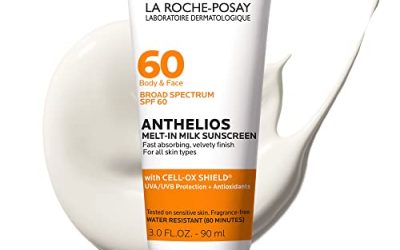
La Roche-Posay Anthelios Clear Skin Dry Touch Sunscreen SPF 60
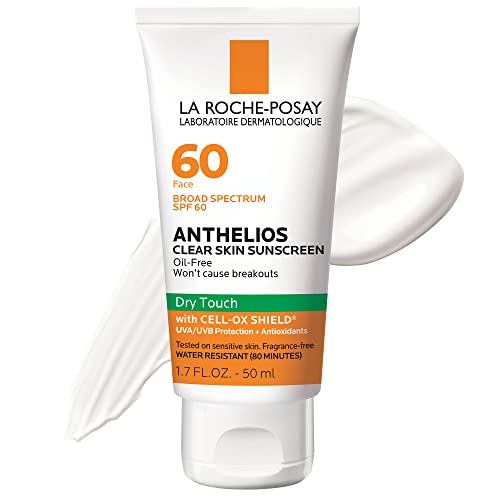
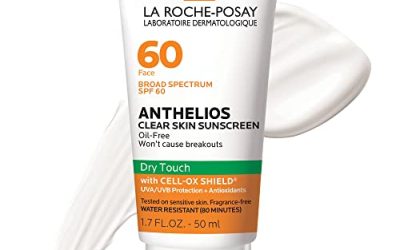
The La Roche-Posay Anthelios Clear Skin Dry Touch Sunscreen SPF 60 is made for oily skin, and the listing says so directly. It is an oil-free, dry-touch sunscreen with broad spectrum SPF 60 protection, described as oil absorbing and non-greasy, with antioxidants and a formula that is oxybenzone free. The listing describes it as tested on sensitive skin and fragrance-free, and it is water resistant for 80 minutes. The tube holds 1.7 fluid ounces.
- Broad spectrum SPF 60 with oil-free, dry-touch finish
- Oil absorbing formula made for oily skin
- Tested on sensitive skin and fragrance-free
- Water resistant for 80 minutes
- Oxybenzone free with antioxidants
Best for: Oily skin that needs high SPF protection with a dry, non-greasy finish.
EltaMD UV Clear Broad-Spectrum SPF 46
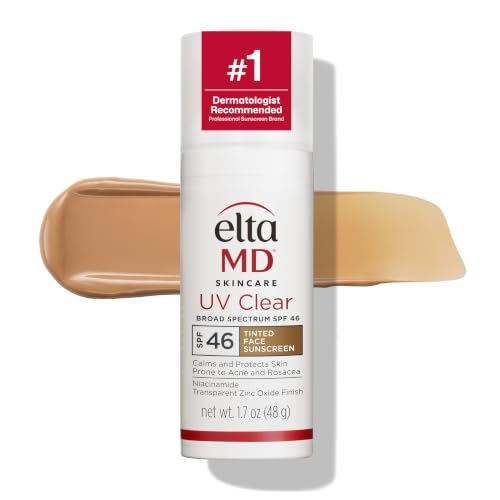
The EltaMD UV Clear Broad-Spectrum SPF 46 is described in its Amazon listing as dermatologist recommended, and it is the pick in this guide with the clearest dermatologist statement. It is an oil-free face sunscreen with zinc oxide, made for sensitive skin and skin prone to acne and rosacea. The formula includes niacinamide, which the listing describes as calming for skin that reacts easily, and it leaves a transparent zinc oxide finish. The bottle holds 1.7 ounces.
- Broad spectrum SPF 46, oil-free, with zinc oxide
- Described in the listing as dermatologist recommended
- Made for sensitive skin and skin prone to acne and rosacea
- Includes niacinamide for calming care
- Transparent zinc oxide finish without a heavy feel
Best for: Oily, acne-prone, or sensitive skin where a dermatologist recommended statement matters most.
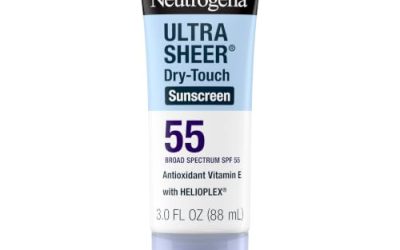
Neutrogena Clear Face Liquid Lotion Sunscreen SPF 55

The Neutrogena Clear Face Liquid Lotion Sunscreen SPF 55 is a breakout-free, oil-free sunscreen made for skin prone to acne. The listing describes it as lightweight and non-comedogenic, with a matte finish that leaves the skin able to breathe. It uses Helioplex technology for broad spectrum SPF 55 protection, it is water resistant for 80 minutes, and it contains no fragrance. The tube holds 3 fluid ounces.
- Broad spectrum SPF 55 with Helioplex technology
- Oil-free, lightweight, and non-comedogenic
- Matte finish for skin prone to breakouts
- Water resistant for 80 minutes
- Fragrance-free formula
Best for: Acne-prone oily skin that needs a matte finish and a larger tube for daily use.
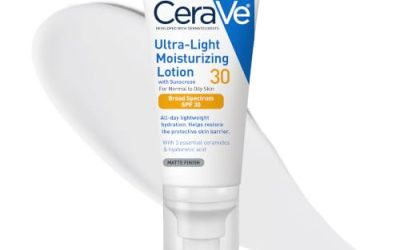
CeraVe Ultra-Light Moisturizing Lotion SPF 30

The CeraVe Ultra-Light Moisturizing Lotion SPF 30 combines a daily moisturizer with sun protection, which suits oily skin that does not want two separate layers in the morning. The listing describes it as developed with dermatologists, with hyaluronic acid and ceramides, broad spectrum SPF 30, oil-free, and a matte finish. It is made for normal to oily skin, and the tube holds 1.7 ounces.
- Broad spectrum SPF 30 with a matte finish
- Developed with dermatologists, with ceramides and hyaluronic acid
- Oil-free lotion made for normal to oily skin
- Doubles as a daily face moisturizer with SPF
- Lightweight, fast-absorbing texture
Best for: Oily skin that wants one light morning step instead of a separate moisturizer and sunscreen.
Comparison
| Product | Key Feature | Best For |
|---|---|---|
| La Roche-Posay Anthelios Clear Skin SPF 60 | Oil-free dry touch, SPF 60, water resistant 80 minutes | High SPF with a dry finish |
| EltaMD UV Clear SPF 46 | Dermatologist recommended, zinc oxide, niacinamide | Sensitive, acne-prone oily skin |
| Neutrogena Clear Face SPF 55 | Oil-free, non-comedogenic, matte finish | Acne-prone skin, daily use |
| CeraVe Ultra-Light Moisturizing Lotion SPF 30 | Developed with dermatologists, moisturizer with SPF | One light morning step |
Buying Guide
Read the label like a checklist
A sunscreen label for oily skin should answer five questions in a few seconds: is it broad spectrum, what is the SPF number, is it oil-free, is it non-comedogenic, and is it water resistant. If the listing answers all five, the formula is worth a closer look. If it answers only two or three, keep looking. The dermatologist recommended or developed with dermatologists statement is a useful sixth check, and it is strongest when the listing also says the formula is fragrance-free and tested on sensitive skin.
Apply enough, then let it dry
A sunscreen works only when enough of it is applied, and the amount that works is larger than most people use. A thin smear across the face does not give the protection the SPF number promises. Apply a generous layer to the face and neck, spread it evenly, and let it dry for a few minutes before makeup or going outside. A dry-touch formula such as the La Roche-Posay pick in this guide dries down faster than a rich cream, which makes the wait shorter and the finish cleaner.
Reapply on long days outdoors
Reapplication is where most routines fail. A sunscreen applied in the morning does not last all day, and sweat, water, and touching the face all wear it down. The listing for most water-resistant sunscreens gives a water resistance time of 80 minutes, and that is a useful guide for how often to reapply when outdoors. Keep the tube where it is easy to reach, and reapply after swimming, after heavy sweating, and at least every two hours on a long day outside.
Fit sunscreen into the routine, not on top of it
Sunscreen works best when it is the last step of a morning skincare routine, after cleanser and moisturizer, and before makeup. For oily skin, a moisturizer with SPF such as the CeraVe pick in this guide can replace a separate moisturizer on days when the skin feels balanced. On days when the skin feels oilier, a light gel moisturizer under a dry-touch sunscreen works better than a rich cream under the same sunscreen. The goal is a routine that feels light enough to repeat every morning.
Watch for breakouts and adjust
Oily skin that breaks out easily needs a short testing period with any new sunscreen. Use the new formula for a week or two and watch for new breakouts, clogged pores, or extra shine. If breakouts appear, switch to a different formula in this guide, and check whether the new formula is also oil-free and non-comedogenic. A formula that works for one person with oily skin may not work for another, and the right answer is the one that the skin tolerates day after day.
Frequently Asked Questions
What SPF number is best for oily skin?
SPF 30 is a solid baseline for daily use, and SPF 50 or 60 gives a larger margin on long days outdoors. The formula matters more than the number. An oil-free, non-comedogenic SPF 30 that is worn every day protects better than an SPF 60 that feels heavy and gets skipped.
Is mineral or chemical sunscreen better for oily skin?
Both types can work for oily skin. Mineral sunscreens use zinc oxide and titanium dioxide and suit sensitive skin, while chemical sunscreens use filters such as avobenzone and tend to feel lighter. EltaMD UV Clear uses zinc oxide in a lightweight formula, and La Roche-Posay Anthelios Clear Skin uses chemical filters in a dry-touch formula. Choose by finish and tolerance, not by type alone.
Can sunscreen cause breakouts on oily skin?
A sunscreen that is not oil-free or non-comedogenic can contribute to clogged pores and breakouts. The picks in this guide are oil-free and non-comedogenic, and several are made for acne-prone skin. If breakouts appear with a new sunscreen, stop using it and try a different formula from this guide.
How often should I reapply sunscreen?
Reapply at least every two hours on a long day outdoors, and sooner after swimming or heavy sweating. Water-resistant formulas in this guide are rated for 80 minutes of water resistance, which is a useful guide for reapplication timing when in or near water.
Conclusion
The best sunscreen for oily skin is the one that feels light enough to wear every day and is described in its listing as oil-free, non-comedogenic, and broad spectrum. The La Roche-Posay Anthelios Clear Skin SPF 60 gives high protection with a dry-touch finish. The EltaMD UV Clear SPF 46 carries the clearest dermatologist recommended statement in this guide and suits sensitive, acne-prone skin. The Neutrogena Clear Face SPF 55 gives a matte finish for acne-prone skin in a larger tube. The CeraVe Ultra-Light SPF 30 doubles as a daily moisturizer for oily skin. Pick the formula that matches the skin, apply enough of it, and reapply on long days outdoors, and daily sun protection becomes a habit rather than a chore.
Disclosure: As an Amazon Associate, we earn from qualifying purchases.
Related guides
More from Amazon
Programs that pair well with the guide above. Offers and eligibility are set by Amazon and may change.
Free shipping on eligible items, Prime Video and more. Eligible new members can start with a free trial.
Start a Prime free trialAudiobooks and podcasts to listen to on the go. Eligible new members can start with a free trial.
Try Audible freeAd-free music streaming. Eligible new subscribers can start with a free trial.
Try Music Unlimited freeA free business account with business pricing and bulk-buying tools for work, shop or home office.
Create a business accountAs an Amazon Associate we earn from qualifying purchases.
Write Your Review
No reviews yet. Be the first to share your experience!