
Key takeaways
- Compare the best sable paint brushes for miniatures, with natural hair points for smooth detail and layer work, chosen from Amazon listing specs.
What's inside
As an Amazon Associate I earn from qualifying purchases. This post may contain affiliate links at no extra cost to you.
Choosing a natural sable brush for miniature work is a decision about hair, habits and patience. A good Kolinsky point can place an eye highlight and then widen into a smooth layer stroke, but the same brush asks for gentle rinsing, careful reshaping and storage away from rough jobs. If you paint in thin coats and value a point that reforms on its own, sable rewards that care. If your bench habits are rough, the finest bundle will suffer first.
This guide serves painters stepping up from basic hobby rounds, painters building a small set of fine rounds for faces and trim, and painters who layer display figures slowly. Every pick is a named sable or Kolinsky sable line, taken from the names and details given on the Amazon product pages, in sizes suited to work on small figures.
Quick Picks
As an Amazon Associate we earn from qualifying purchases
| Product | Best for | Key spec from title |
|---|---|---|
| Winsor & Newton Series 7 Kolinsky Sable Brush, Round SH #1 | An all-round size 1 for layering and detail on 28mm figures | Round SH, Size #1 |
| Raphael 8404 Kolinsky Round 3/0 | The finest marks: pupils, lens dots and tiny insignia | Series 8404 Round, Size 3/0 |
| da Vinci Maestro Series 10 Kolinsky Red Sable Size 2 | Fuller layer and glaze passes with a sharp round point | Sharp Round, Size 2 |
| Escoda Optimo Series 1210 Pure Kolinsky Round Size 0 | Firm, close control on gems, buckles and recessed trim | Short Handle Round, Size 0 |
How to Choose
Kolinsky and red sable hair grades
Kolinsky hair comes from the tail of a small Siberian weasel, and each fibre tapers along its length, so a bundle closes into a point by shape rather than by trimming. Red sable grades sit close behind, with a slightly softer feel that many painters enjoy for smooth layer work. Read the listing wording closely: a page that names the hair, its grade and its origin gives you something real to judge, while a page that only says natural hair leaves the bundle quality unknown.
Point and belly at miniature sizes
At miniature sizes the belly matters as much as the point. The belly is the fuller middle of the bundle, and it holds the thin paint that feeds the tip while you pull a line or lay a glaze. A size 1 or 2 round with a healthy belly can paint a cloak fold and still close down for an edge line. Very fine sizes such as 3/0 hold little paint and dry fast, so they suit single marks rather than long passes. Match the size to the longest stroke you plan, not the smallest dot.
Ferrule build and how the hair is set
The ferrule joins hair to handle, and on a fine round any flaw there shows up at the point. Seamless ferrules have no join to split or loosen, and plated finishes resist the damp that comes with constant rinsing. Hair should sit centred and even, with no stray fibres crossing the point. Check the listing for ferrule material and making details, and look at the product photos for a bundle that sits straight. A brush whose hair leans or forks in the photo will not paint straighter in your hand.
Care needs of natural hair
Natural sable asks for a routine that fibre brushes forgive you for skipping. Rinse often during a session so acrylic never dries near the ferrule, wash the bundle gently when you finish, and reshape the point with damp fingers before the brush goes away. Keep sable away from rough primed surfaces, metallic mixes and glue work, which grind the tip down. Store the brush flat or tip up in a holder, with the point free. Painters who follow that routine keep one good point for years of figures.
The 4 Best Options
Winsor & Newton Series 7 Kolinsky Sable Brush, Round SH #1
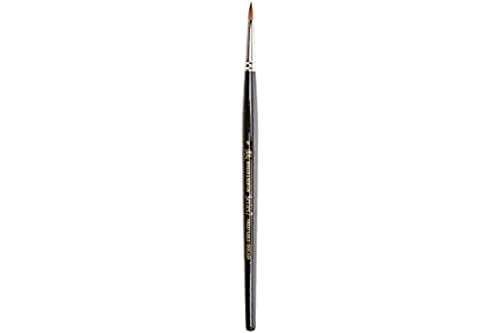
This is the reference point for miniature painters who want one sable round that covers most of a figure. The listing names Kolinsky sable hair and a short handle form in size 1, a pairing that gives a working belly for layering cloaks and armour while the point still closes for eyes and trim. It suits painters who glaze and layer with thinned acrylic and want a single brush to stay in hand across a whole session, moving from broad folds to fine edges without swapping tools.
Specs
- Brand: Winsor & Newton
- Hair: Kolinsky sable
- Shape: Round, short handle form
- Size: #1
- Material: Animal hair
- Handle length: 7 inches
- Model number: 5007001
- Manufacturer: ColArt Americas
Best for: Layering and detail work on 28mm figures with one main brush.
Watch out for: Series 7 comes in many sizes and handle forms, so confirm the Round SH #1 marking on the page before ordering.
ASIN: B0013E68T4
Raphael 8404 Kolinsky Round 3/0

Choose the 8404 in 3/0 when the job shrinks to single marks: a pupil, a lens dot, a rivet highlight or a tiny rune on a shield. The listing names Kolinsky hair in the long-running 8404 round series, and at this fine size the bundle is short and narrow, built for placing one controlled touch at a time. It holds little paint, so it rewards painters who work slowly, reload often and keep a larger round beside it for everything else on the figure.
Specs
- Brand: Raphael
- Series: 8404
- Hair: Kolinsky
- Shape: Round
- Size: 3/0
- Model number: B8404.3/0
Best for: Pupils, lens dots, rivets and the smallest freehand marks.
Watch out for: A 3/0 bundle dries quickly and covers almost nothing, so check the size marking and plan on a larger companion round.
ASIN: B005QSADLW
da Vinci Maestro Series 10 Kolinsky Red Sable Size 2

The Maestro name is the pick for painters who want the hair pedigree spelled out and a fuller bundle for longer passes. The listing describes a sharp round in size 2, made with Kolinsky red sable and built in Germany, and that combination gives a point with enough belly behind it to carry a glaze across a robe or a wing without constant trips back to the palette. It fits painters who layer display figures in thin coats and like a brush that feels calm and steady through a long stroke.
Specs
- Brand: da Vinci
- Series: Maestro Series 10
- Hair: Kolinsky red sable
- Shape: Sharp round
- Size: 2
- Origin: Made in Germany
Best for: Glazes and layered coats on robes, wings and large cloaks.
Watch out for: da Vinci sells several Maestro series with different bundle shapes, so confirm Series 10 on the page before ordering.
ASIN: B000PHBDFE
Escoda Optimo Series 1210 Pure Kolinsky Round Size 0

Reach for the Optimo when you want Kolinsky hair in a compact, short handle form for close work on small parts. The listing names pure Kolinsky hair in a size 0 round from the 1210 series, with a short handle that suits a braced grip when your wrist rests on the desk and the figure sits low. The small bundle gives firm, direct placement for gems, buckles, pouch straps and recessed trim, where a longer brush would feel vague and wander at the edges of the area.
Specs
- Brand: Escoda
- Series: 1210
- Hair: Pure Kolinsky
- Shape: Round
- Handle: Short handle
- Size: 0
- Model number: 1210-0
Best for: Gems, buckles, straps and recessed trim painted at close range.
Watch out for: Confirm the 1210 series number when ordering, because Escoda also sells fibre brushes under similar Optimo naming.
ASIN: B09KS7FTK6
Which One Fits Your Situation
You paint faces and eyes first
Faces punish a wandering point, so begin with the Raphael 8404 in 3/0 for pupils and lens dots, then move to the Winsor & Newton size 1 for brows, lips and skin layer transitions. The fine Raphael handles single marks, while the fuller Series 7 bundle carries enough paint to blend small areas without drying mid-stroke. Keeping the two roles apart also spares the finest tip from work that would wear it down.
You layer whole squads in thin coats
Squad painting needs a belly that keeps thin paint moving from figure to figure. The da Vinci Maestro Series 10 in size 2 fits that rhythm, with a sharp round point and enough bundle behind it for cloaks, robes and armour panels. Work in passes, rinsing between colours, and use the Escoda size 0 only for the trim and buckles at the end, so the main brush keeps its point through the batch.
Your grip braces against the desk
If your wrist rests on the desk and the model sits in a holder below your hand, short handles give cleaner control. The Escoda Optimo size 0 was built in that form, and the Winsor & Newton Round SH #1 pairs a short handle with a larger working belly. Pick the Escoda for dots and recesses, and the Series 7 when the same braced grip must also lay longer layer strokes.
You are buying your first sable brush
A single size 1 round is the sensible opening buy, and the Winsor & Newton Series 7 in that size covers layering, edges and most facial work on standard figures. Learn the care routine on that one brush: rinse often, reshape the point, keep it away from rough jobs. Add the Raphael 3/0 later for the smallest marks, once your habits are kind enough to keep two fine points alive.
Common Mistakes
- Letting acrylic dry inside the ferrule, which pushes the bundle apart and ruins the point.
- Using a fine sable round on rough primed or textured surfaces that grind the tip down.
- Pressing harder to make a small brush cover more area instead of moving up a size.
- Storing sable brushes tip down in a water jar, where the point bends and keeps the bend.
- Skipping the gentle wash after a session, leaving pigment packed at the base of the hair.
Frequently Asked Questions
Is Kolinsky sable better than red sable for miniatures?
Both hairs serve miniature work well. Kolinsky fibres taper strongly and spring back with a lively feel, which helps a point reform after every stroke. Red sable tends to feel a touch softer and lays paint down smoothly, which many painters enjoy for blending. The grade, bundle shaping and ferrule work on the individual brush matter more than the label alone.
Which sable size should a miniature painter buy first?
A size 1 round is the most useful first buy for standard figures. Its belly holds enough thinned paint for cloaks and armour, while a well-shaped point still reaches eyes and edge lines. Add a finer size such as 3/0 or 0 later for pupils and tiny marks, and a size 2 when layer work on larger figures begins to feel slow.
How do you clean a sable brush after acrylic painting?
Rinse the brush in clean water whenever the colour changes, and wash it gently with mild soap once the session ends. Work the lather through the bundle with your fingers, rinse again, then reshape the point while the hair is damp. Never leave the brush standing in water, and let it dry flat or with the tip protected.
Can a sable brush be used for basecoats and rough work?
It can, but doing so shortens the life of the point. Rough primed surfaces, heavy pigment and metallic mixes wear natural hair quickly, and a worn sable point loses the precision you paid for. Keep an older brush for basecoats and harsh jobs, and save the sable round for layering, glazing and detail, where its point earns its keep.
Related guides
More from Amazon
Programs that pair well with the guide above. Offers and eligibility are set by Amazon and may change.
Free shipping on eligible items, Prime Video and more. Eligible new members can start with a free trial.
Start a Prime free trialAudiobooks and podcasts to listen to on the go. Eligible new members can start with a free trial.
Try Audible freeAd-free music streaming. Eligible new subscribers can start with a free trial.
Try Music Unlimited freeA free business account with business pricing and bulk-buying tools for work, shop or home office.
Create a business accountAs an Amazon Associate we earn from qualifying purchases.










Write Your Review
No reviews yet. Be the first to share your experience!