
Key takeaways
- Find the best sunscreen for sensitive skin, with gentle mineral formulas that protect without fragrance, dyes, or common irritants and keep reactive skin calm.
What's inside
As an Amazon Associate I earn from qualifying purchases. This post may contain affiliate links at no extra cost to you.
Sensitive skin reacts to things that other skin tolerates. A sunscreen can sting, turn the skin red, or trigger a rash, and the result is that sunscreen gets skipped. That is the worst outcome, because sensitive skin still needs UV protection, and unprotected sun exposure can make sensitivity worse over time.
The right sunscreen for sensitive skin is a simple one. It has few ingredients, no fragrance, and a mineral UV filter that sits on the skin rather than being absorbed into it. This guide covers what to look for in a sunscreen for sensitive skin and compares four gentle formulas that are made for reactive skin.
How to Choose a Sunscreen for Sensitive Skin
Mineral filters are the safest starting point
Mineral sunscreens use zinc oxide or titanium dioxide to block UV rays on the surface of the skin. They are less likely to cause stinging or irritation than chemical sunscreens, because the active ingredients are not absorbed into the skin. For sensitive skin, a mineral formula is the safest starting point. Look for zinc oxide on the ingredient list, and check that the formula is described as hypoallergenic.
Fewer ingredients is better
Every added ingredient is another chance for a reaction. A sunscreen for sensitive skin should have a short ingredient list, with no fragrance, no dyes, no lanolin, and no parabens. Fragrance is the most common irritant in skincare, and it includes both added perfume and masking fragrance, which is used to cover the smell of other ingredients. A fragrance-free formula avoids both.
Patch test first
Before using a new sunscreen on the whole face, test it on a small area first. Apply a small amount to the inside of the wrist or behind the ear, and wait a full day. If there is no redness, itching, or stinging, it is safe to use on the face. This is especially important for skin that has reacted to skincare products before.
Broad spectrum protection
Sensitive skin needs the same UV protection as any other skin type. Broad spectrum protection covers UVA rays, which contribute to skin aging, and UVB rays, which cause sunburn. SPF 30 is enough for most everyday use, and SPF 50 or 60 suits long days outdoors. A higher SPF does not mean the sunscreen lasts longer, so reapplication still matters.
Water resistance
Sensitive skin often needs sunscreen during outdoor activity, when sweat and water are involved. Water resistance is measured in minutes, and 80 minutes is the standard for the strongest water-resistant formulas. Reapply after swimming, heavy sweating, or towelling off. No sunscreen is fully waterproof.
Top Picks
BLUE LIZARD Sensitive Mineral Sunscreen with Zinc Oxide, SPF 50+, 3 oz. Tube

The BLUE LIZARD Sensitive Mineral Sunscreen is a mineral sunscreen made for sensitive skin. It uses zinc oxide for broad spectrum SPF 50+ protection, and it is water resistant for 80 minutes. The formula is fragrance-free and free from parabens, oxybenzone, and octinoxate, and it includes soothing organic aloe. The tube is described as trusted by dermatologists, and it uses Smart Cap Technology, where the cap changes colour in the presence of UV light as a reminder to apply sunscreen. The 3 oz tube is a practical size for daily use.
- Broad spectrum SPF 50+ with zinc oxide
- Mineral sunscreen for sensitive skin
- Water resistant for 80 minutes
- Fragrance-free, free from parabens, oxybenzone, and octinoxate
- Soothing organic aloe
- Smart Cap Technology as a UV reminder
- Trusted by dermatologists, per the tube
- 3 oz tube
Best for: Sensitive skin that needs a simple mineral sunscreen with a built-in reminder to reapply.
Vanicream Sunscreen Broad Spectrum SPF 50+, 3 Ounce
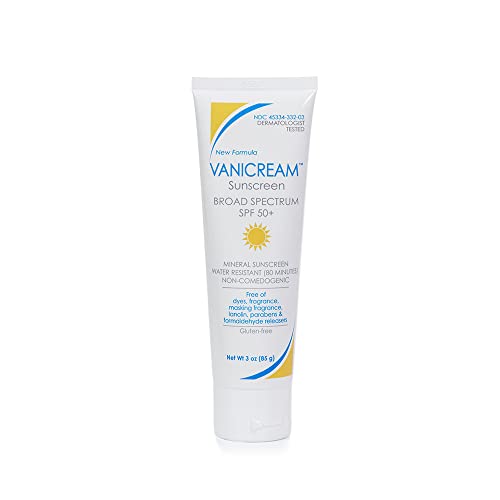
The Vanicream Sunscreen Broad Spectrum SPF 50+ is a mineral sunscreen made for sensitive skin. It is water resistant for 80 minutes and non-comedogenic, and the formula is free of dyes, fragrance, masking fragrance, lanolin, parabens, and formaldehyde releasers. It is also gluten-free and made for sensitive skin, and the listing describes it as dermatologist tested. Vanicream is a brand that makes products specifically for sensitive skin, and this sunscreen follows the same approach, with a short list of ingredients and no common irritants.
- Broad spectrum SPF 50+
- Mineral sunscreen, water resistant for 80 minutes
- Non-comedogenic
- Free of dyes, fragrance, masking fragrance, lanolin, parabens, and formaldehyde releasers
- Gluten-free
- Made for sensitive skin
- Dermatologist tested, per the listing
- 3 ounce tube
Best for: Very sensitive skin that needs a sunscreen with as few potential irritants as possible.
Neutrogena Sensitive Skin Mineral Sunscreen Lotion, Broad Spectrum SPF 60+, 3 fl. oz
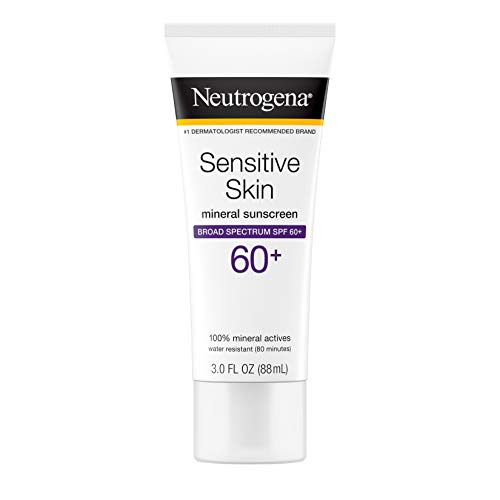
The Neutrogena Sensitive Skin Mineral Sunscreen Lotion is a broad spectrum SPF 60+ mineral lotion with zinc oxide. It is water resistant, hypoallergenic, and fragrance-free and oil-free, which suits skin that reacts to added ingredients. The formula uses PureScreen technology with naturally sourced sunscreen ingredients. The 3 fl oz tube is a practical size for face and body, and the high SPF suits long days outdoors.
- Broad spectrum SPF 60+ with zinc oxide
- Mineral sunscreen lotion
- Water resistant
- Hypoallergenic, fragrance-free, and oil-free
- PureScreen technology with naturally sourced sunscreen ingredients
- 3 fl oz tube
Best for: Sensitive skin that needs high SPF protection in a gentle, hypoallergenic mineral lotion.
EltaMD UV Clear Broad-Spectrum SPF 46, 1.7 oz
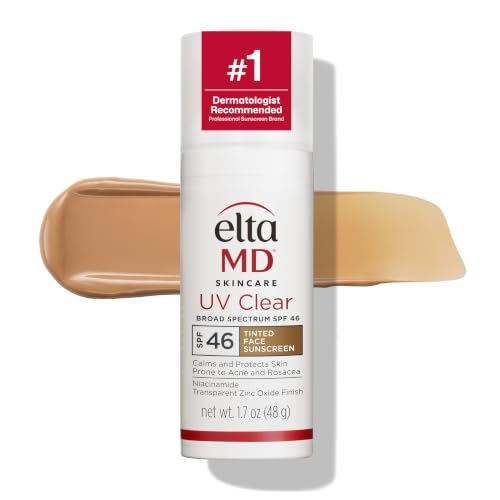
The EltaMD UV Clear Broad-Spectrum SPF 46 is a face sunscreen made for sensitive skin, including skin that is prone to acne and rosacea. It is an oil-free formula with zinc oxide and niacinamide, and it has a transparent zinc oxide finish, so it does not leave a heavy white cast. The listing describes EltaMD as a dermatologist recommended brand, and the formula is made to calm skin that is prone to acne and rosacea. It is lightweight and non-comedogenic, and it suits sensitive skin. The 1.7 oz pump bottle is a practical size for a bathroom counter.
- Broad spectrum SPF 46 for the face
- Oil-free formula with zinc oxide and niacinamide
- Transparent zinc oxide finish
- Made to calm skin prone to acne and rosacea, per the listing
- Lightweight and non-comedogenic
- Suits sensitive skin
- 1.7 oz pump bottle
Best for: Sensitive skin on the face, especially skin that is also prone to acne or rosacea.
Comparison
| Product | Key Feature | Best For |
|---|---|---|
| BLUE LIZARD Sensitive Mineral SPF 50+ | Zinc oxide, Smart Cap Technology, fragrance-free | A simple mineral sunscreen with a UV reminder |
| Vanicream Sunscreen SPF 50+ | Fewest added ingredients, dermatologist tested | Very sensitive skin |
| Neutrogena Sensitive Skin Mineral SPF 60+ | SPF 60+, hypoallergenic, fragrance-free and oil-free | High SPF in a gentle mineral lotion |
| EltaMD UV Clear SPF 46 | Zinc oxide and niacinamide, transparent finish | Sensitive skin on the face |
Buying Guide
How to introduce a new sunscreen
Sensitive skin does best with slow changes. Introduce one new product at a time, and patch test it first on the inside of the wrist or behind the ear. Wait a full day before using it on the face. If the skin reacts, stop using it and wait for the skin to settle before trying another formula. A reaction to one sunscreen does not mean every sunscreen will cause a reaction.
How much to use
Most people use far too little sunscreen. A good rule is a full finger-length of lotion for the face and neck, and a shot-glass amount for the body. A thin layer gives far less protection than the SPF number on the tube suggests. Apply generously and spread evenly, and pay attention to the ears, the hairline, and the back of the neck.
When to apply and reapply
Apply sunscreen 15 minutes before going outside. Reapply at least every two hours, and sooner after swimming, heavy sweating, or towelling off. Sensitive skin can feel tighter after reapplication, so a light second layer of a gentle formula works better than a thick single coat. Keep a tube where it will actually be used.
Sunscreen and other skincare
Sensitive skin often uses a simple routine, and sunscreen should fit into it without adding irritation. Apply sunscreen after moisturiser and before makeup. If the skin stings after applying sunscreen, the problem may be another product in the routine, such as an exfoliant, rather than the sunscreen itself. A mineral formula with few added ingredients is the safest choice when the routine is uncertain.
What to do after a reaction
If a sunscreen causes redness, itching, or stinging, wash it off gently with lukewarm water and a mild cleanser, then apply a plain moisturiser. Do not scrub the skin or apply more products to calm it. Wait for the skin to settle, then patch test a different formula. A mineral sunscreen with a short ingredient list is the best next step.
Frequently Asked Questions
Is mineral sunscreen better for sensitive skin?
Yes, in most cases. Mineral sunscreens use zinc oxide or titanium dioxide, which sit on the skin rather than being absorbed into it. They are less likely to cause stinging or irritation than chemical sunscreens, and they start working as soon as they are applied.
What ingredients should I avoid in sunscreen for sensitive skin?
Fragrance is the most common irritant, including masking fragrance. Dyes, lanolin, parabens, and formaldehyde releasers are also common irritants. A formula that is free of these ingredients, such as the Vanicream Sunscreen, is a good starting point.
Can sensitive skin use a chemical sunscreen?
Some people with sensitive skin use chemical sunscreens without any problem. But if the skin has reacted to sunscreen before, a mineral formula is the safer choice. Patch test any new sunscreen before using it on the whole face.
What SPF should I use for sensitive skin?
SPF 30 is enough for most everyday use, and SPF 50 or 60 suits long days outdoors. The SPF number does not change how gentle a formula is, so choose the gentlest formula first and the SPF second, as long as it is at least SPF 30.
Conclusion
The best sunscreen for sensitive skin is a simple one, with few ingredients and a mineral UV filter. The BLUE LIZARD Sensitive Mineral Sunscreen SPF 50+ gives a straightforward zinc oxide formula with a UV reminder in the cap. The Vanicream Sunscreen SPF 50+ has the shortest list of potential irritants in this guide. The Neutrogena Sensitive Skin Mineral Sunscreen SPF 60+ gives high protection in a hypoallergenic lotion. The EltaMD UV Clear SPF 46 suits sensitive skin on the face, including skin prone to acne and rosacea. Patch test first, apply generously, reapply through the day, and sun protection becomes safe for even the most reactive skin.
Disclosure: As an Amazon Associate, we earn from qualifying purchases.
Related guides
More from Amazon
Programs that pair well with the guide above. Offers and eligibility are set by Amazon and may change.
Free shipping on eligible items, Prime Video and more. Eligible new members can start with a free trial.
Start a Prime free trialAudiobooks and podcasts to listen to on the go. Eligible new members can start with a free trial.
Try Audible freeAd-free music streaming. Eligible new subscribers can start with a free trial.
Try Music Unlimited freeA free business account with business pricing and bulk-buying tools for work, shop or home office.
Create a business accountAs an Amazon Associate we earn from qualifying purchases.
Write Your Review
No reviews yet. Be the first to share your experience!