
Key takeaways
- Compare switchable MM-MC phono preamps that feed an integrated amplifier line input, with gain and loading matched to both cartridge families.
What's inside
As an Amazon Associate I earn from qualifying purchases. This post may contain affiliate links at no extra cost to you.
Adding a turntable to an integrated amplifier usually turns on one question: does the amp have a phono input, and if it does, does it handle both moving magnet and moving coil cartridges? Many integrated amplifiers offer an MM-only phono stage or skip phono entirely, so a switchable MM-MC phono preamp feeding a spare line input is the flexible fix. The real decision is matching gain and loading to your cartridge today while keeping the door open to a low-output MC upgrade later.
This guide serves integrated-amplifier owners who listen with an MM cartridge now, listeners planning a move to MC, and anyone replacing a noisy built-in stage. Every pick below is a true MM-MC model that connects to a standard line input, and each was chosen from the names and specifications printed on its Amazon product page, with cartridge support, gain range, and loading options checked against that listing before inclusion.
Quick Picks
As an Amazon Associate we earn from qualifying purchases.
| Product | Best for | Key spec from title |
|---|---|---|
| Cambridge Audio Alva Duo | Listeners who also want headphone playback | Moving Coil & Moving Magnet Phono Preamplifier |
| Schiit Mani 2 | Fine-tuning gain and loading per cartridge | Phono Preamp for MM, MC, and MI Cartridges |
| Fosi Audio Box X5 | Compact shelves and simple gain switching | 4-Level Adjustable Gain 38/48/56/66 dB with RCA |
| Douk Audio T4 Plus | Tube character with a VU meter | HiFi MM/MC Turntable Preamplifier with Headphone Amp |
How to Choose
Gain Range for Both Cartridge Families
Gain is the first figure to check, because MM and MC cartridges live at very different output levels. A typical MM cartridge needs roughly 40 dB of gain, while a low-output MC design can need 60 dB or more to reach line level. A switchable MM-MC preamp should cover both ends without forcing the integrated amplifier volume control into its noisy extremes. Look for clearly separated MM and MC gain settings, and prefer models whose steps also suit high-output MC cartridges, which sit awkwardly between the two families and overload easily on a full MC setting.
Loading Options and Impedance Switching
Loading decides how the cartridge is electrically matched, and it matters more once MC cartridges enter the picture. MM cartridges usually want a 47 kΩ input with a modest capacitance, while MC models respond to much lower resistive loads, often somewhere between 10 Ω and 1 kΩ depending on the maker guidance. A preamp with several switchable load settings lets you follow the cartridge specification instead of accepting one fixed compromise. Capacitance choices help MM fine-tuning, while a wide resistance range is the feature that keeps an MC upgrade from demanding a second phono stage.
Line Input Pairing and Grounding
An external phono stage feeds a line input, never the amplifier phono input, so confirm your integrated amplifier has a spare RCA line input before ordering. Run the turntable ground wire to the preamp ground terminal, not the amplifier chassis, and keep the short turntable leads on the preamp input side, since phono-level signals pick up hum easily. Place the preamp away from power supplies and speaker cables where the shelf allows. If your amplifier offers a fixed-gain home theater bypass input, an ordinary line input is still the safer choice for volume control.
Filters, Headphone Outputs, and Tube Circuits
Extra features separate otherwise similar MM-MC stages. A subsonic filter tames woofer pumping from warped records before the signal reaches your integrated amplifier, and a balance control can correct small cartridge channel differences. A built-in headphone amplifier, like the one on the Alva Duo, adds private listening without waking the main system. Tube models such as the Douk T4 Plus trade some measurement neatness for a different presentation and add tube-rolling to the hobby. None of these extras replaces correct gain and loading, so rank them after the electrical match to your cartridge.
The 4 Best Options
Cambridge Audio Alva Duo
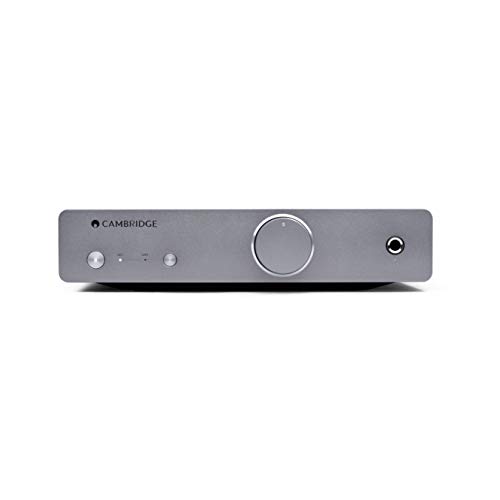
The Alva Duo suits integrated-amplifier owners who want one polished box covering both cartridge families, with separate moving magnet and moving coil inputs on the rear panel. Its switch-mode power supply is designed to keep noise away from the phono signal, a subsonic filter addresses rumble from imperfect pressings, and a balance control helps correct small channel differences between cartridges. The built-in headphone amplifier is a genuine bonus for late listening sessions when the main speakers stay off. Lunar Grey finish and a compact chassis make it easy to place beside an amplifier on a standard hi-fi shelf.
Specs
- Brand: Cambridge Audio
- Model name: Alva Duo
- Model number: C11027
- Cartridge support: moving magnet and moving coil
- Inputs: separate MM and MC phono inputs
- Headphone amplifier: integrated, with volume control
- Features: subsonic filter, balance control, auto power down
- Power supply: switch-mode
- Included: Alva Duo phono preamp, user manual, safety guide, mains lead
Best for: Integrated-amplifier owners wanting MM and MC inputs plus headphone listening in one unit.
Watch out for: The MM and MC inputs are separate sockets, so swapping cartridges can mean moving cables as well as changing settings.
ASIN: B07932QK4N
Schiit Mani 2

The Mani 2 is the fine-tuning pick for an integrated amplifier setup, because its underside switches expose an unusually wide spread of gain and loading choices for its size. Four gain steps run from a low setting suited to unusual high-output designs up to a full MC setting, and the resistive and capacitive loading options cover standard MM practice and demanding low-output MC cartridges alike. A selectable passive low-frequency filter helps with warped records. It arrives preset for MM use, so MM listeners can connect it straight away, then reconfigure later if an MC cartridge joins the system.
Specs
- Brand: Schiit
- Model: Mani 2
- Part number: SCH-18-2B-FA
- Cartridge support: MM, MC, and MI
- Gain settings: 33, 42, 48, or 60 dB
- Resistive loading: 47KΩ, 200Ω, 47Ω, or 38Ω
- Capacitive loading: 47pF, 100pF, 150pF, or 200pF
- Low-frequency filter: passive, 6dB or 12dB per octave at 15 Hz
- Power supply: 16VAC wall-wart transformer, 115VAC USA plug
- Size: 5 x 3.5 x 1.25 inches
- Weight: 1 lb
Best for: Cartridge swappers who want documented gain and loading control in a small chassis.
Watch out for: The configuration switches sit underneath the unit, so note your settings before sliding it into a crowded rack.
ASIN: B09S5H9MP6
Fosi Audio Box X5

The Box X5 is the straightforward compact option for an integrated amplifier with a free line input and limited shelf depth. A rear gain selector offers four steps spanning MM duty through low-output MC territory, and a dedicated switch chooses between the two cartridge types, so setup stays simple even for a first external phono stage. The mini chassis tucks beside or behind an amplifier, the RCA input and output keep cabling conventional, and the ground terminal sits where turntable leads expect it. Listeners who value quick installation over deep loading menus will find this the easiest route into switchable MM-MC playback.
Specs
- Brand: Fosi Audio
- Model: Box X5
- Cartridge support: MM and MC
- Gain: 4-level adjustable, 38/48/56/66 dB
- Input: MM/MC RCA
- Output: RCA
- Signal to noise ratio: 92 dB or better
- Equalization: RIAA
- Power: external power adapter
Best for: Small integrated-amplifier shelves that need simple, clearly stepped MM and MC gain.
Watch out for: Loading is fixed rather than switchable, so check your MC cartridge recommended load before choosing it.
ASIN: B0DLVZF5Y7
Douk Audio T4 Plus

The T4 Plus brings tubes to the integrated-amplifier phono role, pairing an MM/MC phono input with JAN5654 valves, a front VU meter, and a headphone output driven for a wide range of headphone impedances. Seven switchable impedance settings give MC cartridges a broader matching range than most compact tube stages offer, and a 3.5 mm auxiliary input lets the same box serve a phone or streamer into the amplifier line input between records. It suits listeners who enjoy an analog presentation and visible needle movement, and who accept that a tube unit wants ventilation and a little warm-up patience.
Specs
- Brand: Douk Audio
- Model: T4 PLUS
- Manufacturer: Nobsound
- Audio input: MM/MC phono and 3.5 mm AUX
- Impedance settings: 1KΩ, 470Ω, 220Ω, 100Ω, 47Ω, 22Ω, 10Ω
- Tubes: JAN5654 valve tubes
- Headphone output: supports 32 to 300Ω headphones
- Equalization: RIAA
- Display: VU meter
- Chassis: aluminum
Best for: Listeners who want tube MM-MC playback, a VU meter, and headphone output feeding one amplifier.
Watch out for: Confirm the tube type printed on the listing variant you order, since regional listings describe different stock tubes.
ASIN: B09MHHM4XM
Which One Fits Your Situation
Your Integrated Amplifier Has No Phono Input at All
Any of the four stages here solves the missing-input problem by feeding a spare line input, but the Fosi Audio Box X5 keeps the job simplest. Its four gain steps and MM/MC switch cover a first MM cartridge and a later MC move without menus or underside switches. Connect the turntable ground wire to the Box X5 terminal, run one RCA pair to the amplifier, and the turntable joins the system cleanly.
You Swap Between MM and MC Cartridges
Frequent cartridge changes reward the Schiit Mani 2, whose four gain settings and broad loading choices can be reset for each cartridge you mount. The Cambridge Audio Alva Duo is the alternative when you keep two turntables or arms connected, since its separate MM and MC inputs remove cable swapping. Either way, write down the gain and load that suits each cartridge so a swap takes minutes rather than guesswork.
You Want Headphones Without Waking the House
The Cambridge Audio Alva Duo builds a headphone amplifier into the phono stage, so late-night record listening does not need the integrated amplifier powered at all. The Douk Audio T4 Plus also offers a headphone output, with tube character and a VU meter as part of the experience. Choose the Duo for a quiet solid-state presentation, or the T4 Plus if the tube presentation is the point of the purchase.
Shelf Space Beside the Amplifier Is Tight
Compact chassis earn their place here. The Schiit Mani 2 measures only five inches wide, and the Fosi Audio Box X5 is a mini unit that can sit beside a turntable or behind the amplifier where ventilation allows. Measure the shelf before ordering, leave room for the RCA plugs and ground wire at the rear, and avoid stacking any phono stage directly on top of the amplifier power supply section.
Common Mistakes
- Plugging the phono stage output into the amplifier phono input instead of a line input, which applies RIAA equalization and gain twice.
- Leaving the preamp set to MC gain for an MM cartridge, overloading the input and producing harsh, distorted playback.
- Forgetting the turntable ground wire, or attaching it to the amplifier instead of the phono preamp ground terminal.
- Ignoring the cartridge maker load recommendation when a switchable preamp offers several impedance settings.
- Buying an MM-only stage because it costs less, then replacing it when the first MC cartridge arrives.
Frequently Asked Questions
Can an MM-MC phono preamp replace the phono input on my integrated amplifier?
Yes. Connect the turntable to the external preamp, then run its line-level output into any spare RCA line input on the integrated amplifier and select that input for records. Bypass the amplifier built-in phono stage entirely, because feeding a line-level signal into a phono input applies equalization and gain a second time and overloads the input.
How much gain do I need for a low-output MC cartridge?
Most low-output MC cartridges need around 60 dB of phono gain to reach a healthy line level, while high-output MC designs often work near MM settings. Check the cartridge output voltage in its specification, then choose the preamp gain step the maker guidance supports. Too little gain sounds thin and noisy; too much risks overload distortion on loud passages.
Does loading really change how an MC cartridge sounds?
Yes, loading changes the electrical environment the cartridge works into, and MC cartridges are especially sensitive to resistive load. A setting far from the maker recommendation can dull transients or exaggerate brightness. Switchable loading, like the ranges on the Mani 2 and T4 Plus above, lets you follow the cartridge specification and then fine-tune by ear within it.
Where should the phono preamp sit in my rack?
Place it close to the turntable so the phono-level leads stay short, and connect its output to the integrated amplifier with a normal interconnect. Keep it away from power supplies, power strips, and speaker cables where possible, since the tiny cartridge signal is vulnerable to hum before amplification. Leave ventilation space above tube models such as the T4 Plus.
Related guides
More from Amazon
Programs that pair well with the guide above. Offers and eligibility are set by Amazon and may change.
Free shipping on eligible items, Prime Video and more. Eligible new members can start with a free trial.
Start a Prime free trialAudiobooks and podcasts to listen to on the go. Eligible new members can start with a free trial.
Try Audible freeAd-free music streaming. Eligible new subscribers can start with a free trial.
Try Music Unlimited freeA free business account with business pricing and bulk-buying tools for work, shop or home office.
Create a business accountAs an Amazon Associate we earn from qualifying purchases.










Write Your Review
No reviews yet. Be the first to share your experience!