
Key takeaways
- Compare balanced headphone DAC amplifiers for desktop listening, with 4.4mm outputs, power, inputs and gain explained for home desktop setups.
What's inside
As an Amazon Associate I earn from qualifying purchases. This post may contain affiliate links at no extra cost to you.
A balanced headphone output is only useful when the whole unit behind it suits your desk, so the real decision is not balanced versus single-ended in the abstract. It is which DAC amplifier offers a genuine 4.4mm balanced jack, enough balanced power for your headphones, the digital inputs your computer and other sources need, and gain settings that work with both sensitive earphones and demanding full-size models.
This guide serves desktop listeners upgrading from a computer headphone jack, owners of balanced cables who need a matching 4.4mm socket, and listeners driving harder planar or high-impedance headphones at home. Every product below is one box combining a DAC and a headphone amplifier, chosen from the names and specifications printed on its Amazon product page.
Quick Picks
As an Amazon Associate we earn from qualifying purchases.
| Product | Best for | Key spec from title |
|---|---|---|
| TOPPING DX5 II Hi-Res DAC & Headphone Amp Combo | High balanced power with EQ and Bluetooth | 4.4mm Balanced & 6.35mm Headphone Output |
| FiiO K7 Desktop DAC and Amplifier | Strong balanced drive with several wired inputs | 4.4mm balanced output |
| FiiO K11 DAC and Headphone Amplifier | A compact first balanced desktop setup | Balanced 4.4mm, 1400mW |
| iFi ZEN DAC V2 | A simple USB-focused desk with balanced output | 4.4mm Balanced |
How to Choose
Understand What Balanced Drive Actually Changes
A balanced headphone connection carries each channel with separate conductors and separate ground paths, instead of sharing one ground return as a single-ended cable does. On the models in this guide, the practical benefit is usually power: the balanced jack commonly delivers substantially more output than the single-ended jack on the same unit, which helps with low-sensitivity planar headphones and high-impedance models. Balanced drive is not magic and it does not repair a weak recording or a poor headphone. Treat it as a way to access the amplifier stage’s full output, then judge the unit on its inputs, gain range, and controls as a complete desktop purchase.
Match Balanced Power to Your Headphones
Start with the headphones you already own, because their sensitivity decides how much balanced power matters. A rating such as 1400mW on the FiiO K11 or 2000mW into 32 ohms on the FiiO K7 only helps if your headphones can use that headroom without forcing the volume control into an awkwardly low position. Check the balanced output figure on the Amazon page, not just the single-ended figure, since the two can differ widely. Efficient earphones need modest power and careful low-gain control, while planar magnetic and 300-ohm models benefit from the stronger balanced figures quoted for the K7 and DX5 II.
Count the Digital Inputs Your Desk Really Uses
Every unit here is a DAC as well as an amplifier, so its input list decides what can feed it. A computer connects over USB on all four models, while the FiiO K7 and K11 also list optical and coaxial inputs for a games console, CD transport, or television. The iFi ZEN DAC V2 keeps things deliberately simple with USB input only, which suits a single-computer desk but limits future sources. The TOPPING DX5 II adds Bluetooth with LDAC for phone listening without a cable. List your sources before buying, because adding a source later often means replacing the whole unit rather than plugging into a spare socket.
Check Gain, Volume Control, and Line Outputs
Gain settings decide whether the volume knob stays in a comfortable, finely adjustable range. Multiple gain levels, such as the three settings listed for the FiiO K11, help one unit serve both earphones and full-size headphones. Also check how the unit behaves beside powered speakers: the DX5 II lists a preamp mode, and several models provide RCA line outputs, so headphone listening and speaker listening can share one DAC. Confirm whether line output is fixed or follows the volume control, because that detail affects speaker safety and convenience every day. A remote, where supplied, matters most when the unit sits beyond arm’s reach.
The 4 Best Options
TOPPING DX5 II Hi-Res DAC & Headphone Amp Combo

The DX5 II is the most complete desktop option here for listeners who want balanced drive plus adjustment tools in one box. Its Amazon title lists dual ES9039Q2M converters, an X-Hybrid amplifier stage, a 10-band parametric EQ, and LDAC Bluetooth, alongside both 4.4mm balanced and 6.35mm headphone outputs. That combination suits listeners with several headphones who want to store different tunings, switch between wired computer audio and a phone, and use the preamp mode with other equipment. Buyers who prefer simple physical controls and no menus may find its feature depth more than a quiet desk setup requires.
Specs
- Dual ES9039Q2M DAC chips
- X-Hybrid headphone amplifier
- 10-band PEQ
- LDAC Bluetooth 5.1
- 4.4mm balanced and 6.35mm headphone outputs
- Preamp mode
- 12V trigger
- Colour listed: White
Best for: Listeners wanting the broadest feature set and balanced output in one desktop unit.
Watch out for: Confirm the listed colour and current configuration before ordering, since finishes can be sold under separate listings.
ASIN: B0FC6HRB2S
FiiO K7 Desktop DAC and Amplifier
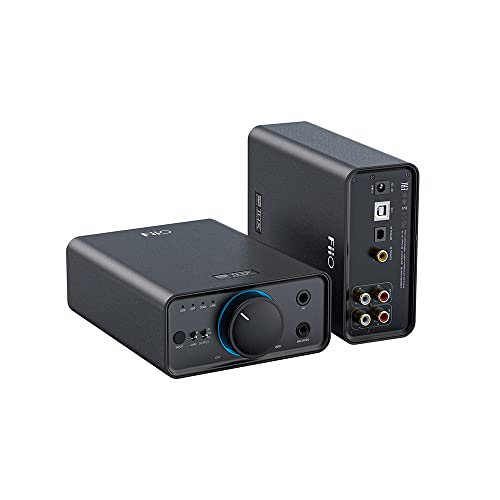
The K7 suits listeners who want strong balanced amplification and a traditional set of wired inputs without relying on wireless features. Its Amazon listing describes dual AK4493SEQ DACs and THX AAA 788+ amplifier modules, with outputs for both 6.35mm single-ended and 4.4mm balanced headphones. It lists 2000mW into a 32-ohm load and 560mW into a 300-ohm load, figures that make it relevant for demanding full-size headphones as well as everyday models. USB, optical, coaxial, and RCA inputs give a desk computer, console, or other source several connection routes in a single chassis.
Specs
- Dual AK4493SEQ DACs
- THX AAA 788+ amplifier modules
- 6.35mm single-ended and 4.4mm balanced headphone outputs
- Output listed as 2000mW into 32 ohms and 560mW into 300 ohms
- USB, optical, coaxial, and RCA inputs
- Item model number: K7
Best for: Wired desktop systems needing high balanced power and several digital inputs.
Watch out for: Check whether your balanced cable uses a 4.4mm plug, because no XLR headphone output is listed.
ASIN: B0BJKKPL71
FiiO K11 DAC and Headphone Amplifier

The K11 is the compact entry point in this group for a listener buying a first dedicated balanced desktop unit. Its Amazon title lists 6.35mm and balanced 4.4mm headphone outputs, RCA, coaxial, and optical connections, 1400mW output, and support for 384kHz/24Bit audio and DSD256. That is enough connectivity for a computer plus one or two additional digital sources, while the balanced jack lets compatible headphones use the stronger output path. Its smaller role is clear: it covers the essentials for a personal desk without the K7’s higher quoted power or the DX5 II’s EQ and Bluetooth features.
Specs
- 6.35mm and balanced 4.4mm headphone outputs
- RCA, coaxial, and optical connections listed
- 1400mW output listed in the title
- 384kHz/24Bit and DSD256 support listed
- Colour listed: Black
Best for: A first balanced DAC amplifier for a compact computer desk.
Watch out for: Confirm that 1400mW and the listed input set meet your headphones and sources, since this is the simplest FiiO option here.
ASIN: B0CJFG3DC7
iFi ZEN DAC V2
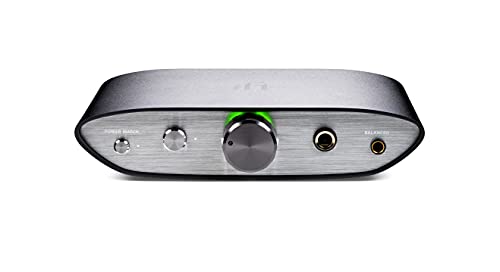
The ZEN DAC V2 is for a listener whose desktop system begins and ends with a computer connected by USB. Its Amazon title specifies a USB 3.0 B input and outputs for 6.3mm unbalanced headphones, 4.4mm balanced headphones, and RCA, with MQA decoding included. That focused layout avoids the input switching and menus of larger units, while still providing the balanced socket this guide requires. It fits a tidy desk where one source feeds either headphones or an RCA-connected system. Buyers expecting optical, coaxial, Bluetooth, or several digital sources should choose one of the other models instead.
Specs
- USB 3.0 B input only, as listed in the title
- 6.3mm unbalanced headphone output
- 4.4mm balanced headphone output
- RCA output
- MQA decoder
- Unit only, as listed
Best for: A simple computer-only desk that still needs a 4.4mm balanced headphone output.
Watch out for: Verify that USB-only input is acceptable, because the title lists no optical, coaxial, or Bluetooth input.
ASIN: B091B2JCXQ
Which One Fits Your Situation
You Own a Balanced Cable and One Computer
Choose the iFi ZEN DAC V2 if your only source is a computer and your headphone already has a 4.4mm balanced cable. Its USB-only design keeps setup narrow and direct, and the front balanced output gives you the connection you bought the cable for. If a console or television may join the desk later, the FiiO K11 is the safer step because its listing includes optical and coaxial connections.
Your Headphones Need Serious Balanced Power
Choose the FiiO K7 for a wired setup built around demanding full-size headphones. Its listing quotes 2000mW into 32 ohms and 560mW into 300 ohms through its balanced amplification, which addresses both low-impedance planar models and higher-impedance headphones. The DX5 II is the alternative when you also want EQ and Bluetooth, but the K7 keeps the decision focused on wired power and inputs.
You Switch Between Headphones and Powered Speakers
Choose the TOPPING DX5 II when one DAC needs to serve headphones and other desktop equipment. Its title lists a preamp mode and a 12V trigger alongside the balanced headphone output, which suits a more integrated desk system. Check how you want line-level volume handled before buying, then use the headphone outputs for personal listening and the preamp function when the unit feeds compatible powered speakers or amplification.
You Want the Smallest Sensible First Step
Choose the FiiO K11 if desk space and simplicity matter more than maximum features. It still provides a balanced 4.4mm output, a listed 1400mW output figure, and USB-class desktop use with coaxial and optical connections in its title. That makes it a practical first dedicated unit for one listener, one computer, and a pair of balanced headphones, without paying for wireless or extensive processing features.
Common Mistakes
- Buying a balanced DAC amplifier before confirming that your headphone cable actually terminates in a 4.4mm or 4-pin XLR plug.
- Using a cheap adapter to force a single-ended headphone cable into a balanced jack, which can be electrically inappropriate for some amplifiers.
- Comparing only single-ended power figures when the balanced output rating is the one your headphones will use.
- Choosing a USB-only model and later expecting to connect a television, console, or CD player with optical or coaxial output.
- Assuming balanced drive will change the basic character of a headphone, when its main practical gains are available power and separate channel grounds.
Frequently Asked Questions
Does a balanced output make every headphone sound better?
Not automatically. A balanced output mainly provides a separate return path for each channel and, on these models, usually more available power than the single-ended output. A headphone that was already driven comfortably may change very little. The benefit is clearest when extra headroom helps a demanding model or when you already own a properly wired balanced cable.
Can I use a balanced headphone cable with an adapter on a single-ended jack?
A balanced cable can often be adapted down to a single-ended plug when the adapter is wired correctly for that purpose, because both channels then share the single-ended ground as intended. The reverse direction is the risky one: never adapt a standard single-ended headphone cable up to a balanced jack unless the amplifier maker explicitly permits it. Check the manual for your exact model first.
Why do these models use 4.4mm instead of XLR headphone outputs?
The 4.4mm connector carries a balanced headphone connection in a compact front-panel socket, which suits smaller desktop units such as the K11, K7, and ZEN DAC V2. A 4-pin XLR headphone output performs the same general role on larger equipment but takes more panel space. Neither connector is automatically superior; choose the one that matches your existing cable or budget for a replacement.
Do I still need the DAC if my computer has a headphone jack?
A computer headphone jack already contains a DAC and a small amplifier, so this type of unit is an upgrade in connectivity, output choice, and available drive rather than a requirement for sound. A dedicated DAC amplifier adds a balanced socket, more suitable gain and volume control, and inputs for other digital sources. Whether that matters depends on your headphones, noise issues, and desktop sources.
Related guides
More from Amazon
Programs that pair well with the guide above. Offers and eligibility are set by Amazon and may change.
Free shipping on eligible items, Prime Video and more. Eligible new members can start with a free trial.
Start a Prime free trialAudiobooks and podcasts to listen to on the go. Eligible new members can start with a free trial.
Try Audible freeAd-free music streaming. Eligible new subscribers can start with a free trial.
Try Music Unlimited freeA free business account with business pricing and bulk-buying tools for work, shop or home office.
Create a business accountAs an Amazon Associate we earn from qualifying purchases.










Write Your Review
No reviews yet. Be the first to share your experience!