
Key takeaways
- Compare five network DACs for high-resolution music: built-in Wi-Fi and Ethernet streaming, hi-res PCM and DSD playback, and analog outputs for any amp.
What's inside
As an Amazon Associate I earn from qualifying purchases. This post may contain affiliate links at no extra cost to you.
Buying a network DAC for high-resolution music means choosing one box that both pulls music off your network and converts it well. The real decision is not whether a unit streams — nearly all of them do — but whether its DAC stage, app platform and outputs match the amplifier and speakers you already own, and whether it handles the file formats your library actually uses, from 24-bit FLAC to DSD.
This guide is for listeners upgrading an existing stereo system, building a streaming-first setup around powered speakers, or replacing a phone-and-dongle arrangement with a proper source component. Every pick below combines network streaming and a built-in DAC in a single unit, and every specification comes from the product names and details published on the Amazon product pages.
Quick Picks
As an Amazon Associate we earn from qualifying purchases.
| Product | Best for | Key spec from title |
|---|---|---|
| WiiM Pro Plus | Adding hi-res streaming to an existing stereo | Premium AKM DAC with 24-bit/192 kHz streaming |
| WiiM Ultra | A touchscreen front end with TV and turntable inputs | 3.5-inch touchscreen, HDMI ARC and phono input |
| Bluesound Node (2024) | Multi-room systems built on the BluOS platform | ESS SABRE DAC, hi-res to 24-bit/192 kHz, HDMI eARC |
| Cambridge Audio MXN10 | Compact racks that need a discreet streaming source | ESS Sabre DAC in a half-width chassis |
| Eversolo DMP-A6 Master Edition | Local libraries and the highest-resolution files | Dual ESS DACs, DSD512 and PCM 768 kHz decode |
How to Choose
Confirm the DAC is built in, not just a digital pass-through
Some network players only output a digital signal and leave conversion to an external DAC, which adds a second box and a second purchase. For this category, the analog outputs are what matter: check that the listing shows RCA line outputs fed by an internal DAC, and note the DAC chip named in the listing, since that is the stage your amplifier will actually hear. Digital outputs are still useful as a future upgrade path, but they should be a bonus, not the whole product.
Match format support to your library
High-resolution support is only useful if it covers the files you own. A streaming service listener may never exceed 24-bit/192 kHz, while a collector with SACD rips needs a unit whose listing publishes DSD playback, and MQA listeners should look for full decoding rather than rendering. Compare the maximum PCM rate and DSD level in each listing against your most demanding files, and remember that some services cap their own streams below what the hardware can accept.
Decide how you will control playback
The app platform shapes daily use more than any single specification. WiiM Home, BluOS and StreamMagic each handle multi-room grouping, presets and service logins differently, while Roon Ready units hand control to a separate subscription platform. If other people in the household will use the system, favour the platform with the services they already use built in, and check whether physical presets or a touchscreen reduce how often anyone needs to open an app at all.
Check inputs and outputs against your other sources
A network DAC often becomes the hub of the whole system. HDMI ARC lets the same box handle television sound, a phono input brings a turntable into the chain, and a headphone output covers late-night listening without a separate amplifier. Count the sources you realistically switch between, then verify each one against the listing. Also confirm whether analog output volume is fixed or variable, because variable output is what allows direct connection to a power amplifier or powered speakers.
The 5 Best Options
WiiM Pro Plus

The Pro Plus suits listeners who want high-resolution streaming added to an amplifier they already like, without paying for a screen or extra inputs they will never use. Its listing highlights a premium AKM DAC and hi-res streaming up to 24-bit/192 kHz, with AirPlay 2, Google Cast, Spotify Connect and TIDAL Connect covering most services, plus multiroom grouping with other WiiM units. A voice remote is included in the box, which keeps basic control away from the phone.
Specs
- Premium AKM DAC
- Hi-res streaming up to 24-bit/192 kHz
- AirPlay 2, Google Cast, DLNA, Spotify Connect, TIDAL Connect and Alexa Cast
- Multiroom audio support
- Voice remote control included
Best for: Modernising an existing stereo system with hi-res streaming at the lowest complexity.
Watch out for: There is no display on the unit, so track information and settings live entirely in the WiiM Home app.
WiiM Ultra
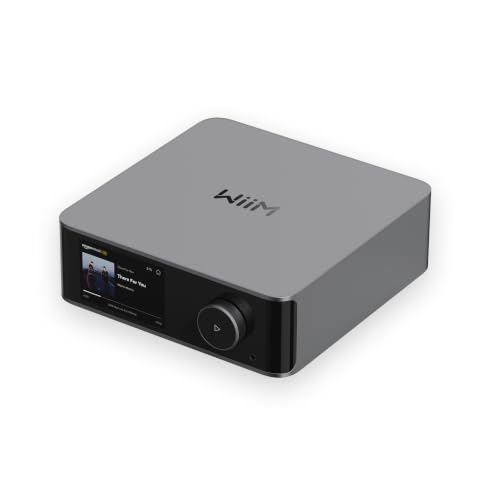
Choose the Ultra when the streamer will sit at the centre of the system rather than hide inside a rack. The listing pairs a 3.5-inch touchscreen with an ESS DAC, HDMI ARC for television sound, a phono input for a turntable and a headphone output, which makes it a genuine digital preamp as much as a streamer. Built-in room correction is part of the package, and Google Cast plus Alexa compatibility cover voice and casting duties across Spotify, Amazon Music and Tidal.
Specs
- ESS DAC
- 3.5-inch touchscreen display
- HDMI ARC, phono input and headphone output
- Google Cast and Alexa compatible
- Built-in room correction
- Streams Spotify, Amazon Music, Tidal and more
Best for: A single-box digital hub for streaming, TV sound and vinyl playback.
Watch out for: The phono input expects a moving-magnet cartridge signal, so check your turntable’s output before relying on it.
Bluesound Node (2024)

The 2024 Node fits households planning more than one streaming room, because the BluOS platform groups Bluesound and NAD components across the home. Its listing specifies an ESS ES9039Q2M SABRE DAC, high-resolution streaming up to 24-bit/192 kHz and DSD playback, alongside a THX AAA headphone amplifier with a full-size quarter-inch output. HDMI eARC handles TV integration, Dirac Live readiness offers a room-correction upgrade path, and five programmable presets put favourite sources on the top panel.
Specs
- ESS ES9039Q2M SABRE DAC
- Hi-res streaming up to 24-bit/192 kHz, with DSD playback
- Quad-core 1.8 GHz ARM Cortex A53 processor
- THX AAA headphone amplifier with 1/4-inch (6.3 mm) headphone output
- HDMI eARC and optical input
- Dirac Live Ready, AirPlay 2, Spotify Connect and TIDAL Connect
Best for: Multi-room homes that want one app and one platform across several systems.
Watch out for: Dirac Live correction requires a separate licence and microphone, so budget for those if room correction is the reason you are buying.
Cambridge Audio MXN10

Pick the MXN10 when shelf space is tight and the streamer mainly needs to feed an amplifier quietly and reliably. Cambridge’s listing presents a compact, half-width network player with an ESS Sabre DAC, Wi-Fi and Ethernet connection, Bluetooth 5.0 and internet radio, controlled through the StreamMagic app. Analog output lets its own DAC feed your amplifier directly, while coaxial and optical digital outputs leave the door open to an external DAC later. Four front-panel presets keep favourite stations and playlists one press away.
Specs
- ESS Sabre DAC
- High-resolution Wi-Fi network audio player and streamer
- Ethernet and Wi-Fi network connection
- Bluetooth 5.0 and internet radio
- Analog line output plus coaxial and optical digital outputs
- StreamMagic app control with front-panel presets
Best for: Compact systems that need a discreet, app-controlled hi-res source.
Watch out for: There is no screen and no remote handset in the box, so day-to-day control depends on the StreamMagic app.
Eversolo DMP-A6 Master Edition

The DMP-A6 Master Edition targets listeners whose high-resolution library lives on local storage as much as on streaming services. Its listing data shows dual ESS ES9038Q2M DAC chips, decoding up to DSD512 and PCM 768 kHz at 32-bit, and full MQA decoding, fronted by a 6-inch touchscreen. An internal M.2 NVMe SSD slot accepts up to 4TB of music files, Gigabit Ethernet and dual-band Wi-Fi handle network duties, and Tidal, Qobuz and Amazon Music are integrated alongside AirPlay and DLNA.
Specs
- Dual ESS ES9038Q2M DAC chips
- Decoding up to DSD512 and PCM 768 kHz / 32-bit, with MQA full decode
- 6-inch LCD touchscreen
- Gigabit Ethernet RJ-45 and dual-band Wi-Fi (2.4G + 5G)
- XMOS XU316 audio processor
- M.2 NVMe SSD slot supporting up to 4TB
Best for: Large local hi-res libraries and listeners who want the widest format support.
Watch out for: The SSD is not included, so the cost of storage comes on top of the unit itself.
Which One Fits Your Situation
You stream from services and rarely play local files
The WiiM Pro Plus covers this pattern completely: its 24-bit/192 kHz ceiling sits above what streaming services deliver, and AirPlay 2, Google Cast and the Connect protocols mean you mostly control playback from the apps you already use. There is little reason to pay for local-storage features or a touchscreen you will seldom look at.
One box must handle streaming, television and a turntable
The WiiM Ultra is the natural fit because its HDMI ARC, phono input and headphone output are all in the listing, alongside the touchscreen that makes source switching obvious to everyone at home. The Bluesound Node also covers TV duty through HDMI eARC if you prefer the BluOS platform and want a stronger headphone stage.
You are building a multi-room system over time
Start with the Bluesound Node (2024). BluOS is designed around grouping rooms and is shared with a wide range of Bluesound and NAD products, so a second or third zone later stays inside one app. Its five hardware presets also make it the easiest unit here for family members who never open a control app.
Your shelf space is limited but your files are demanding
The Cambridge Audio MXN10 solves the space problem with its half-width chassis while still feeding your amplifier from its own ESS Sabre DAC. If instead the demanding files are DSD rips stored locally, the Eversolo DMP-A6 Master Edition is the better answer, since its internal SSD slot and DSD512 support are built for exactly that library.
Common Mistakes
- Buying a streamer-only transport and discovering it has no analog outputs, so an external DAC becomes a second, unplanned purchase.
- Assuming every service streams at the hardware’s maximum rate, when several services cap playback below 24-bit/192 kHz regardless of the DAC.
- Ignoring the control app: the platform you open every day matters more than small differences in published specifications.
- Forgetting that AirPlay 2 and Bluetooth connections can limit resolution, while Ethernet or Wi-Fi streaming through the unit’s own platform usually does not.
- Overlooking output volume behaviour and connecting a fixed-output unit directly to a power amplifier with no volume control in between.
Frequently Asked Questions
Does a network DAC improve sound over streaming from a phone?
It can, mainly by replacing the phone’s modest analog output stage with a dedicated DAC and by receiving the stream directly over your network instead of through a compressed wireless link. The improvement depends on your amplifier and speakers, but the convenience gain — gapless playback, presets and no interruptions from calls — applies to almost every setup.
What resolution do I actually need for high-resolution music?
For streaming services, 24-bit/192 kHz covers everything the major platforms currently offer, and every unit in this guide reaches at least that level. Higher ceilings such as PCM 768 kHz or DSD512 only matter if you own files in those formats, typically SACD rips or specialist downloads, in which case the Eversolo’s published support becomes relevant.
Can I use a network DAC with powered speakers?
Yes, provided the unit offers variable analog output or you are comfortable controlling volume from the speakers themselves. The WiiM Ultra works naturally in this role as a digital preamp, while fixed-output players such as the MXN10 rely on the speakers or an amplifier for volume control, so check the listing before pairing.
Is Ethernet better than Wi-Fi for high-resolution streaming?
A wired Ethernet connection removes wireless dropouts from the equation and is the safer choice for the largest DSD files or homes with congested Wi-Fi. In practice, a strong dual-band Wi-Fi signal handles 24-bit/192 kHz streaming comfortably, and all five units here support Wi-Fi, with Ethernet available when you want the extra stability.
Related guides
More from Amazon
Programs that pair well with the guide above. Offers and eligibility are set by Amazon and may change.
Free shipping on eligible items, Prime Video and more. Eligible new members can start with a free trial.
Start a Prime free trialAudiobooks and podcasts to listen to on the go. Eligible new members can start with a free trial.
Try Audible freeAd-free music streaming. Eligible new subscribers can start with a free trial.
Try Music Unlimited freeA free business account with business pricing and bulk-buying tools for work, shop or home office.
Create a business accountAs an Amazon Associate we earn from qualifying purchases.










Write Your Review
No reviews yet. Be the first to share your experience!