
Key takeaways
- Compare the 5 best 12-inch powered subwoofers for low-frequency upgrades, from compact sealed models to deep ported cabinets for movies and music.
What's inside
As an Amazon Associate I earn from qualifying purchases. This post may contain affiliate links at no extra cost to you.
A low-frequency upgrade is a specific decision, not a general one. You already own speakers and a receiver you like, and the missing piece is the bottom end: bass lines that feel thin, movie explosions that sound flat, and kick drums that never quite land. The real question is how much depth and output your room needs, and which cabinet style gets you there without swallowing your living room or fighting your existing speakers.
This guide is for music listeners who want tighter bass, movie fans who want deeper rumble, and apartment dwellers who need real low end from a compact box. Every subwoofer below was chosen from the model name and specifications shown on its Amazon product page, so you can check each claim against the listing before you buy.
Quick Picks
As an Amazon Associate we earn from qualifying purchases.
| Product | Best for | Key spec from title |
|---|---|---|
| SVS SB-1000 Pro | Tight, musical bass in small rooms | 12-inch sealed subwoofer with app control |
| SVS PB-1000 Pro | Deep movie rumble in larger rooms | 12-inch ported subwoofer with dual front ports |
| Klipsch R-120SW | High-output home theater on a moderate budget | 12-inch subwoofer with 400 watts peak power |
| BIC America F12 | First subwoofer upgrade on a tight budget | 12-inch 475-watt front-firing powered subwoofer |
| Dayton Audio Classic CS1200 | Simple, affordable low-end upgrade | 12-inch 200-watt powered subwoofer with Class-D amplifier |
How to Choose
Sealed or Ported Cabinet
The cabinet decides the character of the bass more than any other single feature. A sealed cabinet, like the SVS SB-1000 Pro, tends to produce tighter, more controlled bass that starts and stops cleanly, which suits music and smaller rooms where accuracy matters more than sheer rumble. A ported cabinet uses one or more openings to reinforce the lowest notes, so it plays deeper and louder at the same amplifier power, which suits movies and larger rooms. Ported cabinets are usually bigger and need breathing room around the port, so measure your space and check whether the port fires from the front or the rear before you commit.
Amplifier Power and Low-Frequency Extension
Amplifier power and the lowest frequency a subwoofer reaches are the two numbers that tell you how deep the upgrade really goes. Look at the RMS wattage rather than the peak figure, because RMS reflects sustained output while peak describes brief bursts. Then check the low end of the frequency response: a subwoofer rated down to 20 Hz or lower reaches the notes you feel more than hear, while one rated to 29 Hz still covers most music and movie bass but leaves the deepest effects behind. Match these numbers to your room, because a powerful subwoofer in a small room can overwhelm the space, while a modest one in a large open room can disappear.
Room Size and Placement
A 12-inch powered subwoofer can pressurize a medium room, but placement decides whether the bass sounds even or boomy. Corners boost output, which helps a smaller subwoofer fill a bigger room, but they can also exaggerate certain notes and make bass sound muddy. A spot along the front wall near your main speakers usually blends more smoothly with music, while a position near the seating area can deliver stronger impact for movies. Before buying, measure the floor space and the clearance behind the cabinet, especially for rear-ported models that need distance from the wall. If your room is open plan or has high ceilings, lean toward a ported model with more output.
Connections and Controls
A low-frequency upgrade only works if the subwoofer connects cleanly to the system you already own. Most AV receivers have a dedicated subwoofer output, usually labelled LFE or Sub Out, which connects with a single RCA cable and lets the receiver manage the crossover. If your stereo amplifier has no subwoofer output, look for a model with high-level speaker connections, which tap the signal from your main speaker terminals. On the subwoofer itself, check for a volume control, an adjustable crossover, and a phase switch, since these let you blend the subwoofer with your main speakers instead of hearing it as a separate source. App control and DSP, offered on some SVS models, add finer tuning from your phone.
The 5 Best Options
SVS SB-1000 Pro

The SB-1000 Pro is the pick for buyers who want their upgrade to sound precise rather than simply loud. Its sealed cabinet keeps bass tight and controlled, so double bass, kick drums, and acoustic recordings stay clean instead of blooming into a vague rumble. The compact cube fits beside a media console or in a corner without dominating the room, and the SVS app gives you volume, crossover, phase, and parametric EQ control from your phone, which makes blending it with existing speakers far easier than turning knobs behind the cabinet. It reaches down to 20 Hz, so it covers the deepest notes in most music and a large share of movie soundtracks.
Specs
- 12-inch high-excursion driver
- Sledge STA-325D amplifier, 325 watts RMS and 820 watts peak
- Frequency response 20 Hz to 270 Hz
- Sealed cabinet design
- SVS Subwoofer Control App with DSP and parametric EQ
- Dimensions 13.5 inches high by 13 inches wide by 14.8 inches deep
Best for: Music listeners and small-room owners who want tight, accurate bass from a compact sealed box.
Watch out for: The sealed design trades some maximum output for control, so in a very large room it may not deliver the room-shaking rumble a ported model would.
SVS PB-1000 Pro

The PB-1000 Pro uses the same driver and amplifier family as its sealed sibling but puts them in a ported cabinet, and that change is aimed squarely at movie lovers. Two front-firing ports extend the low end down to 17 Hz, so explosions, earthquakes, and low synthesizer notes arrive with a physical weight the sealed version cannot match. The front ports also mean you can place it closer to a wall than a rear-ported design, which helps in rooms where space is tight. It keeps the same app-based DSP control, so you can still fine-tune volume, crossover, and EQ from your seat, and the included port plugs let you seal the cabinet for a tighter sound when you switch from movies to music.
Specs
- 12-inch high-excursion driver
- Sledge STA-325D amplifier, 325 watts RMS
- Frequency response down to 17 Hz
- Ported cabinet with dual front-firing ports and port plugs included
- SVS Subwoofer Control App with DSP and parametric EQ
- Black Ash finish
Best for: Home theater owners in medium to large rooms who want the deepest extension for movie soundtracks.
Watch out for: The cabinet is noticeably larger and heavier than the sealed version, so measure your floor space and check the depth before ordering.
Klipsch R-120SW

The R-120SW is the straightforward high-output option in this group, built around a 12-inch spun-copper IMG woofer and a digital amplifier that delivers strong volume for movie nights and parties. Its frequency response reaches down to 29 Hz, which covers the bass in nearly all music and most film soundtracks, and its maximum acoustic output of 116 dB means it can fill a living room without strain. The rear-firing port adds punch to the low end, and the simple control set of volume, crossover, and phase keeps setup quick. It is a good match for buyers who already own Klipsch speakers, since the voicing blends naturally, but it works just as well with any receiver that has a subwoofer output.
Specs
- 12-inch front-firing spun-copper IMG woofer
- All-digital amplifier, 200 watts continuous and 400 watts peak
- Frequency response 29 Hz to 120 Hz, plus or minus 3 dB
- Maximum acoustic output 116 dB
- Bass-reflex design with rear-firing port
- Dimensions about 15.7 inches high by 14.4 inches wide by 15.8 inches deep
- Includes manual, grille, and power cord
Best for: Home theater owners who want loud, punchy bass and simple setup without app-based tuning.
Watch out for: The rear port needs clearance from the wall, so it does not suit tight corners or placement hard against furniture.
BIC America F12
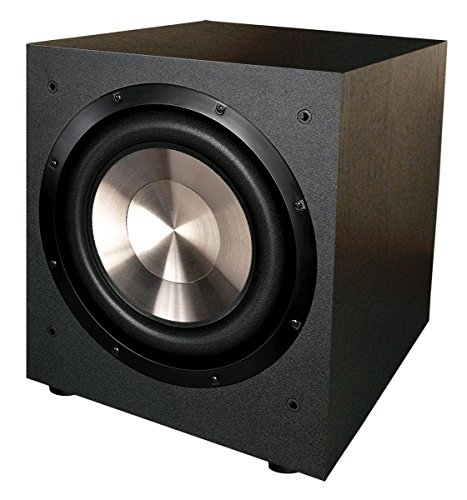
The F12 has been a common first subwoofer upgrade for years because it delivers a genuine 12-inch driver and a ported cabinet at a level where most competitors use smaller drivers. Its long-throw woofer reaches down to 25 Hz, which is deep enough to transform movie soundtracks and add real weight to music, and the front-firing design makes placement forgiving since the port and driver both face the room. The rear panel carries the controls that matter for integration: volume, adjustable crossover, phase, and an auto on and off switch, plus speaker-level inputs for amplifiers without a subwoofer output. It is not the most refined subwoofer here, but it is the easiest way to find out what a dedicated subwoofer adds to a system.
Specs
- 12-inch injection-molded long-throw woofer
- 475 watts peak power, 150 watts RMS
- Frequency response 25 Hz to 200 Hz
- Front-firing ported design
- Adjustable crossover, volume, and phase controls
- Auto on and off power switch
- 5-year warranty
Best for: First-time buyers who want a large, audible low-frequency upgrade while keeping the budget modest.
Watch out for: Bass is powerful rather than precise, so music listeners who value tight, detailed low end may prefer a sealed model instead.
Dayton Audio Classic CS1200

The CS1200 is the replacement for Dayton Audio’s long-running budget 12-inch subwoofer, and it keeps the same idea: a large driver, a simple Class-D amplifier, and no features you will never use. The 12-inch mineral-reinforced paper cone driver moves plenty of air for its size, and the 200-watt RMS amplifier gives it enough headroom for movie nights in a medium room. High-level inputs are included alongside the line-level input, so it connects to older stereo amplifiers as well as modern receivers with a subwoofer output. It is the newest listing in this guide, and its straightforward design makes it a sensible choice when you want the upgrade without paying for app control or DSP you do not need.
Specs
- 12-inch mineral-reinforced paper cone driver
- 200-watt RMS Class-D amplifier
- Powered subwoofer with line-level and high-level inputs
- Black finish
- Rigid MDF cabinet
Best for: Budget buyers who want a simple, current-model 12-inch powered subwoofer for a first low-frequency upgrade.
Watch out for: This is a newer model line with a shorter track record than the others here, so confirm the listing details and return terms before buying.
Which One Fits Your Situation
You Listen to Music More Than Movies
Choose the SVS SB-1000 Pro. Its sealed cabinet keeps bass notes tight and distinct, which matters when a bass guitar line or a kick drum needs to stay articulate instead of turning into a wash of low sound. The app-based EQ also lets you tame room peaks without touching the cabinet, and its compact size fits easily beside a stereo rack.
Your Room Is Large and Movies Come First
Choose the SVS PB-1000 Pro. The ported cabinet and 17 Hz extension deliver the deep rumble that makes action scenes physical, and the front-firing ports make placement more flexible than a rear-ported design. It has the output to fill a bigger space without sounding strained at high volume.
You Want the Biggest Upgrade for the Smallest Outlay
Choose the BIC America F12. Its 12-inch driver and 25 Hz extension add a dramatic amount of low end to a system that previously had none, and the front-firing design is forgiving about placement. If you later decide you want tighter bass, you will already know what a subwoofer adds and what to look for next.
You Want Strong Output With a Simple Setup
Choose the Klipsch R-120SW. It delivers high volume and punchy bass with only the essential controls, so setup takes minutes rather than an evening of app tuning. It pairs naturally with Klipsch speakers and works well in a living room home theater where the subwoofer sits near the front wall.
Common Mistakes
- Buying a passive subwoofer by accident: a low-frequency upgrade for an existing receiver needs a powered model with its own amplifier, so check the listing says powered before ordering.
- Choosing a 10-inch or 8-inch driver when the room needs a 12-inch: smaller drivers can sound quick, but they move less air and run out of depth sooner in medium and large rooms.
- Placing a rear-ported subwoofer hard against the wall: the port needs space to breathe, and blocking it makes bass boomy and indistinct.
- Setting the crossover too high: when the subwoofer plays notes your main speakers already handle, voices and instruments start sounding thick and localized at the subwoofer.
- Skipping the phase and volume matching step: a subwoofer that is too loud or out of phase with your speakers will sound like a separate box rather than part of the system.
Frequently Asked Questions
Do I need a subwoofer output on my receiver?
Not always. Most AV receivers have a dedicated subwoofer output, and that is the simplest connection. If your stereo amplifier has none, choose a model with high-level speaker inputs, such as the BIC America F12 or the Dayton Audio Classic CS1200, which connect from your main speaker terminals instead.
Is a sealed or ported subwoofer better for a low-frequency upgrade?
It depends on what you listen to. Sealed models like the SVS SB-1000 Pro sound tighter and suit music and smaller rooms. Ported models like the SVS PB-1000 Pro and Klipsch R-120SW play deeper and louder, which suits movies and larger rooms where maximum low-end impact matters more.
Will a 12-inch subwoofer overwhelm a small room?
It can if the volume is set too high, but a 12-inch driver itself is not the problem. Start with the volume low, set the crossover to blend with your main speakers, and use the phase control to match them. A sealed model is usually the safer choice in a small room because its bass stays controlled.
Should I buy one subwoofer or two?
One good 12-inch powered subwoofer is enough for most rooms and most upgrades. Two subwoofers can smooth out uneven bass across several seats, but that matters most in large rooms or dedicated theaters. Start with one, place it carefully, and only add a second if some seats still sound thin.
Related guides
More from Amazon
Programs that pair well with the guide above. Offers and eligibility are set by Amazon and may change.
Free shipping on eligible items, Prime Video and more. Eligible new members can start with a free trial.
Start a Prime free trialAudiobooks and podcasts to listen to on the go. Eligible new members can start with a free trial.
Try Audible freeAd-free music streaming. Eligible new subscribers can start with a free trial.
Try Music Unlimited freeA free business account with business pricing and bulk-buying tools for work, shop or home office.
Create a business accountAs an Amazon Associate we earn from qualifying purchases.










Write Your Review
No reviews yet. Be the first to share your experience!