
Key takeaways
- Compare triple-output bench power supplies for prototype testing, with three rails for analog, digital and logic circuits in one compact bench unit.
What's inside
As an Amazon Associate I earn from qualifying purchases. This post may contain affiliate links at no extra cost to you.
Prototype testing rarely runs on a single rail. A typical board under development needs a higher analog rail, a lower digital rail, and a logic supply at the same time, and swapping one single-output supply between them slows every bring-up session and invites wiring mistakes. The real decision is which three outputs you need: two adjustable rails plus a fixed logic rail, or three fully independent outputs, and how much current each rail must deliver without sagging.
This guide serves prototype builders, embedded developers, and small laboratory teams who power mixed-signal boards daily. The products below were chosen from the names and specifications printed on their Amazon product pages, and every model here is a genuine triple-output bench supply with three usable outputs.
Quick Picks
As an Amazon Associate we earn from qualifying purchases.
| Product | Best for | Key spec from title |
|---|---|---|
| Keysight E36313A 160W Triple Output Power Supply | High-current logic rails in mixed-signal prototypes | 6V, 10A and 2 x 25V, 2A, 160W |
| Siglent Technologies SPD3303X-E Triple Output Power Supply | Everyday prototype benches needing a selectable logic rail | Triple output with two adjustable channels |
| Rigol DP832 Programmable Linear DC Power Supply | Programmable three-channel prototype work | 3 channels, 195W, 30V/3A, 30V/3A, 5V/3A |
| Siglent Technologies SPD3303C DC Power Supply | Isolated rails for boards with separate grounds | 220W, three independent outputs |
How to Choose
Match the Three Outputs to Your Rails
Start by listing the rails your prototype actually uses. Many boards pair two adjustable rails, such as a positive and negative analog supply, with a fixed logic rail, and the Rigol DP832 follows exactly that pattern with two 30V channels and one 5V channel, while the Siglent SPD3303C pairs two 32V channels with a selectable logic rail. Other designs need a high-current low-voltage rail for a processor or FPGA core, which is where the Keysight E36313A stands out with 10A available on its 6V output. If your third rail must switch between several logic voltages, check whether the supply offers selectable settings on that channel before ordering.
Check Current Headroom on Each Channel
Total wattage alone can mislead, because a supply can reach its headline power figure on one channel while starving another. Read the per-channel current ratings printed in the product title and details, then compare them with the worst-case draw of each section of your board, including start-up surges from motors, relays, or charging capacitors. Prototype loads change as firmware enables more peripherals, so leaving sensible headroom on the rail that feeds your digital section prevents nuisance current limiting during debugging. A supply that limits early can look like a board fault, so generous per-channel current saves real troubleshooting time.
Decide How Much Programmability You Need
Some prototype work is purely manual: set a rail, watch the board, adjust, and repeat. Other work benefits from stored settings, timed output sequences, and computer control so the same power-up routine runs identically after every firmware change. Programmable models such as the Siglent SPD3303X-E and the Rigol DP832 expose interfaces for remote control, while simpler manual units keep the front panel uncluttered and the learning curve short. Think about whether your research is repetitive enough to reward automation, and whether your team will actually write the scripts, before paying for connectivity you may never use.
Confirm Isolation and Grounding Behavior
Whether the three outputs float independently matters whenever your prototype has separate ground domains, split analog and digital returns, or a negative rail referenced away from earth. Isolated outputs, such as the three independent outputs on the Siglent SPD3303C, let you wire channels in series for a higher voltage or reference them to different points on the board without creating ground loops. If channels share a common ground internally, series wiring and bipolar rails behave differently, and discovering that after purchase is frustrating. Check the isolation description on the product page against the grounding scheme your prototype uses.
The 4 Best Options
Keysight E36313A 160W Triple Output Power Supply

The Keysight E36313A leads this guide because its output mix suits demanding prototypes: a 6V channel able to deliver 10A for hungry logic and processor rails, plus two 25V channels at 2A for analog sections, all inside a 160W triple-output chassis. Buyers bringing up boards with separate core, analog, and auxiliary rails get genuine headroom instead of running a channel at its limit. LAN and USB connectivity also support repeatable bench setups, and the color-coded channels simplify manual setup when several rails change during a single debugging session.
Specs
- Brand: Keysight
- Model name: E36313A
- Output 1: 6V, 10A
- Outputs 2 and 3: 25V, 2A each
- Output wattage: 160 watts
- Connector type: USB
- Compatible devices: Personal computer
Best for: Prototypes whose logic or processor rail draws several amps while two analog rails run alongside it.
Watch out for: Confirm the 25V ceiling on the two higher-voltage channels covers your analog rails, since this model trades voltage range for current on its first output.
ASIN: B076W33D1K
Siglent Technologies SPD3303X-E Triple Output Power Supply
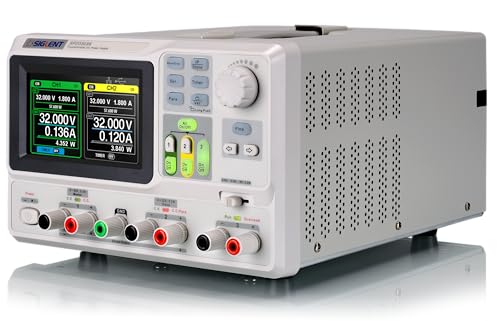
The Siglent SPD3303X-E is the balanced everyday choice for prototype benches, pairing two adjustable channels with a third channel offering selectable 2.5V, 3.3V, and 5V logic settings. That selectable rail is genuinely useful when a project moves between older 5V logic and modern lower-voltage parts, because the supply adapts without external regulators. Its programmable design, series and parallel channel modes, and timer functions suit developers who repeat the same power-up checks daily. For mixed analog and digital boards that do not need extreme current, it covers the common cases in one tidy unit.
Specs
- Brand: Siglent Technologies
- Model: SPD3303X-E
- Channels 1 and 2: 32V, 3.2A each
- Channel 3: selectable 2.5V, 3.3V, or 5V at 3.2A
- Total power: 220W
- Display: 4.3-inch TFT LCD
- Connectivity: USB and LAN
Best for: Prototype benches that switch between 5V and lower-voltage logic families during development.
Watch out for: Verify the selectable third channel matches your logic voltages, and check the listing configuration carefully because Siglent sells several closely named SPD3303 variants.
ASIN: B01410O424
Rigol DP832 Programmable Linear DC Power Supply

The Rigol DP832 follows the classic prototype layout: two 30V, 3A adjustable channels and a 5V, 3A channel, delivering 195W in total from a programmable linear design. Linear topology appeals to builders working with sensitive analog front ends, where a quiet supply keeps measurement results believable during bring-up. Its three channels can be set and monitored from the front panel display, and the channel isolation arrangement supports flexible wiring for bipolar rails. Teams that want a well-known programmable platform for mixed-signal prototypes, without stepping up to premium instrument pricing tiers, will find this configuration easy to live with.
Specs
- Brand: Rigol
- Model: DP832
- Channel 1: 30V, 3A
- Channel 2: 30V, 3A
- Channel 3: 5V, 3A
- Total power: 195W
- Type: Programmable linear DC power supply, 3 channels
Best for: Mixed-signal prototype bring-up where a quiet linear supply and two 30V rails matter most.
Watch out for: Note that the third channel is a 5V rail rather than a third full-range output, so confirm your board does not need three adjustable voltages.
ASIN: B09S3GQ24H
Siglent Technologies SPD3303C DC Power Supply
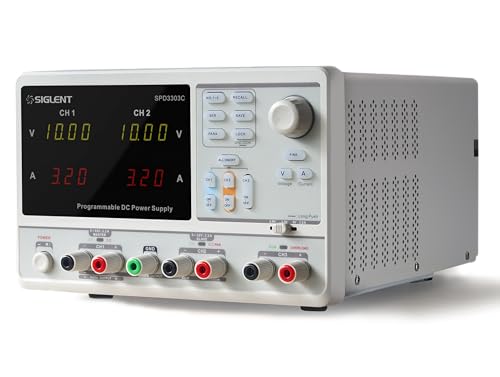
The Siglent SPD3303C brings three independent, isolated outputs to prototype benches that need flexible grounding: two adjustable channels at 32V and 3.2A, plus a third channel selectable between 2.5V, 3.3V, and 5V at 3.2A, for 220W in total. Its true linear design, 10mV and 10mA resolution, and short-circuit and overload protection suit everyday bring-up work, while independent, series, and parallel output modes cover bipolar rails and combined-channel tests. Builders who want isolated rails and a selectable logic channel in a straightforward LED-display unit will find it an easy fit.
Specs
- Brand: Siglent
- Model number: SPD3303C
- Channels 1 and 2: 32V, 3.2A each
- Channel 3: selectable 2.5V, 3.3V, or 5V at 3.2A
- Maximum power: 220 watts
- Resolution: 10mV, 10mA
- Outputs: Three independent power supplies in one unit
Best for: Prototypes with separate ground domains that need independent, isolated rails from one instrument.
Watch out for: Check the 10mV and 10mA setting resolution against your needs, since finer-resolution models exist in the same Siglent family, and confirm the selectable third channel covers your logic voltages.
ASIN: B01HENYNZS
Which One Fits Your Situation
Powering a Processor Board With a Hungry Core Rail
Choose the Keysight E36313A when your prototype pairs a current-hungry low-voltage rail with two moderate analog rails. Its 6V output delivers 10A, far beyond the third-channel ratings of the other supplies here, so processor, FPGA, and peripheral loads can start up without tripping a limit. The two 25V channels still cover typical analog sections, making it the natural single-box answer for compute-heavy prototypes.
Bringing Up Mixed Analog and Digital Boards Daily
The Siglent SPD3303X-E fits benches that move between projects with different logic voltages. Its selectable 2.5V, 3.3V, and 5V third channel adapts to each board, while the two adjustable channels handle analog rails or a second digital domain. Programmable control and channel series and parallel modes also help when the same bring-up routine repeats across many prototype revisions.
Testing Sensitive Analog Front Ends
Pick the Rigol DP832 when supply noise would undermine your measurements. Its linear design and two 30V channels suit op-amp circuits, sensor interfaces, and audio or instrumentation prototypes where a switching supply could mask real behavior. The 5V channel covers logic and reference circuits, so one instrument powers the whole board while you probe delicate signals with confidence in the rails feeding them.
Working With Split Grounds or Bipolar Rails
The Siglent SPD3303C is the right call when isolation decides the purchase. Its three independent outputs let you reference rails to different points, wire channels in series for higher voltage, or run a negative rail for analog sections without ground conflicts. If your prototypes routinely separate analog and digital returns, that independence prevents wiring compromises that can corrupt an otherwise sound test setup.
Common Mistakes
- Buying by total wattage alone and ignoring the per-channel current ratings that actually limit each rail.
- Assuming the third output is fully adjustable, when many triple-output supplies provide a fixed or selectable logic rail instead.
- Ignoring channel isolation, then discovering the outputs share a ground that conflicts with a split-ground prototype.
- Setting current limits too low during bring-up, so normal start-up surges trip the supply and mimic board faults.
- Forgetting to check the voltage ceiling on high-current channels, which often trade maximum voltage for maximum current.
Frequently Asked Questions
Why do prototype boards need three outputs at once?
Most prototypes combine an analog section, a digital section, and a logic or reference rail, each at a different voltage. Powering all three from one supply keeps start-up sequencing consistent and removes the cable swapping that causes wiring errors. A triple-output supply also lets you raise or drop one rail independently while watching how the rest of the board responds.
Can I combine channels for higher voltage or current?
On several models here, yes. Supplies such as the Siglent SPD3303C and the Siglent SPD3303X-E allow channels to be wired in series for higher voltage or in parallel for higher current, subject to their isolation design. Always confirm the combination modes on the product page, and never series-connect channels that share an internal ground unless the maker explicitly allows it.
Is a fixed 5V third channel a real limitation?
Only if your prototype needs three different adjustable voltages. Many boards genuinely use a fixed logic rail, so a 5V third channel is convenient and simpler to set. If your designs move between logic families, a selectable third channel like the one on the Siglent SPD3303X-E, offering 2.5V, 3.3V, and 5V, removes the limitation without adding a second supply.
What current headroom should I leave on each rail?
Leave enough margin that start-up surges and fully enabled peripherals stay comfortably below the channel rating. Prototype firmware often turns on more circuitry over time, raising the draw beyond the first bring-up measurement. Choosing a channel rated noticeably above your measured load avoids nuisance limiting, which can otherwise look exactly like an intermittent fault on the board under test.
Related guides
More from Amazon
Programs that pair well with the guide above. Offers and eligibility are set by Amazon and may change.
Free shipping on eligible items, Prime Video and more. Eligible new members can start with a free trial.
Start a Prime free trialAudiobooks and podcasts to listen to on the go. Eligible new members can start with a free trial.
Try Audible freeAd-free music streaming. Eligible new subscribers can start with a free trial.
Try Music Unlimited freeA free business account with business pricing and bulk-buying tools for work, shop or home office.
Create a business accountAs an Amazon Associate we earn from qualifying purchases.










Write Your Review
No reviews yet. Be the first to share your experience!