
Key takeaways
- Compare the best triple-output bench power supplies for product development, with three rails for analog stages, logic and auxiliary circuits on one bench.
What's inside
As an Amazon Associate I earn from qualifying purchases. This post may contain affiliate links at no extra cost to you.
Product development boards rarely run on one rail. A typical prototype pairs a positive and negative analog supply with a 5 V or 3.3 V logic rail, and powering that mix from separate single-output units eats bench space and invites wiring mistakes. A triple-output bench supply puts all three rails in one chassis, so the real decision is which channel layout, resolution and remote-control options match the boards you build and the way your team works.
This guide serves hardware engineers, embedded developers and small product teams bringing up mixed-signal prototypes. Every product below is a true three-output bench power supply, chosen from the names and specifications printed on its Amazon product page, and each one was confirmed in stock on Amazon US before inclusion.
Quick Picks
As an Amazon Associate we earn from qualifying purchases.
| Product | Best for | Key spec from title |
|---|---|---|
| Keysight E36313A | High-current logic rails beside dual analog outputs | 160W triple output, 6V/10A and 2x 25V/2A |
| Siglent SPD3303X-E | Scripted bring-up over LAN with a selectable logic rail | 220W total, 2x 32V/3.2A plus 2.5/3.3/5V channel |
| Rigol DP832 | Classic mixed-signal prototypes on a mid-range budget | 195W total, 30V/3A, 30V/3A and 5V/3A |
| Siglent SPD3303C | Cost-conscious benches that still need three isolated rails | 220W total, three independent outputs, USB control |
How to Choose
Match the channel layout to your board’s rails
Start by listing the rails your prototype actually needs. Boards with op-amp stages usually want two matched adjustable outputs that can form a split supply around ground, while a third fixed or selectable channel feeds the microcontroller. The Keysight layout differs from the others here: its first channel is a low-voltage, high-current 6 V output, which suits hungry digital loads, whereas the Siglent and Rigol designs give two higher-voltage adjustable channels plus a logic channel. Choosing the layout first prevents buying a supply whose third channel cannot reach the voltage your analog stage needs.
Check resolution and readback for bring-up work
During first power-up, small setting steps and trustworthy readback matter more than raw power. A supply with 10 mV and 10 mA setting resolution lets you creep a rail upward while watching current draw, which is how shorts and misplaced components reveal themselves safely. Finer readback also helps when you log how a prototype behaves across its input range. Compare the resolution figures printed in each listing, and prefer four-digit or better displays when your development work involves low-voltage rails where a few millivolts of error change circuit behaviour.
Decide how much remote control you need
Development benches increasingly script their power. If your team runs automated regression checks on prototypes, a LAN or USB interface with standard remote commands lets a script sweep rails, log current and shut outputs down on a fault. The Siglent SPD3303X-E adds Ethernet alongside USB, the Rigol and the SPD3303C focus on USB, and the Keysight lists USB connectivity in its product details. Decide before buying whether the supply must join a network, because interfaces cannot be added later on most bench models.
Plan for series, parallel and protection behaviour
Two channels that combine in series deliver a higher single voltage for motor drivers or industrial inputs, while parallel mode doubles current for a hungry load. Check that the listing states these modes explicitly, as the Siglent and Rigol models here do. Protection behaviour matters just as much during development: overvoltage and overcurrent limits guard prototype boards that cost far more than the supply. Also confirm how outputs behave at switch-on, since a rail that overshoots can damage a board before you ever load firmware.
The 4 Best Options
Keysight E36313A

The E36313A suits development teams whose prototypes combine a power-hungry digital section with a dual-rail analog front end. Its first output delivers up to 10 A at low voltage, which covers processor boards, radios and display subsystems that would starve a typical 3 A logic channel, while the two 25 V outputs handle analog stages and sensor excitation. The 160 W total budget is shared across all three outputs, so it fits bench prototypes rather than power hardware. For product development work where one board draws uneven loads across its rails, this asymmetric layout is the most flexible option in this guide.
Specs
- Triple output: one 6 V, 10 A channel and two 25 V, 2 A channels
- Output wattage: 160 watts
- Connector type: USB
- Model number: E36313A
- Brand: Keysight
Best for: Prototypes with a high-current low-voltage rail plus two moderate analog rails.
Watch out for: The 25 V ceiling on channels two and three is lower than the 30 V or 32 V rivals here, so confirm your analog rails fit.
ASIN: B076W33D1K
Siglent SPD3303X-E
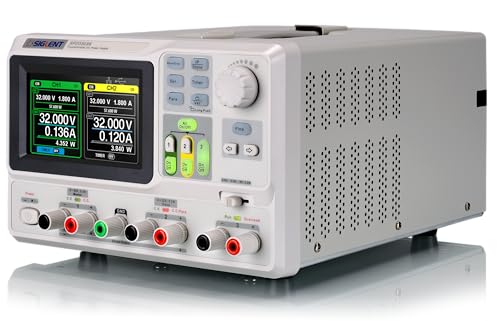
The SPD3303X-E is the natural pick for engineers who script their bench. Two isolated channels adjust up to 32 V and 3.2 A, and the third channel selects between 2.5 V, 3.3 V and 5 V, which maps neatly onto the logic voltages modern prototypes use. Independent, series and parallel modes cover split supplies and higher-voltage experiments, and the colour display shows all channels at once. USB and LAN connections support remote control from a PC, so automated bring-up sequences and overnight soak runs can drive the supply without anyone standing at the bench.
Specs
- Three independent, isolated outputs totalling 220 W
- Channels 1 and 2: 0 to 32 V, 0 to 3.2 A each
- Channel 3: selectable 2.5 V, 3.3 V or 5 V at 3.2 A
- Output modes: independent, series and parallel
- Resolution: 10 mV and 10 mA
- Remote interfaces: USB and LAN (Ethernet)
- Display: 4.3 inch true colour TFT-LCD
Best for: Automated prototype testing and mixed-signal boards needing a selectable logic rail.
Watch out for: Channel 3 only offers the three fixed voltages, so a board needing an unusual logic voltage must use one of the adjustable channels.
ASIN: B01410O424
Rigol DP832

The DP832 has been a development-bench staple for years because its layout mirrors the classic prototype: two 30 V, 3 A channels for analog or split-rail work and a 5 V, 3 A channel for logic. The linear design keeps output noise low for sensitive analog stages, and the 195 W total covers most board-level development without crowding the bench. Programmable control and built-in protection features suit teams that repeat the same bring-up sequence across many board revisions. If your products live in the 30 V world and you value a proven, widely documented instrument, this is the straightforward choice.
Specs
- Three channels with 195 W total power
- Channel 1: 30 V, 3 A
- Channel 2: 30 V, 3 A
- Channel 3: 5 V, 3 A
- Resolution: 10 mV and 10 mA
- Programmable linear DC power supply
Best for: Mixed-signal prototypes that follow the traditional dual analog rail plus 5 V logic pattern.
Watch out for: The third channel is fixed at 5 V, so 3.3 V logic must be powered from an adjustable channel or a regulator on the board.
ASIN: B00ENX02GC
Siglent SPD3303C
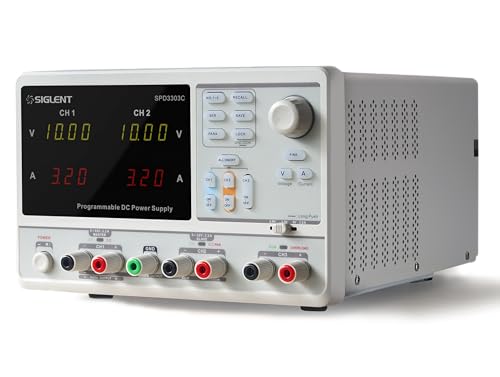
The SPD3303C brings the same three-rail idea to benches where the supply budget competes with oscilloscopes and soldering stations. It delivers 220 W across three independent outputs, with two channels adjustable to 32 V and 3.2 A and a third channel offering the common logic voltages. Series and parallel modes extend its reach for occasional higher-voltage or higher-current experiments, and a USB interface provides PC control for simple automated checks. For a small team equipping a first product development bench, it covers the essential triple-output requirements while leaving funds for the rest of the lab.
Specs
- Three independent outputs totalling 220 W
- Two adjustable channels up to 32 V and 3.2 A
- Third channel: 2.5 V, 3.3 V or 5 V at 3.2 A
- Output modes: independent, series and parallel
- USB interface for PC control
- Model number: SPD3303C
Best for: Startups and small teams building a first development bench around three rails.
Watch out for: It is the simplest interface in this group, so confirm the display and control style suit engineers who adjust settings constantly.
ASIN: B01HENYNZS
Which One Fits Your Situation
You are bringing up a mixed-signal prototype
Choose the Siglent SPD3303X-E. Its two 32 V adjustable channels form the positive and negative analog rails, the selectable third channel matches your logic voltage exactly, and the LAN connection lets you script the power-up sequence so every board revision sees identical conditions. That repeatability is what turns bring-up from guesswork into a controlled process during active product development.
Your digital section draws serious current
Choose the Keysight E36313A. Most triple-output supplies cap every channel near 3 A, which leaves processor-heavy prototypes short on the logic rail. The Keysight dedicates its first channel to 10 A at low voltage, so radios, displays and compute modules get the current they need while the two 25 V channels keep the analog side powered independently.
You build traditional 30 V analog and 5 V logic boards
Choose the Rigol DP832. Its two 30 V, 3 A channels and fixed 5 V channel match the rail pattern that decades of products have used, and its linear output suits noise-sensitive analog work. Teams standardising on one supply for maintenance, training and new designs benefit from how widely this model is documented and understood.
You are equipping a bench on a tight equipment budget
Choose the Siglent SPD3303C. It keeps the features development work actually requires, three independent rails, series and parallel modes and USB control, at the lowest commitment in this group. The money saved can fund a better oscilloscope or a second unit later, and a matched pair of these still covers two engineers working on separate prototypes.
Common Mistakes
- Buying a dual-output supply and planning to add a wall adapter for the third rail, which defeats the shared ground, sequencing and protection that make a triple-output unit useful.
- Ignoring the third channel’s voltage range, then discovering it cannot produce the 3.3 V or 12 V rail the prototype actually needs.
- Adding the channel wattages together and assuming the total is always available, when most supplies share one overall power budget across outputs.
- Skipping remote control at purchase time and later finding that automated regression testing of prototypes requires an interface the supply does not have.
- Setting current limits to the maximum during first power-up, which lets a soldering fault damage a prototype board that a low limit would have protected.
Frequently Asked Questions
Why do product development boards need three outputs?
Most prototypes combine at least two power domains. An analog front end often needs positive and negative rails, while the digital section needs its own logic voltage. A triple-output supply powers all three from one chassis with a shared reference, coordinated switch-on and per-channel current limits, which is safer and tidier than stacking separate supplies on the bench.
Can two channels really replace a dedicated split supply?
Yes, within the voltage and current ratings. Two isolated channels of equal range can be wired as positive and negative rails around a common ground point, which is how the Siglent and Rigol models here support op-amp and audio development. Series mode goes further and combines channels into one higher-voltage output when a design needs it.
What current limit should I set for a first prototype power-up?
Start low and raise it deliberately. Set each channel slightly above the current the board is calculated to draw, then watch the readback as the rail rises. A board that pulls the limit immediately is telling you about a short or assembly error, and the supply folds back instead of feeding the fault with full current.
Is a programmable supply worth it for a small development team?
Usually yes, once more than one engineer shares the bench. Stored setups recall exact rail voltages for each project, remote interfaces let scripts repeat power sequences during regression checks, and output timers help with soak testing. Teams that only power one simple board may not use these features, but growing product lines quickly make them valuable.
Related guides
More from Amazon
Programs that pair well with the guide above. Offers and eligibility are set by Amazon and may change.
Free shipping on eligible items, Prime Video and more. Eligible new members can start with a free trial.
Start a Prime free trialAudiobooks and podcasts to listen to on the go. Eligible new members can start with a free trial.
Try Audible freeAd-free music streaming. Eligible new subscribers can start with a free trial.
Try Music Unlimited freeA free business account with business pricing and bulk-buying tools for work, shop or home office.
Create a business accountAs an Amazon Associate we earn from qualifying purchases.










Write Your Review
No reviews yet. Be the first to share your experience!