
Key takeaways
- Compare high-frequency LCR meters for product development, with test ranges up to 300 kHz, Kelvin leads, sorting and logging, from Amazon listing specs.
What's inside
As an Amazon Associate I earn from qualifying purchases. This post may contain affiliate links at no extra cost to you.
A passive component rarely behaves in a circuit the way its headline value suggests. A decoupling capacitor that measures perfectly at 1 kHz can be dominated by its own inductance at the frequency your converter actually switches, and a small inductor can drift far from its marked value near resonance. The real decision when equipping a development bench is therefore not resolution or display size, but whether the meter can measure parts at, or near, the frequencies your design will run at.
This guide is written for hardware engineers, prototype technicians and small development teams choosing an LCR meter for design work rather than repair. Every pick below comes from the names and specifications published on its Amazon product page, and each one lists a maximum test frequency of 100 kHz or higher, from a 300 kHz benchtop bridge down to pocket-sized handhelds that suit quick bench-side checks between board revisions.
Quick Picks
As an Amazon Associate we earn from qualifying purchases
| Product | Best for | Key spec from title |
|---|---|---|
| GW Instek LCR-6300 | Bench characterization across frequency | 10 Hz to 300 kHz test frequency |
| B&K Precision 880 | Bench-side checks with Kelvin leads | 100 kHz top test frequency |
| Keysight U1733C | Documented measurements in design reviews | 100 kHz with 0.2% basic accuracy |
| Peak Atlas LCR45 | Quick inductor and coil checks | 200 kHz automatic test frequency |
| DER EE DE-5000 | Sorting prototype and incoming parts | 100 kHz with tolerance sorting |
How to Choose
Top test frequency and how finely it is set
Start with the highest frequency your circuits use, then look at how the meter reaches it. A switching supply that runs at 150 kHz needs readings close to that point, not only at 1 kHz. Benchtop bridges such as the LCR-6300 adjust frequency continuously, so a part can be measured at the exact operating point and swept around it. Handhelds offer fixed steps, typically 100 Hz through 100 kHz, which is enough when your designs stay below that ceiling but leaves a gap if magnetics work pushes higher.
Accuracy and resolution where it counts
Published basic accuracy is usually quoted at comfortable mid-range values and moderate frequencies, and it loosens at range extremes and at the top test frequency. For development work, read the accuracy table rather than the headline figure: a meter rated at 0.05 percent that holds close to that at 100 kHz tells you far more than a vague claim. Display counts matter alongside, because a 40,000-count display resolves small changes in a prototype value that a 2,000-count display rounds away entirely.
Fixtures, Kelvin connections and compensation
At 100 kHz and above, your test leads are part of the measurement. Long unshielded leads add inductance and capacitance that swamp small parts, so four-terminal Kelvin clips or a short SMD tweezer connection keep lead effects out of the reading. Before measuring small values, run the open and short compensation routine with the exact leads and fixture you will use, at the frequency you will use. Benchtop meters add plug-in fixtures for leaded parts, which repeat far better than hand-held clips during a long characterization session.
Sorting, sweeping and data logging for iteration
Development work repeats measurements dozens of times, so workflow features save real hours. A list or sweep function plots how a part behaves across frequency, which exposes a capacitor rolling off or an inductor approaching self-resonance. Tolerance sorting speeds up matching components for a prototype build and checking samples from a new supplier. PC logging matters when numbers must land in a design file or review document: look for a USB or serial interface and confirm what software or cable the listing actually includes.
The 5 Best Options
GW Instek LCR-6300

This is the bench anchor of the group, built for teams that characterize parts rather than spot-check them. Its continuously adjustable test frequency runs to 300 kHz, so a filter inductor or RF capacitor can be measured at the exact frequency the circuit uses, and the list function steps through preset frequencies for repeatable plots. A 3.5-inch color display, selectable output impedance and a handler interface suit a fixed development bench that also feeds prototype builds and incoming checks.
Specs
- Test frequency: 10 Hz to 300 kHz, adjustable with 4-digit resolution
- Basic accuracy: 0.05% at slow and medium speeds, 0.1% at fast speed
- Test signal level: 10.00 mV to 2.00 V AC
- Output impedance: 30, 50 or 100 Ω selectable
- Display: 3.5-inch color LCD
- Interfaces: RS-232 (SCPI), Handler and USB host
- Dimensions and weight: 265 x 107 x 312 mm, approx. 3 kg
Best for: Development benches characterizing passives across frequency before a layout is frozen.
Watch out for: Confirm which test leads or fixture the listing bundles; plug-in fixtures such as the LCR-05 are optional accessories.
ASIN: B01BMCT2IA
B&K Precision 880

The 880 brings bench-style measurement to a handheld that can move between prototype stations. Its five test frequencies top out at 100 kHz, and the four-terminal connection with shielded Kelvin clips keeps lead resistance out of low-value readings, which matters when you are verifying milliohm-level ESR on decoupling capacitors. The dual display shows the primary value alongside D, Q, theta or ESR, so a single measurement answers both the value question and the loss question during debugging.
Specs
- Test frequencies: 100 Hz, 120 Hz, 1 kHz, 10 kHz and 100 kHz
- Display: dual display, 40,000 counts primary and 10,000 counts secondary, backlit
- Basic accuracy: 0.1%
- Measurement parameters: L, C, R, Z and DCR, with D, Q, theta and ESR as secondary parameters
- Four-terminal measurement with shielded Kelvin clip leads and SMD tweezer included
- Interface: mini USB
- Power: rechargeable Ni-MH 9 V battery or AC adapter
Best for: Bench-side prototype debugging where Kelvin connections and ESR readings matter.
Watch out for: The 100 kHz step is the ceiling, with no setting between 10 kHz and 100 kHz; confirm the Kelvin clip leads are in the box, since listings vary.
ASIN: B01GVCS160
Keysight U1733C

Choose the U1733C when readings have to be documented and defended in a design review. It covers the same five test frequencies up to 100 kHz with 0.2 percent basic accuracy and a 20,000-count dual display, and its infrared-to-USB link moves measurements into PC records instead of notebook scribbles. That combination suits regulated or client-facing development, where a component decision may need traceable numbers weeks after the prototype session that produced them.
Specs
- Test frequencies: 100 Hz, 120 Hz, 1 kHz, 10 kHz and 100 kHz
- Basic accuracy: 0.2%
- Display: 20,000-count dual display
- PC connection: infrared to USB for data logging
- Form factor: handheld LCR meter, model U1733C
Best for: Documented measurements for design reviews and client-facing development work.
Watch out for: PC logging needs the infrared USB cable, which is a separate accessory on many listings; check whether it is included before relying on logging.
ASIN: B00OVEV06Y
Peak Atlas LCR45
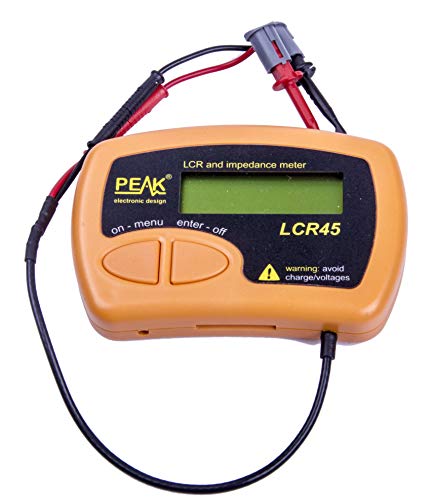
The LCR45 takes a different route: instead of many frequency steps it analyzes the part and picks the test frequency itself, up to 200 kHz, or lets you fix DC, 1 kHz, 15 kHz or 200 kHz manually. That automatic analysis, with resolution down to 0.2 microhenries, makes it quick for identifying unmarked inductors and checking wound components during magnetics experiments. It is a pocket instrument with a two-button interface, aimed at fast answers rather than logged characterization.
Specs
- Test frequency: automatic or manual, DC, 1 kHz, 15 kHz or 200 kHz
- Resolution: 0.2 µH, 0.2 pF and 0.2 Ω
- Measures inductance, capacitance, resistance and complex impedance
- Automatic component identification and analysis
- Probes: detachable micro hooks and 2 mm compatible probes
- Battery: 12 V
Best for: Fast identification and checking of inductors and wound components.
Watch out for: There is no 100 kHz step, since the manual choices jump from 15 kHz to 200 kHz, and it runs on a 12 V battery rather than common AA cells.
ASIN: B00JVT0CSG
DER EE DE-5000

The DE-5000 earns its place in development work through its sorting mode as much as its 100 kHz top frequency. Selectable tolerance windows let you bin capacitors and inductors for a matched prototype build or flag samples that drift from a supplier’s claim, and the dual display reports D, Q, theta and ESR beside the main value. With alligator clips and SMD tweezers in the common bundle, it moves between leaded parts and board-level surface-mount checks.
Specs
- Test frequencies: 100 Hz, 120 Hz, 1 kHz, 10 kHz and 100 kHz
- Dual display with secondary parameters D, Q, theta and ESR
- Series and parallel measurement modes for L, C and R, plus DCR
- Component sorting with selectable tolerances from ±0.25% to ±20% and -20%/+80%
- Included leads: TL-21 alligator clips and TL-22 SMD tweezers
Best for: Sorting and matching components for prototype builds and supplier checks.
Watch out for: Bundle contents differ between listings; verify the TL-21 clips and TL-22 tweezers are included, and check the stated accuracy at 100 kHz rather than at 1 kHz.
ASIN: B00O5537V0
Which One Fits Your Situation
Characterizing magnetics for a power stage
If your current project is a converter or filter whose inductors must behave at the switching frequency, start with the GW Instek LCR-6300. Its adjustable frequency reaches 300 kHz and the list function repeats measurements across preset points, which shows how inductance and Q hold up where the part will actually work. The Peak Atlas LCR45 is the faster second tool for quick coil checks away from the main bench.
Verifying decoupling capacitors on prototypes
For checking whether the capacitors on a new board still look capacitive at operating frequency, the B&K Precision 880 fits best. The 100 kHz step and four-terminal Kelvin clips expose rising ESR on parts that a 1 kHz meter would pass without comment. Keep the DE-5000 nearby when the same session turns into comparing several candidate parts for the next board spin.
Producing numbers for a design review
When measurements feed a report, a client deliverable or a compliance file, pick the Keysight U1733C. Its PC logging through the infrared USB link keeps readings tied to the session, and the 0.2 percent basic accuracy gives the figures credibility. For a larger characterization study that will be repeated across revisions, step up to the LCR-6300 and store its setups instead.
Matching and sorting parts for a build
Prototype runs often need ten capacitors that genuinely match, not ten from the same reel assumed identical. The DER EE DE-5000’s tolerance sorting handles that job directly, flagging parts inside or outside the window you set. The same mode earns its keep when qualifying a second-source supplier: measure the sample batch at 100 kHz and compare the spread against the original part before committing the design.
Common Mistakes
- Judging a capacitor or inductor only at 1 kHz when the circuit runs at tens or hundreds of kilohertz, where parasitics change both the value and the losses.
- Skipping open and short compensation before measuring small capacitances or inductances, especially after changing leads or fixtures.
- Measuring at high frequency through long, unshielded test leads, which add enough inductance and capacitance to distort the reading.
- Ignoring the test signal level, since some ceramic capacitors change value with applied AC level and a reading at one level may not match in-circuit behavior at another.
- Treating the headline basic accuracy as the accuracy at 100 kHz, when most meters specify wider tolerances at the top frequency and at range extremes.
Frequently Asked Questions
Why does test frequency matter in product development?
Components are not ideal outside the frequency they were characterized at. A capacitor’s effective value falls and its ESR rises as frequency climbs, and an inductor loses inductance near self-resonance. Measuring at or near the operating frequency during development catches those shifts while the design can still change, instead of after a prototype fails its first power-up or emissions check.
Is 100 kHz enough, or should you choose 200 kHz or 300 kHz?
Match the meter to the fastest frequency your designs actually use. For audio, control and many power circuits switching below 100 kHz, a 100 kHz meter covers the working range. If you develop converters switching at several hundred kilohertz, RF matching networks or fast digital decoupling, the extra reach of a 200 kHz or 300 kHz instrument measures parts where they will really operate.
Handheld or benchtop for a development bench?
Pick by workflow rather than by accuracy alone. A benchtop bridge gives continuously adjustable frequency, plug-in fixtures, stored setups and automation interfaces, which suit repeated characterization. A handheld with 100 kHz capability suits debugging at the board, quick supplier samples and shared benches. Many development teams end up with one of each, using the handheld daily and the bench unit for formal measurements.
Can these meters measure parts already soldered on a board?
Only with caution. In-circuit readings include every parallel path around the part, so the number rarely equals the component’s true value, and at high frequencies board traces add their own inductance. For development decisions, lift one leg or measure an identical part off-board. Treat in-circuit readings as comparisons against a known-good board rather than as absolute values.
Related guides
More from Amazon
Programs that pair well with the guide above. Offers and eligibility are set by Amazon and may change.
Free shipping on eligible items, Prime Video and more. Eligible new members can start with a free trial.
Start a Prime free trialAudiobooks and podcasts to listen to on the go. Eligible new members can start with a free trial.
Try Audible freeAd-free music streaming. Eligible new subscribers can start with a free trial.
Try Music Unlimited freeA free business account with business pricing and bulk-buying tools for work, shop or home office.
Create a business accountAs an Amazon Associate we earn from qualifying purchases.










Write Your Review
No reviews yet. Be the first to share your experience!