
Key takeaways
- Compare benchtop DC electronic loads for testing power supplies and batteries, with input ratings, operating modes and interfaces from Amazon listings.
What's inside
As an Amazon Associate I earn from qualifying purchases. This post may contain affiliate links at no extra cost to you.
A benchtop DC electronic load earns its place by sinking current in a controlled, repeatable way, and the real decision is matching its voltage, current and power envelope to the sources on your bench. A load that handles a 12 V adapter comfortably may hit its power ceiling halfway through a battery discharge, and one chosen only for headline wattage may measure poorly at the low currents a charger idles at. The four models below cover the common ground between those extremes.
This guide is for bench technicians qualifying power supplies, engineers characterising DC-DC converters, and battery testers running capacity checks. Every pick is a benchtop DC electronic load sold on Amazon US, and the shortlists, ratings and mode lists are taken from the names and specifications published on each product’s Amazon page rather than from brochure claims elsewhere.
Quick Picks
As an Amazon Associate we earn from qualifying purchases
| Product | Best for | Key spec from title |
|---|---|---|
| Siglent SDL1020X-E | Automated supply and battery validation | 150 V / 30 A, 200 W |
| Rigol DL3021 | Higher-current converter testing | 150 V / 40 A, 200 W |
| East Tester ET5410A+ | Battery discharge and capacity runs | 150 V / 40 A, 400 W |
| MUXWELL DH-801 | Small chargers and low-power supplies | 150 V / 20 A, 120 W |
How to Choose
Match the Input Envelope to Your Sources
Voltage, current and power limits apply at the same time, so a load rated 150 V and 40 A does not sink 40 A at 150 V; the wattage ceiling cuts in first. Work out the worst case you actually test: a 24 V battery discharged at 10 A needs 240 W of headroom, while a 5 V USB supply at 3 A needs only 15 W but demands clean behaviour at low voltage. Buy for the largest simultaneous combination, not the biggest single number on the box.
Modes and Dynamic Testing Decide Converter Work
Constant current is the everyday mode, but constant resistance simulates real resistive loads, constant power mirrors downstream converters, and constant voltage suits current-source testing. If you evaluate switching regulators, look for a dynamic or transient mode as well: the Siglent below switches load current at up to 25 kHz in CC dynamic mode, which exposes regulation problems that a static draw hides. A load with only static modes is fine for chargers and batteries, limiting for converter development.
Resolution and Low-Voltage Behaviour
Readback resolution of 1 mV and 1 mA, offered by the Siglent and East Tester models here, matters when you log small changes during a discharge curve or set precise cutoff points. Equally important is how the load behaves near the bottom of its range: testing single lithium cells or low-voltage rails needs an instrument that still regulates at a few volts. Check the listing’s stated ranges against the voltages you test most, because accuracy figures are usually quoted mid-range.
Interfaces and Built-In Battery Functions
A front panel alone is enough for occasional checks, but repeated validation work benefits from a USB or serial link for logging and scripted sequences. Battery-focused models add discharge capacity measurement in amp-hours and internal resistance checks, which removes a separate calculation step after every run. Decide before buying whether the load is a standalone bench tool or part of an automated setup, since retrofitting logging later usually means replacing the instrument.
The 4 Best Options
Siglent SDL1020X-E

The SDL1020X-E is the most complete general-purpose load in this group, aimed at technicians who alternate between power supply sign-off and battery work. Its 150 V and 30 A input range with a 200 W ceiling covers most bench supplies and mid-size packs, while CC dynamic mode at up to 25 kHz lets you pulse a converter the way a real digital load does. The 3.5-inch TFT-LCD and 1 mV / 1 mA resolution suit logged discharge curves, and the single channel keeps the front panel uncluttered for shared benches.
Specs
- Input range: 150 V / 30 A
- Maximum power: 200 W
- Channels: 1
- Modes: CC, CV, CR, CP, plus CC dynamic mode
- CC dynamic frequency: up to 25 kHz
- Resolution: 1 mV / 1 mA
- Display: 3.5-inch TFT-LCD
Best for: Labs that automate power supply and battery validation
Watch out for: The 200 W ceiling is the binding limit on high-voltage discharges, so check your worst-case wattage before ordering
ASIN: B07RS2B8VT
Rigol DL3021

Rigol’s DL3021 trades some of the Siglent’s dynamic speed for a higher current range at the same power class, which suits converter and supply testing where current headroom matters more than pulse frequency. It sinks up to 40 A within its 200 W envelope, offers dynamic operation up to 15 kHz according to its listing, and includes USB communication for bench logging. For a development bench that tests 12 V and 24 V rails at substantial currents, that balance of range, speed and brand support is easy to justify.
Specs
- Input range: 150 V / 40 A
- Maximum power: 200 W
- Channels: 1 (single channel)
- Dynamic mode: up to 15 kHz
- Interface: USB communication
Best for: Higher-current testing of converters and bench supplies
Watch out for: Confirm the listing is the DL3021 and not the DL3021A variant, since the two models differ in dynamic performance
ASIN: B074P7MTSS
East Tester ET5410A+
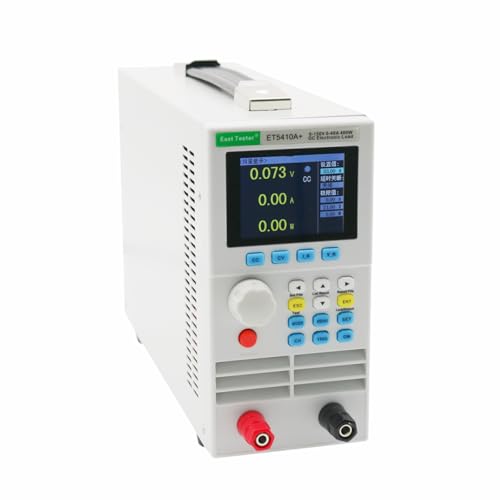
The ET5410A+ is the high-power value pick here, doubling the wattage of the two 200 W instruments while keeping the same 150 V ceiling and raising current to 40 A. Its listing highlights battery capacity and internal resistance testing alongside the standard CC, CV, CR and CP modes, which makes it a natural fit for discharge characterisation of larger packs. Resolution is quoted at 1 mV and 1 mA, and a colour screen presents the discharge data. It is sold under generic branding, so the model code is the detail to verify.
Specs
- Input range: 150 V / 40 A
- Maximum power: 400 W
- Modes: CC, CV, CR, CP
- Resolution: 1 mV / 1 mA
- Battery functions: capacity and internal resistance testing
- Interface: USB
Best for: Battery discharge and capacity runs needing 400 W of headroom
Watch out for: Check the listing shows model ET5410A+ specifically, as the same seller family lists single- and dual-channel variants under similar names
ASIN: B0C9LVZ8WK
MUXWELL DH-801

Not every bench needs hundreds of watts. The DH-801 is a compact programmable load rated at 120 W, aimed at chargers, adapters, LED drivers and small DC supplies that never approach three-figure power. Its listing states a 0 to 150 V input range with up to 20 A, a constant resistance range of 0.1 to 999.9 ohms, and the full CC, CV, CR and CP mode set, so the operating behaviour matches its bigger rivals even though the envelope is smaller. For a repair bench qualifying wall adapters, it covers the job without crowding the workspace.
Specs
- Maximum power: 120 W
- Input voltage: 0 to 150 V
- Input current: 0 to 20 A
- Constant resistance range: 0.1 to 999.9 ohms
- Modes: CC, CV, CR, CP
- Model: DH-801
Best for: Qualifying USB chargers, adapters and low-power supplies
Watch out for: The 120 W and 20 A limits rule out large battery packs, so size it against the biggest source you test
ASIN: B0F5WB851K
Which One Fits Your Situation
Characterising a New Power Supply Design
Pick the Siglent SDL1020X-E. Its CC dynamic mode at up to 25 kHz stresses a regulator with realistic current steps, the four static modes cover load regulation sweeps, and the fine readback resolution makes small output deviations visible in your logged results.
Running Battery Capacity and Discharge Tests
Choose the East Tester ET5410A+. The 400 W envelope absorbs long discharges from larger packs without thermal throttling concerns dominating the run, and its built-in capacity and internal resistance functions report the figures battery work actually needs.
Qualifying Chargers and Adapters on a Repair Bench
The MUXWELL DH-801 fits this work. Wall adapters and USB chargers sit far below its 120 W ceiling, all four operating modes are present for input testing, and its compact bench footprint leaves room for the devices under repair.
Stocking a Shared or Teaching Laboratory
Take the Rigol DL3021. A 40 A range at 200 W covers the spread of student and technician projects, USB communication supports logged coursework, and an established instrument brand simplifies spares, documentation and replacement if a channel is damaged.
Common Mistakes
- Sizing a load by wattage alone and discovering the current limit blocks a low-voltage, high-current test.
- Ignoring minimum operating behaviour, then finding the load regulates poorly at single-cell battery voltages.
- Using thin test leads at high current, so cable voltage drop corrupts both the load reading and the result.
- Skipping dynamic mode entirely when testing switching converters, missing transient faults a static draw never triggers.
- Buying a panel-only instrument for work that later needs logged data, then replacing it within a year.
Frequently Asked Questions
What size DC electronic load do I need for a bench power supply?
Multiply the highest voltage you test by the highest current you draw at that voltage; the result is your minimum wattage. A 30 V supply tested at its full 5 A needs 150 W, so a 200 W load gives working headroom. Also confirm the load’s current range covers your supply’s maximum output.
Can a benchtop DC electronic load test batteries?
Yes. Set constant current or constant power mode, define a cutoff voltage, and the load discharges the pack at a controlled rate while recording capacity. Models like the ET5410A+ add internal resistance measurement. Never discharge below the cell manufacturer’s minimum voltage, since the load will keep sinking until its cutoff is reached.
What is the difference between CC and CP mode?
In constant current mode the load holds a fixed current as voltage changes, which suits capacity testing. In constant power mode it continuously adjusts current to hold a set wattage, mimicking a downstream converter whose draw stays constant as its input voltage sags. Both are standard on every model listed here.
Do I need remote sense on an electronic load?
Remote sense compensates for voltage dropped along the test leads by measuring at the source terminals instead of the load’s front panel. At high currents even short leads drop measurable voltage, which distorts low-voltage testing most. If your work involves high current at low voltage, treat sense capability as a requirement, not a luxury.
Related guides
More from Amazon
Programs that pair well with the guide above. Offers and eligibility are set by Amazon and may change.
Free shipping on eligible items, Prime Video and more. Eligible new members can start with a free trial.
Start a Prime free trialAudiobooks and podcasts to listen to on the go. Eligible new members can start with a free trial.
Try Audible freeAd-free music streaming. Eligible new subscribers can start with a free trial.
Try Music Unlimited freeA free business account with business pricing and bulk-buying tools for work, shop or home office.
Create a business accountAs an Amazon Associate we earn from qualifying purchases.










Write Your Review
No reviews yet. Be the first to share your experience!