
Key takeaways
- Five programmable DC electronic loads for tight benches, from 150 W to 400 W, with CC, CV, CR and CP modes plus USB, RS-232 and LAN control for small labs.
What's inside
As an Amazon Associate I earn from qualifying purchases. This post may contain affiliate links at no extra cost to you.
A crowded bench changes how an electronic load earns its place. When the desk also holds a scope, a soldering station and a power supply, a load that sinks serious power still has to fit between them, breathe through its fan and leave room for test leads. Buying on wattage alone leads to a box that blocks airflow, crowds the work area and ends up parked on a shelf. The real decision weighs footprint and cooling against the voltage, current and power your circuits actually demand.
This guide serves hobbyists, repair technicians and small-team engineers who test supplies, chargers, converters and battery packs in a compact room. Every load below is a programmable DC electronic load, chosen from the model name and specifications shown on its Amazon listing, with attention to case size, interface options and the modes that matter for everyday bench work.
Quick Picks
As an Amazon Associate we earn from qualifying purchases.
| Product | Best for | Key spec from title |
|---|---|---|
| Siglent SDL1030X-E | Automated supply and battery tests from a script | 150 V, 30 A, 300 W |
| Rigol DL3021 | Stepped test profiles that run on their own | 150 V, 40 A, 200 W |
| Korad KEL103 | Networked logging of long discharge curves | 120 V, 30 A, 300 W |
| Maynuo M9712 | Charger testing in the narrowest case here | 150 V, 30 A, 300 W |
| East Tester ET5410 | Large packs and 24 V supplies needing the most watts | 150 V, 40 A, 400 W |
How to Choose
Measure the bench before the headline wattage
Width tells only part of the story in a small lab. Depth decides whether the load fits at all, because rear cables, input terminals and fan exhaust all need space behind the case, and a handle on top blocks stacking. Check side vents too, since a load pushed against a shelf wall or a second instrument can starve its own cooling. Tape out the footprint on the desk, leave a clear lane for the fan outlet, and confirm the front terminals stay reachable once a scope or supply sits beside it.
Match voltage, current and power as one number
Watts alone mislead, because a load reaches its power limit through a combination of voltage and current. A 24 V supply at 10 A already asks for 240 W, so a 200 W load runs out of headroom even though its current rating looks generous. A 5 V rail at 30 A needs only 150 W yet still demands the full current range. Work out the highest voltage times the highest current you will test, then check the minimum operating voltage as well, since every load needs some voltage across its input before it can sink its rated current.
Choose modes you will actually run
Constant current covers most regulation checks, constant voltage suits chargers and solar panels, constant resistance mimics a resistive downstream circuit, and constant power imitates a converter drawing a fixed wattage. Beyond those four, a dynamic or transient mode steps between two currents to expose regulator droop under pulsed demand, while a list mode walks through a programmed sequence without manual input. A battery discharge mode with a cut-off voltage matters if you measure cell capacity, because it stops the test before a pack drains too far.
Plan remote control and heat before you buy
USB covers scripted tests from a single bench computer, RS-232 fits older setups and simple serial logging, and LAN lets a load sit on a shared network where tests run from another machine. Confirm which interface actually ships in the box, since some makers list an interface as an option rather than standard equipment. Heat deserves the same attention: a fan that spins up under load needs clear exhaust space, and a small room warms quickly during a long discharge, so place the load where its outlet does not blow straight onto you or a neighbouring instrument.
The 5 Best Options
Siglent SDL1030X-E
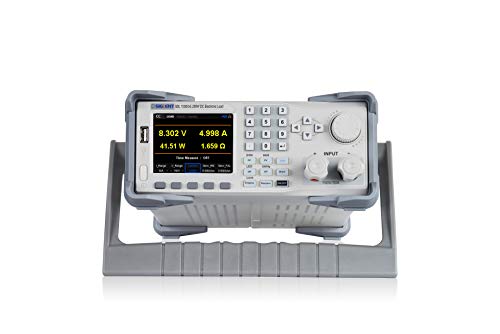
The SDL1030X-E packs 300 W into the same instrument family as its 200 W sibling, which makes it a strong fit when 12 V and 24 V supplies keep hitting the power ceiling of a smaller load. It sinks up to 150 V and 30 A across CC, CV, CR and CP modes, adds a CC dynamic mode reaching 25 kHz for pulsed-demand checks, and includes a dedicated battery discharge test. Four-wire remote sense keeps readings honest at higher currents, while built-in USB, RS-232 and LAN cover scripted tests from almost any bench computer.
Specs
- Input range: 150 V, 30 A, 300 W
- Modes: CC, CV, CR and CP, plus CC dynamic mode to 25 kHz
- Battery discharge test with cut-off voltage
- Interfaces: USB, RS-232 and LAN built in
- Display: 3.5-inch TFT-LCD with 1 mV and 1 mA setting resolution
Best for: A small lab that automates supply and battery tests from a script.
Watch out for: Confirm the listing is the SDL1030X-E 300 W version, not the 200 W SDL1020X-E, since the cases look alike.
Rigol DL3021

Rigol built the DL3021 around repeatable sequences, and that focus shows in a list function of up to 512 steps plus three dynamic modes for continuous, pulsed and toggled load changes. It handles 150 V, 40 A and 200 W in CC, CV, CR and CP modes, with built-in battery, over-current and over-power tests that let it step a supply through a whole profile unaided. Readback resolution reaches 0.1 mV and 0.1 mA, and RS-232 and USB come built in for remote control.
Specs
- Input range: 150 V, 40 A, 200 W
- Modes: CC, CV, CR and CP, plus three dynamic modes
- List function with up to 512 steps
- Built-in battery, over-current and over-power tests
- Interfaces: RS-232 and USB built in
- Size: 239 mm wide by 157 mm high by 442 mm deep; weight 7.58 kg
Best for: Stepped and repeated tests where the load runs a profile on its own.
Watch out for: Its 442 mm depth plus rear cables needs more bench depth than a shallow desk allows, so measure first.
Korad KEL103

The KEL103 stands out in this set by putting a LAN port beside USB and RS-232, which suits anyone logging long discharge curves from a script on a shared network. It sinks 120 V, 30 A and 300 W in CC, CV, CR and CW modes, with fine 0.1 mV and 0.1 mA resolution in its low ranges for careful low-voltage work. The power rating stays generous for the class, so 12 V and 24 V supplies get real headroom without moving to a much larger chassis.
Specs
- Input range: 120 V, 30 A, 300 W
- Modes: CC, CV, CR and CW
- Interfaces: USB, RS-232 and LAN
- Resolution: 0.1 mV and 0.1 mA in the low ranges
Best for: Logging long discharge curves from a computer on a shared network.
Watch out for: The 120 V ceiling rules out higher-voltage packs, so check your highest test voltage first.
Maynuo M9712

Maynuo shaped the M9712 as a narrow bench instrument, and its 214 mm width slides between a scope and a supply where wider loads will not fit. It covers 150 V, 30 A and 300 W with six modes: CC, CV, CR and CW plus the combined CC plus CV and CR plus CV modes that help with battery chargers and solar charge controllers. A dynamic mode reaches 25 kHz, a battery test measures capacity up to 999 Ah with a cut-off voltage, and remote control runs over RS-232, RS-485 and USB.
Specs
- Input range: 150 V, 30 A, 300 W
- Modes: CC, CV, CR and CW, plus combined CC plus CV and CR plus CV
- Dynamic mode to 25 kHz
- Battery test with capacity up to 999 Ah and cut-off voltage
- Interfaces: RS-232, RS-485 and USB
- Size: 214 mm wide by 108 mm high by 365 mm deep
Best for: Charger and solar-controller testing where the case must squeeze between other instruments.
Watch out for: Remote interfaces are listed as optional in some Maynuo material, so confirm USB or RS-232 is included in the Amazon listing you buy.
East Tester ET5410

The ET5410 brings the most watts in this set, sinking 150 V, 40 A and 400 W in CC, CV, CR and CP modes, which suits large battery packs and 24 V supplies that would starve a 200 W load. A colour screen keeps voltage, current and power visible at a glance, and battery capacity and internal resistance testing cover pack checks without extra instruments. Its single-channel layout stays simple to operate, so a small lab gets high-power coverage without learning a multi-channel system.
Specs
- Input range: 150 V, 40 A, 400 W
- Modes: CC, CV, CR and CP
- Battery capacity and internal resistance testing
- Colour display with 1 mV and 1 mA resolution
- Interface: USB for PC software control
Best for: Large battery packs and 24 V supplies that need the most watts here.
Watch out for: Notes from other users suggest real-world resolution can run coarser than the headline 1 mV and 1 mA figures, so verify fine low-current steps on arrival.
Which One Fits Your Situation
Your bench already holds a scope, a supply and a soldering station
Pick the Maynuo M9712 first, since its 214 mm width fits where wider instruments crowd each other out, and the combined CC plus CV mode still covers charger work. The Korad KEL103 works as the fallback when networked logging matters more than the last few millimetres of width.
You test 12 V and 24 V supplies or large battery packs
Choose the Siglent SDL1030X-E for its 300 W headroom, battery test and full set of built-in interfaces, or the East Tester ET5410 when a 400 W ceiling matters more than brand support. Both keep a 24 V, 10 A supply inside their power limits with room to spare.
You run the same test sequence again and again
Take the Rigol DL3021, whose 512-step list function and built-in battery, over-current and over-power tests run a whole profile without manual steps. The Siglent SDL1030X-E fits the same job when tests must run over LAN from another machine.
You work mostly below 60 V and want fine low-current control
Use the Korad KEL103, whose low ranges resolve down to 0.1 mV and 0.1 mA for careful low-voltage measurements. The Rigol DL3021 serves the same need with 0.1 mV and 0.1 mA readback resolution and a deeper set of automated tests.
Common Mistakes
- Buying watts without checking current at your test voltage, so a 200 W load still runs out of headroom on a 24 V supply.
- Ignoring the minimum operating voltage, then finding the load cannot sink full current from a low-voltage rail or single cell.
- Pushing the load against a wall or shelf and blocking its fan exhaust, which traps heat in a small room.
- Assuming every interface in the datasheet ships in the box, when some makers list USB or RS-232 as an optional module.
- Running a battery discharge without a cut-off voltage, which risks draining a pack past a safe level.
Frequently Asked Questions
Can a programmable DC load replace a bench power supply?
No, because the two instruments do opposite jobs. A bench supply sources power to a circuit, while an electronic load sinks power from a supply or battery so you can measure how it behaves under demand. A lab that designs or repairs supplies needs both, and the load is the tool that proves a supply holds its voltage when current rises.
How much power do I need for a small lab?
Multiply the highest voltage you will test by the highest current at that voltage. A 5 V, 3 A USB supply needs only 15 W, while a 24 V, 10 A LED supply needs 240 W and calls for a 300 W or 400 W load. Leave headroom above that figure so routine tests do not run the load at its limit.
Do I need LAN, or is USB enough?
USB is enough for scripted tests from the computer sitting on the same bench. LAN earns its place when tests run from another machine, when several people share the lab, or when long discharge curves must log unattended. If your bench is a single desk with one computer, a USB-only load keeps the setup simpler.
Is fan noise a real concern in a small room?
Yes, because a load under sustained power spins its fan up and a small room leaves nowhere for that sound to go. Check how the fan behaves during a long discharge, leave its exhaust clear, and place the load so the outlet does not face your working position. Short bench checks rarely matter, but an hour-long battery test will.
Related guides
More from Amazon
Programs that pair well with the guide above. Offers and eligibility are set by Amazon and may change.
Free shipping on eligible items, Prime Video and more. Eligible new members can start with a free trial.
Start a Prime free trialAudiobooks and podcasts to listen to on the go. Eligible new members can start with a free trial.
Try Audible freeAd-free music streaming. Eligible new subscribers can start with a free trial.
Try Music Unlimited freeA free business account with business pricing and bulk-buying tools for work, shop or home office.
Create a business accountAs an Amazon Associate we earn from qualifying purchases.










Write Your Review
No reviews yet. Be the first to share your experience!