
Key takeaways
- Step up from entry monitors: five powered nearfield studio monitors for studio upgrades, from DSP compacts to 8-inch three-way models, compared clearly.
What's inside
As an Amazon Associate I earn from qualifying purchases. This post may contain affiliate links at no extra cost to you.
Upgrading monitors is the step where a home studio stops guessing. Entry speakers often flatter bass, blur the midrange where vocals and guitars live, and change character as the volume rises, so mixes that sound finished at the desk fall apart elsewhere. The real decision is which kind of step up your room and work need: onboard DSP and room correction, a three-way design for cleaner midrange, or a larger woofer that moves low frequencies you currently cannot judge at all.
This guide is for producers, mixers, and podcast or video editors replacing a first pair of budget monitors with something they can keep for years. Every pick is a powered nearfield model chosen from the names and specifications printed on its Amazon product page, and the five options span compact DSP monitors, a three-way design, and full-size 8-inch cabinets.
Quick Picks
As an Amazon Associate we earn from qualifying purchases.
| Product | Best for | Key spec from title |
|---|---|---|
| Neumann KH 120 II DSP Powered Studio Monitor – Anthracite | Small rooms that need DSP room alignment | DSP Powered Studio Monitor |
| ADAM Audio A7V 7-inch Powered Studio Monitor | Detailed top end and networked DSP tuning | 7-inch Powered Studio Monitor |
| Kali Audio IN-8 V2 8-inch Powered Studio Monitor – Black | Three-way clarity without a subwoofer | 8-inch Powered 3-way Studio Monitor, 140W |
| YAMAHA HS8 Studio Monitor, Black, 8 Inch | A proven full-range reference at the desk | 8 Inch Studio Monitor |
| ADAM Audio T8V Studio Monitor (Single) | Big low end on a tighter upgrade budget | Studio Monitor for Recording, Mixing and Mastering |
How to Choose
Decide What Your Current Monitors Get Wrong
An upgrade only makes sense when it fixes a specific weakness. If bass decisions keep missing, a larger woofer or a model with deeper extension addresses the problem directly. If vocals and snare sit in a fog, a three-way design or a better tweeter helps more than raw power. If the same mix sounds different every time you move your chair, dispersion and room tuning matter most. Write down the one or two faults you hear most often, then match the new monitor to those faults instead of buying the most expensive cabinet in reach.
Match Woofer Size to Room and Listening Distance
Nearfield listening usually happens roughly an arm’s length to about two metres from the speakers, and woofer size should follow that distance and the room. Compact 5-inch class monitors such as the KH 120 II suit small desks and treated corners, where a big woofer would excite more room problems than it solves. Seven and 8-inch models deliver the low-frequency weight that electronic, hip-hop, and film work demands, but they need stands or a deep desk and some space behind them. Measure your desk depth and wall distance before choosing, not after delivery.
Weigh DSP and Room Correction Carefully
Several step-up monitors now carry onboard DSP: the KH 120 II and the A7V both offer digital room adjustment, while the Kali IN-8 V2 uses boundary EQ settings chosen for placement against walls or on a desk. DSP cannot fix a bad room, but it can tame the worst peaks caused by nearby surfaces and make a small space workable. Analog models such as the HS8 and T8V rely on simpler rear-panel switches instead. Decide whether you will actually run a calibration routine; if not, straightforward switches may serve you just as well.
Check Inputs, Controls, and How They Are Sold
Most monitors in this class are sold as a single speaker, so a stereo pair means ordering two, and the listings here are no exception. Confirm that your interface outputs match the monitor inputs: XLR and TRS are the balanced studio standards, while RCA suits consumer sources. Note where the volume and EQ controls sit, because rear-panel adjustments are awkward once speakers are pushed against a wall. Also check whether standby behaviour, input sensitivity switching, and mounting points matter for your setup before the boxes arrive and the returns window starts shrinking.
The 5 Best Options
Neumann KH 120 II DSP Powered Studio Monitor – Anthracite

The KH 120 II is the upgrade for a small room that has outgrown guesswork. Its onboard DSP is built for automatic room alignment, which suits producers whose desk sits in a corner or against a wall and who cannot rebuild the space around the speakers. The compact 5.25-inch format keeps the footprint desk-friendly while the design targets flat, reference-style reproduction rather than excitement. For editors and mixers working close in untreated or lightly treated rooms, it is the most deliberate step up in this group.
Specs
- Brand: Neumann
- Model Name: KH 120 II
- Model Number: KH 120 II US
- Speaker Maximum Output Power: 120 watts
- Woofer Diameter: 5.25 inches
- Tweeter Diameter: 1 inch
- Color: Anthracite
Best for: Small or awkward rooms where DSP room alignment matters more than woofer size.
Watch out for: It is sold as a single monitor, and the deepest bass work may still call for a subwoofer later.
ASIN: B0C2S9DZCK
ADAM Audio A7V 7-inch Powered Studio Monitor

The A7V suits upgraders who find their current top end vague and want a monitor that reveals reverb tails, vocal edges, and cymbal detail without turning harsh. Its rotatable X-ART tweeter can be turned for vertical or horizontal placement, which helps on desks where speakers must lie sideways under a screen. The 7-inch woofer gives more low-frequency authority than compact 5-inch models, and onboard DSP tuning with network control lets the sound be adjusted from the listening position rather than by reaching behind the cabinet.
Specs
- Brand: ADAM Audio
- Model: A7V
- Woofer: 7-inch Multi-Layer Mineral
- Tweeter: Rotatable X-ART with HPS waveguide
- Total Peak Amp Power: 130 W
- Frequency Response at -6 dB: 40 Hz – 45 kHz
- Max Peak SPL per Speaker at 1 m: 105 dB SPL
- Analog Inputs: XLR, RCA
Best for: Mixers who want detailed high frequencies plus DSP tuning in a mid-size cabinet.
Watch out for: Horizontal placement needs the tweeter rotated as directed, and DSP setup uses a network connection.
ASIN: B09XD6RKGS
Kali Audio IN-8 V2 8-inch Powered Studio Monitor – Black

The IN-8 V2 is the three-way option here, and that matters for upgraders whose mixes crowd the midrange. A coaxial midrange and tweeter arrangement aims to keep imaging stable as you move across the desk, while the 8-inch woofer covers low frequencies that smaller monitors only suggest. Boundary compensation EQ settings help when the speakers must sit on a desk or near a wall. For producers moving up from a basic two-way pair and wanting one purchase that covers bass, midrange clarity, and imaging together, this is the broadest single step.
Specs
- Brand: Kali Audio
- Model: IN-8 V2
- Configuration: Powered 3-way studio monitor
- Woofer: 8-inch
- Total Power: 140W speaker system
- EQ: Boundary Compensation EQ settings
- Inputs: XLR, TRS, RCA
- Sold as: Single, Black
Best for: Producers who want three-way midrange clarity and full low end in one cabinet.
Watch out for: The 8-inch cabinet is deep, so measure desk space and rear clearance before ordering.
ASIN: B0993GXV54
YAMAHA HS8 Studio Monitor, Black, 8 Inch
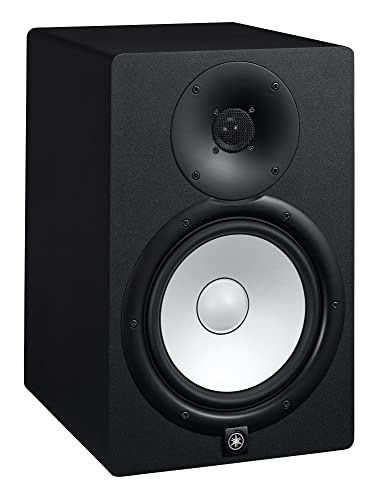
The HS8 is the straightforward reference upgrade: an 8-inch powered monitor from a line long used as a reality check in home and project studios. It suits owners of small entry monitors who mainly need to hear the full picture, from kick and bass decisions up through vocal presence, on a speaker known for a plain-spoken midrange. There is no DSP ecosystem to learn, which some upgraders will count as a virtue. As the second set of ears or the new main pair in a mid-size room, it remains a dependable benchmark.
Specs
- Brand: Yamaha
- Model Name: HS8
- Model Number: HS8
- Size: 8 Inch
- Color: Black
- Type: Powered studio monitor
Best for: A no-nonsense full-range reference for mid-size rooms and desks with stands.
Watch out for: An 8-inch monitor overwhelms very small untreated rooms, so placement space matters.
ASIN: B00DCYMVB2
ADAM Audio T8V Studio Monitor (Single)

The T8V is the value step up for producers whose entry monitors simply cannot reproduce the low end of their music. Its 8-inch woofer reaches into the region where kick, bass, and synth decisions are made, and the U-ART ribbon tweeter keeps the top end open at listening levels typical of a home studio. Rear-firing bass reflex design means it prefers some distance from the wall behind it. For electronic and beat-driven work on a controlled budget, it delivers the size upgrade first and leaves room correction to placement and simple rear-panel switches.
Specs
- Brand: ADAM Audio
- Model Name: AMS-T8V
- Woofer: 8-inch, with 70 W Class D amplifier
- Tweeter: U-ART, with 20 W Class D amplifier
- Speaker Maximum Output Power: 70 Watts
- Max SPL: Up to 118 dB per pair
- Crossover: DSP-managed
- Type: Two-way nearfield studio monitor, single
Best for: Bass-focused producers who want an 8-inch upgrade without paying for DSP features.
Watch out for: The rear port needs breathing room from walls, and each box is a single monitor.
ASIN: B087NC73NZ
Which One Fits Your Situation
Your Desk Sits in a Small, Untreated Room
Choose the Neumann KH 120 II. Its compact cabinet fits where 8-inch monitors cannot, and the DSP room alignment directly addresses the wall and corner problems that dominate small spaces. The A7V is the alternative if your desk is slightly larger and you also want the rotatable tweeter for flexible placement under a wide screen.
Your Mixes Sound Muddy in the Midrange
Choose the Kali Audio IN-8 V2. A dedicated midrange driver in a three-way layout is the most direct hardware answer to crowded vocals, guitars, and synths, and the coaxial design keeps that clarity stable as you shift position. Its boundary EQ also helps if the speakers must live on the desk itself.
You Mix Bass-Heavy Music and Need to Hear the Low End
Choose the ADAM Audio T8V if budget leads the decision, or the Kali IN-8 V2 if you can stretch further. Both use 8-inch woofers that reach the frequencies smaller monitors miss. The T8V concentrates spending on size and output, while the Kali adds a three-way layout and boundary EQ for tighter placement options.
You Want a Reference Pair You Can Cross-Check Anywhere
Choose the Yamaha HS8. Its long-running HS design is a familiar reference point, so decisions made on it translate in a way many collaborators will recognise. Pair it with sensible placement on stands, and it serves as the honest main monitor against which headphone checks and smaller speakers can be judged.
Common Mistakes
- Buying a bigger woofer for a tiny untreated room, then fighting the boom the extra bass creates.
- Ordering one monitor and assuming the listing price covers a stereo pair.
- Placing rear-ported monitors flush against a wall and blaming the speakers for the resulting muddiness.
- Skipping the calibration or EQ setup that justified choosing a DSP model in the first place.
- Judging an upgrade in the first hour, before learning how familiar tracks translate on the new pair.
Frequently Asked Questions
Are studio monitors sold as pairs or singles?
Most models in this class, including every pick in this guide, are sold as a single speaker. A stereo setup therefore needs two units, ordered separately. Check the listing title and quantity carefully before checkout, because product photos often show two monitors even when the price covers only one cabinet.
Is a bigger woofer always the better upgrade?
No. An 8-inch woofer helps only when the room and listening distance can support it. In a small untreated space, the extra low end often excites wall and corner problems that make decisions harder. A compact DSP monitor such as the KH 120 II can be the smarter upgrade there.
Do I still need room treatment with DSP monitors?
Yes, at least basic treatment. DSP and boundary EQ can reduce the worst peaks caused by nearby walls and desks, but they cannot remove reflections or fix a poor listening position. Sensible placement, stands or isolation, and a few absorptive panels still do work that no onboard processing fully replaces.
How long should an upgrade monitor last in a studio?
A step-up powered monitor is normally a long-term purchase that should serve through several interface and computer changes. Choosing balanced inputs, a size matched to your room, and features you will actually use matters more than chasing the newest model, because familiarity with one honest pair improves decisions over time.
Related guides
More from Amazon
Programs that pair well with the guide above. Offers and eligibility are set by Amazon and may change.
Free shipping on eligible items, Prime Video and more. Eligible new members can start with a free trial.
Start a Prime free trialAudiobooks and podcasts to listen to on the go. Eligible new members can start with a free trial.
Try Audible freeAd-free music streaming. Eligible new subscribers can start with a free trial.
Try Music Unlimited freeA free business account with business pricing and bulk-buying tools for work, shop or home office.
Create a business accountAs an Amazon Associate we earn from qualifying purchases.










Write Your Review
No reviews yet. Be the first to share your experience!