
Key takeaways
- Compare the best 10-inch powered subwoofers for dedicated media rooms, with driver, amplifier, extension and placement checks for film bass.
What's inside
As an Amazon Associate I earn from qualifying purchases. This post may contain affiliate links at no extra cost to you.
A dedicated media room asks more of a subwoofer than a living room does. The door closes, the lights go down, and film soundtracks expect real weight in explosions, scores, and dialogue scenes alike. The real decision is whether a 10-inch powered model can pressurize your specific room, reach low enough for cinema effects, and still blend cleanly with your main speakers at your chosen crossover.
This guide serves media room owners upgrading a first system, builders finishing a small theater with limited floor space, and listeners planning a matched pair. Every product below was chosen from the names and specifications printed on its Amazon product page, and each one uses a 10-inch driver confirmed on that page, regardless of cabinet style or brand family.
Quick Picks
As an Amazon Associate we earn from qualifying purchases.
| Product | Best for | Key spec from title |
|---|---|---|
| Klipsch Reference R-101SW | Strongest single-sub impact | 10-inch spun-copper woofer, all-digital amplifier |
| Polk Monitor XT10 | Deep extension in a compact cabinet | 10-inch deep bass woofer, 100W Class D amplification |
| Klipsch R-100SW | Proven design with simple controls | 10-inch subwoofer with all-digital amplifier |
| Yamaha Audio NS-SW100BL | Clean, controlled bass on modest power | 10-inch, 100W powered subwoofer |
| Polk Audio PSW10 | Flexible connections for older receivers | 10-inch powered subwoofer, up to 100 watts |
How to Choose
Room Volume and Seating Distance
Start with the room itself, because a dedicated media room is a closed space with known dimensions. Multiply length, width, and ceiling height, then think about how far the main seats sit from the subwoofer position. A compact room with seating eight feet away asks far less of a 10-inch driver than a long room with two rows. Buyers with larger volumes should plan placement near a corner for boundary reinforcement, or budget for a second matching subwoofer later, rather than expecting one small cabinet to fill every seat evenly on its own.
Low-Frequency Extension for Film
Cinema bass lives below the range most main speakers reach, so compare the lowest frequency each model claims on its product page. A subwoofer rated into the high twenties can reproduce the rumble in action scenes and the lowest notes of a film score, while one that rolls off earlier will sound thinner on the same material. Extension figures are measured differently between brands, so treat them as a guide rather than an absolute ranking. Still, in a media room built for movies, extension deserves priority over almost every other specification on the page.
Amplifier Power and Headroom
The built-in amplifier decides how confidently the driver handles loud passages without strain. Compare continuous and peak figures carefully, because brands present them differently and a large peak number alone says little. In a dedicated room where films are played at consistent, sometimes generous levels, headroom matters during sudden effects: a cannon shot or a collapsing building should arrive as one clean event, not a compressed thud. Match the amplifier to your listening habits, and remember that placement and calibration change perceived output as much as the wattage printed in the listing.
Crossover, Phase, and Connection Options
Integration controls decide whether the subwoofer disappears into the system or draws attention to itself. Look for a variable low-pass crossover so you can blend the subwoofer with your main speakers, a phase control to align timing at the seats, and the inputs your receiver actually offers. Most media rooms use a single LFE cable from an AV receiver, but speaker-level inputs help with older amplifiers. Confirm the connection panel on the product page before ordering, because returning a heavy cabinet over one missing input is an avoidable frustration.
The 5 Best Options
Klipsch Reference R-101SW

The R-101SW is the natural lead pick for a media room that wants one 10-inch subwoofer to carry film nights without a second cabinet. Its front-firing spun-copper woofer and all-digital amplifier suit action soundtracks played at confident levels, and the ported cabinet favors output in a closed room. Buyers building around Klipsch main speakers get a visual and tonal family match, while owners of other brands still gain a subwoofer with generous peak power and straightforward rear-panel controls for crossover, gain, and phase adjustment during setup.
Specs
- Brand: Klipsch
- Model Name: R-101SW
- Speaker Type: Subwoofer
- Subwoofer Diameter: 10 Inches
- Woofer: Front-firing spun-copper
- Speaker Maximum Output Power: 300 Watts
- Connectivity Technology: Wired
Best for: Single-sub media rooms wanting the strongest impact from this group.
Watch out for: Measure the cabinet depth against your planned position, since front-firing placement still needs clearance behind for cables and the rear port.
Polk Monitor XT10

The Monitor XT10 suits media rooms where floor space is tight but low extension still matters. Its down-firing long-throw woofer is rated to reach deep into film bass territory, and the Class D amplifier keeps the cabinet compact enough to tuck beside a screen wall or under a side table. It pairs logically with Polk Monitor XT main speakers, yet its standard line-level connection works with any AV receiver. For a small dedicated room with one row of seating, this is a balanced way to gain genuine low-frequency support without oversizing the cabinet.
Specs
- Brand: Polk Audio
- Model Name: MXT10
- Speaker Type: Subwoofer
- Subwoofer Diameter: 10 Inches
- Speaker Size: 10 Inches
- Speaker Maximum Output Power: 100 Watts
- Connectivity Technology: Wired
Best for: Compact media rooms that still want deep bass extension.
Watch out for: The woofer fires downward, so check clearance on thick carpet and confirm the floor surface suits a down-firing design.
Klipsch R-100SW

The R-100SW is an earlier Klipsch design that remains easy to recommend for media rooms built around simplicity. The front-firing copper-spun woofer, all-digital amplifier, and a frequency range reaching the low thirties cover the core demands of film soundtracks, while the rear controls cover gain, low-pass, and phase without menus or apps. It fits owners who want to set levels once, run their receiver calibration, and stop thinking about the subwoofer. Its cabinet dimensions are printed in the product title itself, which makes checking a planned corner or alcove position unusually straightforward before ordering.
Specs
- Brand: Klipsch
- Model Name: R-100SW
- Speaker Type: Subwoofer
- Subwoofer Diameter: 10 Inches
- Speaker Maximum Output Power: 300 Watts
- Frequency Response: 32 Hz to 120 Hz
- Connectivity Technology: Wired
Best for: Buyers wanting a proven Klipsch design with simple, set-once controls.
Watch out for: Confirm the exact cabinet dimensions in the listing against your alcove or corner, including room for rear cable bends.
Yamaha Audio NS-SW100BL

The NS-SW100BL takes a different route to media room bass, using Yamaha’s Twisted Flare Port and Advanced YST II technology to keep low frequencies clean rather than simply loud. Its rated response reaches low for a cabinet of this size, and the modest amplifier suits smaller dedicated rooms where seats sit close and reference volume is not the goal. It is a sensible match for Yamaha receivers and for viewers who watch a mix of films, concerts, and streamed drama where dialogue clarity matters and bass should support scenes without dominating every quiet passage.
Specs
- Brand: Yamaha Audio
- Model Name: NS-SW100BL
- Speaker Type: Subwoofer
- Subwoofer Diameter: 10 Inches
- Speaker Maximum Output Power: 100 Watts
- Frequency Response: 25 Hz to 180 Hz
- Special Feature: Twisted Flare Port
Best for: Smaller media rooms favoring clean, controlled bass over maximum output.
Watch out for: Output power is modest, so in a long room with two seating rows, plan placement carefully or consider a pair.
Polk Audio PSW10
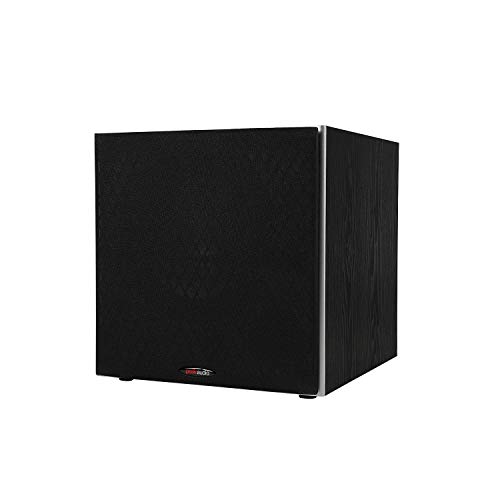
The PSW10 is the long-running, connection-friendly option in this group, and that flexibility is exactly why it still earns a place in media rooms built from mixed or older equipment. Alongside line-level inputs it offers speaker-level connections, which helps when a receiver lacks a dedicated subwoofer output. The Power Port design and continuously variable low-pass filter make blending with smaller main speakers manageable, and the compact cabinet suits rooms where the subwoofer must share space with storage or an equipment rack. It will not match the newest models for output, but it integrates almost anywhere.
Specs
- Brand: Polk Audio
- Model Name: PSW10
- Speaker Type: Subwoofer
- Subwoofer Diameter: 10 Inches
- Woofer Diameter: 10 Inches
- Speaker Maximum Output Power: 100 Watts
- Item Weight: 26 pounds
Best for: Media rooms using older receivers that need speaker-level connections.
Watch out for: Check which inputs your receiver provides and set the variable low-pass filter carefully, since this model relies on manual blending.
Which One Fits Your Situation
One Row of Seats in a Small Room
A single row close to the screen is the easiest case for a 10-inch subwoofer. The Polk Monitor XT10 fits well here, because its down-firing design and deep rated extension serve nearby seats from a compact footprint. The Yamaha NS-SW100BL is the alternative when you prefer cleaner, quieter bass for drama and concert films over maximum impact during action scenes.
Two Rows and a Larger Volume
More air and a second row expose the limits of any single small subwoofer, so start with the strongest option. The Klipsch Reference R-101SW offers the most confident output in this group for effects-heavy films. Place it near a front corner for reinforcement, calibrate from the main seat, and check the second row afterward; if levels differ sharply between rows, plan for a matching second subwoofer later.
A Room Built Around an Older Receiver
Older amplifiers sometimes lack a dedicated subwoofer output, which changes the shortlist completely. The Polk Audio PSW10 solves that problem with speaker-level connections alongside its line-level inputs, so it can join a system that newer models cannot serve as easily. Its variable low-pass filter lets you blend it manually with main speakers that were never designed around a modern receiver’s bass management menu.
Mixed Films, Concerts, and Streaming
Not every media room is an action cinema. If the schedule mixes films with concert recordings, sports, and streamed series, the Yamaha NS-SW100BL keeps bass tidy across varied material, while the Klipsch R-100SW adds more weight when a blockbuster arrives. Choose by the loudest, lowest content you play regularly, not by the quietest, and set gain for the main seats first.
Common Mistakes
- Buying by peak wattage alone instead of comparing driver size, extension, and room volume together.
- Placing the subwoofer wherever furniture allows, then raising the gain to compensate for a weak position.
- Setting the crossover on both the receiver and the subwoofer at once, which double-filters the signal and thins the bass.
- Judging performance on the first film before running receiver calibration and checking phase at the main seat.
- Assuming one 10-inch subwoofer will serve two seating rows evenly without checking levels in each row.
Frequently Asked Questions
Can one 10-inch subwoofer fill a dedicated media room?
It depends on the room’s volume and your listening level. In a small, closed room with one row of seating, a single 10-inch powered subwoofer placed near a corner can deliver satisfying film bass. Larger rooms or two rows usually benefit from the strongest model available or a matched pair, which evens response across more seats.
Is a ported or sealed cabinet better for movies?
Ported cabinets generally produce more output near their tuning point, which suits the impact of film effects, while sealed designs favor compact size and gradual roll-off. Every model in this guide was verified as a 10-inch powered subwoofer on its product page; choose the cabinet style that matches your space, placement options, and preference for impact versus tidiness.
Where should the subwoofer go in a media room?
Start near a front corner beside the screen wall, which usually reinforces output, then compare a position along the front wall. Move the subwoofer in small steps, play a familiar bass-heavy scene, and judge from the main seat rather than beside the cabinet. Keep rear ports clear of the wall by the clearance the product page implies for cable access.
Should I set the crossover on the receiver or the subwoofer?
Use one bass management system, not both. When an AV receiver provides a subwoofer output and crossover settings, set them there and turn the subwoofer’s own low-pass control to its highest setting or bypass position if one is offered. With older equipment connected at speaker level, the subwoofer’s variable filter does the blending instead, adjusted by ear at the seats.
Related guides
More from Amazon
Programs that pair well with the guide above. Offers and eligibility are set by Amazon and may change.
Free shipping on eligible items, Prime Video and more. Eligible new members can start with a free trial.
Start a Prime free trialAudiobooks and podcasts to listen to on the go. Eligible new members can start with a free trial.
Try Audible freeAd-free music streaming. Eligible new subscribers can start with a free trial.
Try Music Unlimited freeA free business account with business pricing and bulk-buying tools for work, shop or home office.
Create a business accountAs an Amazon Associate we earn from qualifying purchases.










Write Your Review
No reviews yet. Be the first to share your experience!