
Key takeaways
- Compare four combat watches for field use: a solar GPS Garmin with tactical tools, a triple-sensor G-Shock, a tritium Luminox and an ABC Suunto Core.
What's inside
As an Amazon Associate I earn from qualifying purchases. This post may contain affiliate links at no extra cost to you.
A combat watch is not a styling exercise. It has to keep working after knocks, mud, rain and full immersion, and after weeks away from a charger, all while staying readable in darkness and quiet in profile under a sleeve. The real decision is which toolset and power system you trust: full GPS with tactical software, sensor-only navigation that never needs pairing, or a plain analog dial with constant glow and no menus. Each path gives something up, and the right pick depends on how the watch will be worn outdoors.
This guide is for service members, field crews, hunters, range staff and outdoor users who need subdued, hard-wearing watches rather than polished dress pieces. The four models were chosen from their Amazon listing names and specification blocks: every one is a combat or tactical design with a rugged sealed build, strong water resistance, and tools meant for land navigation, weather awareness or night work, in finishes that stay low-key on the wrist.
Quick Picks
As an Amazon Associate we earn from qualifying purchases.
| Product | Best for | Key spec from title |
|---|---|---|
| Garmin Instinct 2X Solar – Tactical Edition | GPS navigation and tactical software | Built-in flashlight and ballistics calculator |
| Casio G-Shock Rangeman GW-9400-1CR | Sensor navigation with solar power | Triple Sensor solar build |
| Luminox Navy SEAL 3001 | Analog time with constant night glow | Tritium illumination, Swiss quartz |
| Suunto Core All Black | Weather tracking on a simple cell | Altimeter, barometer and compass |
How to Choose
Build and sealing come first
Combat use punishes weak cases. Look for a shock-resistant construction, a case in fiber-reinforced polymer, resin or carbon composite, and buttons that are guarded or gasket-sealed so grit and mud stay out of the mechanism. Water resistance of 100 meters is a sensible floor for a watch that will be worn in rain, rivers and washdowns, and 200 meters adds margin for swimming and shallow diving. A raised bezel that shields the crystal, a strap that will not tear at the spring bars, and a matte finish that does not flash in sunlight all matter more here than polished detailing.
Pick the navigation toolset you will use
Three levels cover nearly every buyer. A GPS watch records tracks, stores waypoints and can guide you back to a marked point, which suits patrols, hunting and search work. A sensor watch without GPS gives compass bearings, altitude and pressure trends, enough for map-and-compass navigation with no signal and no pairing. A plain analog watch gives time, date and a rotating bezel only, but it never shows a low-battery warning at the wrong moment. Be honest about which level your routine needs, because each step up adds case size, cost in battery life, and menu time.
Match the power system to your time away from base
Rechargeable GPS watches offer the most tools but demand a cable every few weeks, or sooner with heavy satellite use. Solar models from Garmin and Casio stretch that interval greatly in daylight, and the Casio in this guide can run for months on stored light. A replaceable coin cell is the simplest system of all: the Suunto below runs on a CR2032 you can swap in the field with a coin, and the Luminox quartz cell lasts for years. If your work keeps you away from outlets, rank power independence above extra software features.
Night readability and wrist profile
Reading the time at 3 a.m. without giving yourself away is a core combat-watch job. Tritium tubes glow constantly for years with no button press and no charging, which is why the Luminox pattern endures. Backlights and LED torches are brighter but need a press and can spill light. A transflective smartwatch display sits between the two, readable by day and lit on demand. Also weigh the case: 43 mm analog cases slip under cuffs and gloves easily, while 50 mm and larger sensor cases carry more tools but snag on kit, so match diameter to your wrist and sleeves.
The 4 Best Options
Garmin Instinct 2X Solar – Tactical Edition (Coyote Tan)

Choose this one when the watch has to do navigation work, not merely survive it. The Tactical Edition layers waypoint projection, a dual-position coordinate format, stealth mode and night-vision compatibility over multi-band satellite positioning, and a built-in LED flashlight with strobe modes handles map checks and movement after dark. Solar charging through the lens can keep it running indefinitely in smartwatch mode given regular daylight, so long exercises away from a cable are realistic. The 50 mm polymer case is built to a U.S. military standard for thermal, shock and water resistance, and the subdued coyote finish suits uniforms and field clothing.
Specs
- Model: 010-02805-12
- Case: 50 mm fiber-reinforced polymer, 67 g
- Display: 1.1 inch monochrome memory-in-pixel, 240 x 240
- Water resistance: 10 ATM (100 meters)
- Build standard: U.S. military standard MIL-STD-810 for thermal, shock and water resistance
- Power: solar charging lens; unlimited smartwatch-mode life with 3 hours of 50,000 lux light per day
- Tactical tools: LED flashlight with strobe, applied ballistics calculator, stealth mode, night-vision compatibility, waypoint projection, dual-position GPS format
- Satellite systems: GPS, GLONASS and Galileo
- Band: 26 mm silicone
Best for: Users who navigate by GPS and want tactical software and a wrist light in one unit.
Watch out for: The 50 mm case wears large on slim wrists, and the monochrome screen looks plain next to color smartwatch displays.
ASIN: B0BW2VKGXX
Casio G-Shock Rangeman GW-9400-1CR
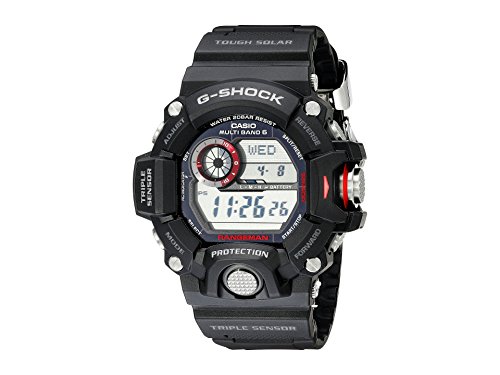
The Rangeman is the pick for sensor navigation with almost no upkeep. Its Triple Sensor supplies a digital compass, an altimeter with memory for 40 records, a barometer with a pressure tendency graph, and a thermometer, all behind sealed, guarded buttons that keep mud away from the shafts. Tough Solar charging and Multi Band 6 radio timekeeping mean it sets itself and rarely needs attention, and the shock-resistant case shrugs off drops that would end a lesser watch. There is no GPS and nothing to pair with a phone, which many field users count as a strength rather than a gap.
Specs
- Model: GW-9400-1CR
- Case size: 55.2 x 53.5 x 18.2 mm; 93 g
- Power: Tough Solar rechargeable cell
- Timekeeping: Multi Band 6 radio-controlled atomic time
- Construction: shock resistant and mud resistant, sealed case and buttons
- Water resistance: 200 meters
- Low-temperature resistance: down to -10 degrees C (14 degrees F)
- Altimeter: -700 to 10,000 meters, manual memory for up to 40 records
- Barometer: 260 to 1,100 hPa with atmospheric pressure tendency graph
- Compass and thermometer: digital compass; thermometer range 14 to 140 degrees F
- Extras: sunrise and sunset data, world time in 31 zones, five daily alarms, 1/100-second stopwatch
Best for: Field users who want compass, altitude and pressure data with nothing to pair, plug in or update.
Watch out for: With no GPS it cannot record a track or guide you back to a stored waypoint.
ASIN: B00GFYYKLA
Luminox Navy SEAL 3001

This is the analog answer: a Swiss quartz watch developed in the pattern Luminox built with U.S. Navy SEAL input, where the headline feature is light that never switches off. Tritium gas tubes on the hands and hour markers glow continuously for more than 25 years, so the dial reads the same at midnight as at noon with no button press and no charge. The 43 mm case keeps the profile trim under cuffs, the unidirectional bezel times elapsed minutes, and 200 meters of water resistance covers swimming and recreational diving. There are no sensors and no alarms beyond a date window, and that simplicity is the point.
Specs
- Model: XS.3001
- Movement: Swiss quartz, analog display, battery powered
- Case: 43 mm diameter, polyurethane case
- Crystal: mineral
- Water resistance: 200 meters (660 feet)
- Bezel: unidirectional rotating
- Illumination: self-powered tritium tubes on hands and markers, continuous glow for more than 25 years
- Functions: hours, minutes, seconds, date at 3 o’clock, GMT scale on the inner ring
- Band: polyurethane strap, 22 mm band width
Best for: Anyone who wants time and date at a glance in full darkness, with zero menus and zero charging.
Watch out for: No compass, sensors or alarms, and the mineral crystal gives up some scratch resistance compared with sapphire.
ASIN: B000F1OGWW
Suunto Core All Black

The Core is a wrist-top weather station in an all-black shell, built around the classic ABC trio of altimeter, barometer and compass. Its storm alarm and weather trend indicator warn when pressure drops fast, an automatic Alti/Baro mode switches between altitude and pressure profiles as you move or rest, and sunrise and sunset times for more than 400 locations help plan movement around daylight. Power comes from a user-replaceable CR2032 cell, so a spare in a pocket keeps it running for years with no cable. At about 64 grams it also wears lighter than the big sensor cases in this guide.
Specs
- Model: SS014279010
- Sensors: altimeter, barometer, compass and thermometer
- Weather tools: storm alarm, weather trend indicator, automatic Alti/Baro switching
- Sun data: sunrise and sunset times for more than 400 locations
- Depth meter: readings to 30 feet
- Functions: dual time, date, alarm, stopwatch, countdown timer
- Battery: user-replaceable CR2032 cell
- Weight: 2.26 ounces (about 64 g)
- Finish: all black case and band
Best for: Hikers and field workers who read weather and altitude daily and prefer a cell they can swap anywhere.
Watch out for: No GPS for position fixes, and the cell needs changing rather than topping up from light.
ASIN: B001DCEKXM
Which One Fits Your Situation
Multi-day patrols and field exercises
Take the Garmin Instinct 2X Solar Tactical Edition. Waypoint projection, dual-position coordinates and stealth mode are built for this work, the flashlight earns its place on night moves, and solar charging stretches battery life across long exercises. It is the only pick here that can record where you have been and guide you back along the same ground.
Mud, vehicles and heavy manual work
Take the Casio G-Shock Rangeman. Sealed buttons with guard cylinders keep grit out when you are working in dirt, under vehicles or in rubble, and the shock-resistant case tolerates knocks against steel and concrete. Solar power and radio timekeeping mean it asks for nothing between shifts, and its compass and altimeter still cover basic land navigation.
Night shifts and low-light duties
Take the Luminox Navy SEAL 3001. Tritium tubes glow all night without a press, so checks stay discreet and instant, and the 43 mm case stays out of the way under cuffs and gloves. With no menus, no pairing and a quartz cell that runs for years, it suits medics, guards and anyone whose work happens while others sleep.
Mountain travel where weather calls the route
Take the Suunto Core All Black. The storm alarm, pressure trend graph and altimeter log give early warning when conditions turn, and sunrise and sunset data for hundreds of locations helps time a summit push or a descent. A spare CR2032 weighs almost nothing, so power planning on a long trek stays simple.
Common Mistakes
- Buying a fashion watch with a military look but no sealed case, weak water resistance and a plated finish that flakes under real field use.
- Choosing full GPS when a compass and altimeter already cover the need, then fighting short battery life far from a charger.
- Ignoring case size: 50 mm and larger sensor cases snag on cuffs, gloves, straps and vehicle interiors, so measure your wrist before ordering.
- Trusting ordinary glow paint for night work; most lume fades within hours, while tritium or a proper backlight keeps the dial readable all night.
- Skipping sensor setup: a compass that is never calibrated and an altimeter with no reference altitude will quietly feed you wrong numbers.
Frequently Asked Questions
Does a combat watch need GPS?
Not always. GPS earns its size and battery cost when you record tracks, mark waypoints or navigate to stored coordinates, as the Garmin here does. For map-based movement, a compass, altimeter and barometer cover the core jobs with far longer power reserves. Many experienced users carry sensor watches for exactly that reason.
How much water resistance is enough for field use?
A watch rated to 100 meters handles rain, river crossings, washdowns and swimming with margin, and it is the floor worth accepting for a combat watch. A 200 meter figure, like the Casio and Luminox in this guide carry, adds safety for shallow diving and repeated immersion. Those figures assume seals are intact, so have gaskets checked after any battery change.
Solar power or a replaceable cell: which suits long deployments?
Both beat a cable-dependent battery. Solar watches from Garmin and Casio run for months when they see regular daylight, and the Casio also syncs its time by radio. A replaceable CR2032, as in the Suunto, trades that automation for total independence: one spare cell, changed with a coin, restores full power anywhere on earth.
Will these watches work with gloves and uniforms?
Mostly yes. The Garmin and Casio use large pushers that respond through light gloves, and their matte finishes sit quietly with uniforms. The Luminox at 43 mm is the easiest under tight cuffs, while the 50 mm and 55 mm cases wear tall and can catch on sleeves, so slimmer wrists and formal uniforms favor the smaller analog pick.
Related guides
More from Amazon
Programs that pair well with the guide above. Offers and eligibility are set by Amazon and may change.
Free shipping on eligible items, Prime Video and more. Eligible new members can start with a free trial.
Start a Prime free trialAudiobooks and podcasts to listen to on the go. Eligible new members can start with a free trial.
Try Audible freeAd-free music streaming. Eligible new subscribers can start with a free trial.
Try Music Unlimited freeA free business account with business pricing and bulk-buying tools for work, shop or home office.
Create a business accountAs an Amazon Associate we earn from qualifying purchases.










Write Your Review
No reviews yet. Be the first to share your experience!