
Key takeaways
- Find professional best paint brushes for acrylic paint for canvas: Escoda signature rounds, a Clasico filbert, a Heritage liner and a University brush.
What's inside
As an Amazon Associate I earn from qualifying purchases. This post may contain affiliate links at no extra cost to you.
On canvas, the gap between a hobby set and a professional line shows up within a single session. A pro head holds its edge while you turn a corner, springs back after every loaded stroke, and keeps that behaviour after months of daily washing. A lesser brush frays at the tip, sheds into wet paint, or loses its ferrule grip just as a large piece reaches the passages that matter. The real decision is which named series matches your paint body, your scale, and the way you work at the easel.
This guide serves four kinds of canvas painter: the realist who builds a picture from small, controlled rounds; the painter who pushes full-bodied paint with firm hog heads; the detail hand who finishes edges and fine lines; and the painter who lays broad, even passages across a big ground. Each pick below is a named professional series, chosen from the names, fibres, shapes and sizes printed on its Amazon product page.
Quick Picks
As an Amazon Associate we earn from qualifying purchases
| Product | Best for | Key spec from title |
|---|---|---|
| Escoda Signature Artist Set, Guillermo Munoz Vera Set #1 | Realist detail and fine rendering on canvas | 3 round pointed brushes, sizes 1, 2 and 4 |
| Escoda Clasico Series 4729 Filbert Brush, Size 14 | Firm, full-bodied passages with softened edges | Long handle filbert, size 14 |
| Princeton Heritage Series 4050 Liner Brush, Size 2 | Fine lines and long, even strokes in fluid acrylic | Synthetic sable liner, size 2 |
| Winsor & Newton University Series 680 One Stroke Brush, 1 Inch | Broad, even passages, grounds and final coats | One stroke brush, 1 inch, short handle |
How to Choose
Filament and Hair Quality and Snap
A professional head earns its place through what the filament does after the hundredth stroke, not the first. Chungking hog bristle carries full-bodied paint with a firm, springy push and leaves a visible mark in the surface. A fine synthetic, such as the Teijin fibre in the Escoda signature set or the synthetic sable in the Heritage liner, holds a sharper point and releases thinner paint in a smoother flow. Polyester heads sit between those poles, with bounce that suits even, flat passages. Match the filament to the paint body you reach for daily, and check that the listing names the fibre rather than hiding behind a vague claim about softness or quality.
Ferrule Build and Balance at the Easel
Canvas work punishes weak construction. A ferrule should grip the head without play, hold its crimp through daily washing, and keep water from sitting against the handle end. Long handles shift the balance point back into the palm, which steadies a brush when you stand away from a large canvas and judge a stroke from a distance. Short handles put the weight near the head and suit close work at a table or a tilted desk easel. Before buying a series, read the listing for handle length and ferrule detail, then picture your usual working position: the right balance feels invisible after an hour, while the wrong one aches.
Shape Range Within a Series
A professional purchase is rarely a single brush; it is entry into a series you can extend size by size as your work changes. Rounds draw, fill and turn corners. A filbert lays paint with a broad belly and finishes with softened edges, which makes it a daily driver for figures and still life. A liner carries thin paint along a long, even path. A one stroke head covers grounds and flat fields in few passes. When a series offers your core shapes in a sensible size ladder, replacements and additions slot in without changing the feel in your hand, and your muscle memory stays useful for years.
Care and Lifespan Under Daily Acrylic Use
Acrylic dries fast, and dried paint at the ferrule line is what ends most professional brushes early. Rinse the head during long sessions whenever the colour on it changes, wash with mild soap at the end of the day, and reshape the tip or edge with your fingers before the brush dries. Store brushes upright in a jar or flat in a roll, never standing on their heads in water. Natural hog tolerates firm handling and rough canvas texture, while fine synthetic points need a gentler wash to keep their shape. A named series rewards this routine: cared for daily, its heads hold their working edge far longer.
The 4 Best Options
Escoda Signature Artist Set, Guillermo Munoz Vera Set #1
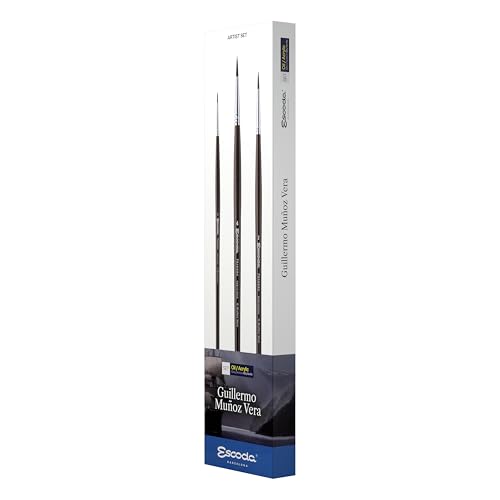
Escoda built this signature set with realist painter Guillermo Munoz Vera, and the listing frames it around fine detail and control in oil and acrylic landscapes. Three round pointed brushes in sizes 1, 2 and 4 give a canvas painter a tight ladder for drawing in a composition, modelling small forms and finishing foliage, masonry or reflections without swapping series mid-picture. The synthetic Teijin fibre is described as holding excellent spring and shape retention, and each brush is made by hand in Spain. For sustained realist work on canvas, where one sitting may run from broad drawing to tiny highlights, a matched trio keeps the hand feel consistent throughout.
Specs
- Brand: Escoda
- Series: Signature Collection
- Model number: 8606-01
- Set size: 3 brushes
- Brush shape: Round pointed
- Sizes: 1, 2 and 4
- Fibre: Synthetic Teijin
- Paint type: Oil and acrylic
- Product dimensions: 3.5 x 0.75 x 13.5 inches
Best for: Realist canvas painters who draw, model and finish with small rounds from one matched series.
Watch out for: All three brushes share one shape, so confirm you work mainly with rounds before choosing this set over a mixed-shape box.
ASIN: B00ABT2OI6
Escoda Clasico Series 4729 Filbert Brush, Size 14

The Clasico line is Escoda’s Chungking hog bristle range for oil and acrylic, and this size 14 filbert is its canvas workhorse format: a long handle for easel distance and a wide, oval-tipped head that lays firm paint down and softens its own edges in the same pass. On a medium or large canvas, that shape covers the middle ground of a painting, the blocking and modelling work that fills most of a session, without the hard track a flat leaves behind. Painters who work full-bodied colour straight from the tube will find this single filbert easier to live with than a bundle of thin, anonymous flats.
Specs
- Brand: Escoda
- Series: Clasico, Series 4729
- Model number: 4729-14
- Brush shape: Filbert
- Size: 14
- Handle: Long handle
- Paint type: Oil and acrylic
- Count: 1 brush
Best for: Canvas painters who block in and model full-bodied acrylic with one large, firm filbert at the easel.
Watch out for: This is a single size 14 brush, so check the width suits your canvas scale before building a working set around it.
ASIN: B004K4K1NS
Princeton Heritage Series 4050 Liner Brush, Size 2

Heritage is the flagship synthetic line Princeton introduced as its first synthetic sable range, and this size 2 liner is the finishing tool in that family. The listing describes synthetic sable fibre formed with a flagged bristle, a wood handle and a scarlet finish, made for acrylic and watercolour. On canvas, a liner earns its keep in the final hour: rigging, stems, whiskers, the thin dark line that lifts a figure off its ground. Fluid acrylic thinned to a flowing body runs from a liner in one long, even path, and the size 2 head carries enough paint to finish a line before it fades.
Specs
- Brand: Princeton
- Series: Heritage, Series 4050
- Model number: P4050L2
- Brush shape: Liner
- Size: 2
- Fibre: Synthetic sable
- Bristle type: Flagged bristle
- Handle type: Wood
- Colour: Scarlet
- Paint type: Acrylic and watercolor
- Item weight: 15 grams
Best for: Painters who finish canvas work with long lines, fine stems, signatures and small linear detail in fluid acrylic.
Watch out for: A liner holds thin paint only, so plan on steady reloading and keep heavier passages for a round or filbert.
ASIN: B0028FKPNM
Winsor & Newton University Series 680 One Stroke Brush, 1 Inch
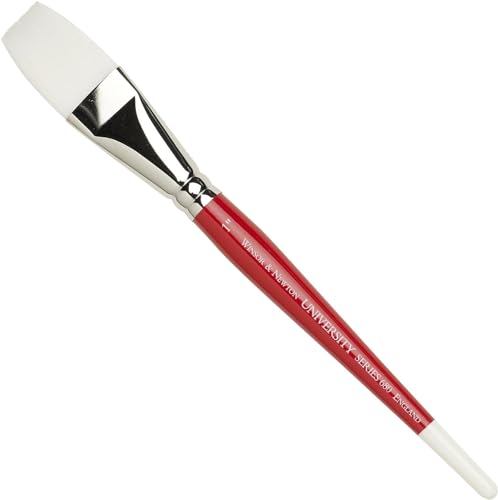
University is Winsor & Newton’s long-running all-purpose series in white polyester fibre, and the Series 680 one stroke in the 1 inch size is the coverage tool in this guide. The flat, wide head lays an even band of colour in a single pass, which suits toning a fresh canvas, building flat fields in a hard-edge composition, or putting down a smooth final coat. The short handle keeps the head close to the hand for control at a table or bench easel, and the polyester fibre is described on the series listing as holding the shape of the head while giving strong bounce back after each stroke.
Specs
- Brand: Winsor & Newton
- Series: University, Series 680
- Model number: 5460125
- Manufacturer: ColArt Americas
- Brush shape: One stroke
- Size: 1 inch
- Handle: Short handle
- Fibre: Polyester
- Count: 1 brush
Best for: Painters who tone canvases, lay flat colour fields and need one wide, even stroke head for grounds and backgrounds.
Watch out for: The short handle and 1 inch width suit close, controlled coverage, so check both against your canvas size and working position.
ASIN: B000GJEV1O
Which One Fits Your Situation
You Render Realist Detail on Canvas
Choose the Escoda signature set. Its three round pointed sizes were picked with a realist landscape painter, and the small ladder from 1 to 4 covers drawing, modelling and finishing within one fibre and one hand feel. Painters who build a canvas slowly, layer over layer, gain the most from that consistency, because every session begins with tools that behave exactly as the last one did.
You Push Full-Bodied Paint in Big Passages
Choose the Clasico filbert in size 14. A firm hog head moves thick acrylic without folding, and the oval tip softens edges as you lay passages side by side. The long handle keeps your arm back from a large canvas, which helps you judge broad shapes as shapes rather than as surface detail. It is the pick for painters whose middle game is bold, direct and physical.
You Finish With Lines and Small Corrections
Choose the Heritage liner. Late in a painting, most problems are linear: an edge that needs a darker thread, a stem that wanders, a highlight that must sit in one clean stroke. The size 2 liner in synthetic sable carries fluid acrylic along those paths with a steady flow, and its flagged head holds the line width as you go. Keep it for finishing, and the rest of your brushes can stay broader.
You Lay Grounds and Even Colour Fields
Choose the University one stroke. Toning a canvas, filling a flat background or covering a large shape in one calm band is this head’s home ground. The 1 inch width finishes the job in few passes, the short handle keeps the stroke level, and the polyester head springs back so the band stays even from edge to edge of the canvas.
Common Mistakes
- Letting acrylic dry in the head during a long session, then forcing the hardened paint out and bending the fibres out of shape.
- Buying a large mixed bundle with no named series, so a worn favourite cannot be replaced by the same brush again.
- Using one soft, fine head for heavy, full-bodied paint until its point gives up, instead of keeping a firm hog brush for that work.
- Leaving brushes standing head-down in water between sessions, which loosens ferrules and bends tips against the jar.
- Judging a professional brush by its first stroke out of the packet rather than by how it behaves after weeks of daily washing.
Frequently Asked Questions
Can professional brushes handle heavy body acrylic on canvas?
Yes, when the head is built for it. Firm hog bristle and stiff synthetic heads push full-bodied paint across canvas weave and spring back after each stroke. Softer, fine-pointed heads belong with thinned paint and finishing work. The practical rule is to keep two families in the jar: firm heads for the heavy passages and fine heads for the closing layers of a painting.
Why buy a named series instead of a large mixed set?
A named series lets you replace the exact size you wear out and add neighbouring sizes with the same fibre, ferrule and handle feel. Mixed bundles rarely publish those details, and their shapes often repeat jobs you already own. Over years of daily canvas work, the ability to rebuild a familiar set one brush at a time saves money and keeps your handling consistent.
How should professional acrylic brushes be cleaned after a session?
Rinse the head in clean water until the flow runs clear, then wash gently with mild soap, working paint out from the ferrule line toward the tip. Rinse again, reshape the head with your fingers, and dry the brush flat or standing upright with the head in the air. Never leave a loaded brush sitting while you work on another part of the painting.
Should canvas painters choose long or short handles?
Long handles suit easel work, where you stand back from a large canvas and want the brush balanced in the palm for broad, judged strokes. Short handles suit close work at a table, small canvases and fine finishing, where control comes from fingers near the head. Many professionals keep both: long handles for blocking and modelling, short handles for detail and final coats.
Related guides
More from Amazon
Programs that pair well with the guide above. Offers and eligibility are set by Amazon and may change.
Free shipping on eligible items, Prime Video and more. Eligible new members can start with a free trial.
Start a Prime free trialAudiobooks and podcasts to listen to on the go. Eligible new members can start with a free trial.
Try Audible freeAd-free music streaming. Eligible new subscribers can start with a free trial.
Try Music Unlimited freeA free business account with business pricing and bulk-buying tools for work, shop or home office.
Create a business accountAs an Amazon Associate we earn from qualifying purchases.










Write Your Review
No reviews yet. Be the first to share your experience!