
Key takeaways
- Compare compact USB oscilloscopes for small laboratory spaces, from slim Hantek and Owon boxes to a PicoScope that frees crowded bench room.
What's inside
As an Amazon Associate I earn from qualifying purchases. This post may contain affiliate links at no extra cost to you.
On a small bench, the real decision is not only bandwidth. A conventional scope claims a deep footprint, a screen, and a power cord, while a USB oscilloscope leaves the display and controls on the laptop you already own. The trade is clear: you gain working room and a tidy surface, but your laptop, its ports, and its battery become part of the instrument, so channel count, sample rate, and cable layout matter more than headline size alone suggests at first.
This guide serves teaching benches, shared workstations, home laboratories, and small service corners where space is shared with soldering tools, boards, and paperwork. Every product below is a USB-connected oscilloscope, chosen from the names and specifications printed on its Amazon product page, with compact hardware suited to narrow benches and drawers.
Quick Picks
As an Amazon Associate we earn from qualifying purchases.
| Product | Best for | Key spec from title |
|---|---|---|
| Hantek 6022BE PC USB Oscilloscope | The smallest budget bench footprint | 2 channels, 20 MHz bandwidth |
| OWON VDS1022I USB PC Oscilloscope | A slim box that slides into a drawer | 25 MHz bandwidth, USB isolation |
| Pico Technology PicoScope 2204A | A tidy bench needing a waveform generator | 10 MHz bandwidth, 100 MS/s sampling rate |
| Hantek 6022BL PC USB Oscilloscope Logic Analyzer | Analog and logic signals on one small bench | 2 digital channels plus 16 logic channels |
How to Choose
Footprint, Depth, and Where the Box Lives
Measure the bench before comparing bandwidth figures. A USB oscilloscope still needs room for BNC connectors, probe cables bending away from the board, and a USB lead reaching the laptop without crossing your soldering area. Slim, flat boxes can stand beside a laptop, slide under a monitor riser, or drop into a drawer between sessions. Deeper boxes with connectors on several faces eat the space you were trying to save. On a genuinely small bench, the winning layout is usually a flat unit pushed to the rear, probes routed sideways, and nothing stacked on top of its case during use.
Bandwidth and Sample Rate for the Signals You Actually Meet
Match the headline numbers to your slowest honest workload first. Audio circuits, power supply ripple, sensor outputs, and slow control signals sit comfortably inside modest bandwidth and sample rate figures, while fast digital edges and switching converters punish a scope that samples too slowly. Check both numbers together on the listing: bandwidth describes the analog front end, and sample rate describes how densely the waveform is captured behind it. A small laboratory that mostly teaches, repairs, and prototypes low-speed electronics can trade headline speed for size and simplicity, but a bench chasing fast transients should not.
Channels, Logic Inputs, and Trigger Extras
Two analog channels cover most small-bench work, letting you compare an input against an output or watch a clock beside its data line. Some compact boxes add a multi channel for an external trigger, and one pick below adds sixteen logic channels, which suits mixed boards where analog shape and digital timing both matter. Count the connectors as carefully as the channels, because extra inputs bring extra leads onto a crowded surface. If your projects are purely analog, those logic leads will live in a drawer; if you debug microcontrollers weekly, they may earn their space.
Power, Ports, and Software on a Shared Laptop
Most of these instruments draw power through the USB connection, which removes a wall adapter and one more cable from the bench. Confirm the connector type and cable length on the listing, and think about which laptop port stays free for storage, a programmer, or a serial adapter during a session. Software matters just as much: the display, measurements, saving, and export all happen in the companion program, so check its stated operating system support before buying. An isolated USB model also deserves attention where ground loops or a shared bench supply could disturb measurements.
The 4 Best Options
Hantek 6022BE PC USB Oscilloscope

The 6022BE is the natural lead pick when bench room and simplicity matter most. Its two channels and modest bandwidth fit the everyday small-laboratory workload of audio stages, sensor signals, power rails, and classroom demonstrations, while the PC-based design keeps knobs and a screen off the desk entirely. Because the listing describes a USB-powered unit supplied with two passive probes and a USB cable, setup is a single box placed wherever a cable run allows. Buyers who need a working scope on a shelf-sized bench, rather than the fastest capture in this group, will find this balance easiest to live with daily.
Specs
- Brand: Hantek
- Model: 6022BE
- Channels: 2 channels
- Bandwidth: 20 MHz
- Sample rate: 48 MSa/s
- Memory depth: 1M
- Interface: USB 2.0, powered through the USB connection
- Included: Oscilloscope, 2 passive probes, USB cable, software media, documentation
Best for: A first scope on a very small bench used for teaching, audio, and general low-speed electronics.
Watch out for: Confirm the companion software supports your laptop operating system, since every control and measurement runs through the PC program.
ASIN: B0728HBNDV
OWON VDS1022I USB PC Oscilloscope

The VDS1022I makes the strongest pure space argument in this group because its listed dimensions describe a thin, flat unit under an inch deep, closer to a paperback than to a bench instrument. That shape suits drawers, laptop bags, and benches that must return to another purpose after each session. Its bandwidth and sample rate step above the lead Hantek, and the isolated USB connection listed in its title will interest benches where the laptop and the circuit under examination should stay electrically separated. For a shared or multi-use room, this is the pick that disappears most completely when the work is done.
Specs
- Brand: OWON
- Model number: 01VDS1022I
- Channels: 2+1 (multi) channels
- Bandwidth: 25 MHz
- Sample rate: 100 MS/s
- Record length: 5K
- Interface: USB, with USB isolation
- Dimensions: 6.69 x 4.72 x 0.71 inches
Best for: Multi-use rooms and drawer storage, where the scope must vanish between sessions and isolation is welcome.
Watch out for: Check the listed record length against your work, because longer single-shot captures need more memory than this compact model provides.
ASIN: B07PRT5WMJ
Pico Technology PicoScope 2204A

The 2204A suits a small bench that wants one tidy box to cover oscilloscope work plus basic signal generation, since its Amazon title lists a waveform generator alongside the two scope channels and the PS7 software. Its bandwidth is the lowest here, so it is aimed squarely at education, audio, embedded control signals, and routine fault finding rather than fast edges. In return, the package keeps the bench uncluttered: probes are listed as included, the laptop provides the screen, and no separate generator instrument needs its own shelf position. For a teaching or hobby laboratory, that consolidation is the real space saving.
Specs
- Brand: Pico Technology
- Model: PicoScope 2204A
- Channels: 2 channels
- Bandwidth: 10 MHz
- Sampling rate: 100 MS/s
- Software: PS7 software
- Extra function: Waveform generator, per the product title
- Connection: USB PC oscilloscope, with probes included
Best for: Teaching and hobby benches that want scope and waveform generation from one compact box.
Watch out for: Confirm the 10 MHz bandwidth covers your fastest signals, because this is the slowest analog front end in this guide.
ASIN: B00GZMRZ3M
Hantek 6022BL PC USB Oscilloscope Logic Analyzer
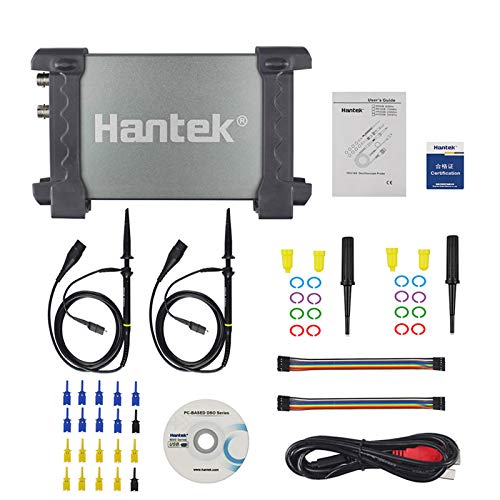
The 6022BL keeps the same compact, USB-powered idea as the lead Hantek and adds a sixteen-channel logic analyzer, which makes it the pick for a small bench working on microcontroller boards. Two analog channels show signal shape and levels, while the logic inputs follow digital lines in the same session, avoiding a second instrument and a second set of bench space. Its analog figures match the 6022BE, so the buying decision rests on whether digital timing work is routine for you. If your projects mix analog sensors with buses and control lines, this single box covers both conversations at once.
Specs
- Brand: Hantek
- Model: 6022BL
- Analog channels: 2 digital channels, per the product title
- Logic channels: 16 channels
- Bandwidth: 20 MHz
- Sample rate: 48 MSa/s real-time sampling
- Memory depth: 1M
- Interface: USB 2.0, no external power source needed
- Included: Oscilloscope host, USB cable, two probes, logic analyzer probes
Best for: Microcontroller and mixed-signal projects on a bench with no room for a separate logic analyzer.
Watch out for: Plan cable storage for the logic leads, since sixteen extra inputs can clutter a small bench faster than the box itself.
ASIN: B01M74UKKC
Which One Fits Your Situation
Your Bench Is a Shelf, a Desk Corner, or a Shared Table
Start with the Hantek 6022BE. It covers the common two-channel workload, arrives with probes and a USB cable in the listing, and asks for nothing beyond a laptop and a cable run. The OWON VDS1022I is the alternative when the surface must be completely clear afterward, because its thin body stores in a drawer or bag instead of living permanently on the bench.
You Debug Microcontroller Boards Every Week
Choose the Hantek 6022BL. Its analog channels handle levels, ripple, and waveform shape, while the sixteen logic channels follow the digital side of the same board in the same session. On a small bench that combination removes a whole second instrument, and the remaining task is simply keeping the logic leads coiled and labelled so they do not sprawl across your working area between projects.
You Teach, Demonstrate, or Learn on a Tight Budget of Space
The PicoScope 2204A fits this room well. The listed waveform generator means demonstrations can source a signal and display the result from one compact unit, and the included probes and PS7 software keep the kit self-contained. Its modest bandwidth matches coursework, audio experiments, and control-signal exercises, which are exactly the sessions most teaching benches run week after week.
Your Laptop and Circuit Should Stay Electrically Apart
Look first at the OWON VDS1022I, whose title calls out USB isolation directly. On benches shared with other powered equipment, that separation can simplify how you arrange grounds and connections. Its slim case also helps here, since an isolated setup often involves extra care with cable routing, and a flat box pushed to the rear of the bench leaves the foreground free for the board itself.
Common Mistakes
- Buying on bandwidth alone and forgetting that BNC connectors, probe bend radius, and the USB cable decide how much bench the scope really uses.
- Assuming every USB scope suits fast digital edges, when modest sample rates are intended for audio, sensors, and slow control signals.
- Ignoring the companion software and its operating system support, even though the laptop provides the screen, controls, measurements, and saving.
- Choosing a model with logic inputs you will never connect, then losing drawer and bench space to leads that stay tangled and unused.
- Stacking boards, tools, or paperwork on top of a slim scope during use, blocking ventilation and making probe connections awkward to reach.
Frequently Asked Questions
Do USB oscilloscopes really save bench space compared with a benchtop scope?
Yes, because the screen, controls, and processing move onto a laptop that is usually on the bench anyway. The remaining hardware is a compact box plus probes and cables. The saving is largest with slim models such as the VDS1022I, and smallest when extra leads, such as logic analyzer cables, sprawl across the surface.
Is 20 MHz bandwidth enough for a small electronics laboratory?
For audio circuits, power supplies, sensors, and many microcontroller peripherals, yes, provided the sample rate also suits the signal. Problems appear with fast edges, high-speed clocks, and switching converters, where a modest front end rounds the waveform. Match the listed bandwidth and sample rate to the fastest signal you honestly expect to examine.
Can one USB oscilloscope replace a separate logic analyzer?
One pick here, the Hantek 6022BL, combines two analog channels with sixteen logic channels in a single USB-powered box, so it can cover both roles for routine embedded work. Dedicated analyzers may offer deeper capture or more protocol features, but for a small bench the combined unit removes an instrument, a cable set, and their storage space.
What should I check about my laptop before buying a USB oscilloscope?
Check the available USB ports, the connector type, and whether a port stays free for other tools during a session. Confirm the companion software supports your operating system, and consider battery life, since a USB-powered scope draws from the laptop. A tidy cable route from laptop to bench also matters more than most buyers expect.
Related guides
More from Amazon
Programs that pair well with the guide above. Offers and eligibility are set by Amazon and may change.
Free shipping on eligible items, Prime Video and more. Eligible new members can start with a free trial.
Start a Prime free trialAudiobooks and podcasts to listen to on the go. Eligible new members can start with a free trial.
Try Audible freeAd-free music streaming. Eligible new subscribers can start with a free trial.
Try Music Unlimited freeA free business account with business pricing and bulk-buying tools for work, shop or home office.
Create a business accountAs an Amazon Associate we earn from qualifying purchases.










Write Your Review
No reviews yet. Be the first to share your experience!