
Key takeaways
- Compare five three-way active studio monitors for large rooms, from compact coaxial designs to midfield mains, with drivers, power and inputs.
What's inside
As an Amazon Associate I earn from qualifying purchases. This post may contain affiliate links at no extra cost to you.
A three-way active studio monitor is a different purchase from a two-way nearfield. The extra driver is not a luxury feature. It means the woofer, the midrange and the tweeter each get their own amplifier and their own slice of the frequency range, so vocals and instruments stop fighting the bass driver for headroom. That separation is what makes a three-way worth the money in a larger room, where you sit farther back and listen louder than a desktop setup allows.
This guide is for mix engineers and producers setting up a midfield or main monitoring position in a treated room, and for home studio owners who have outgrown compact nearfields. Every monitor below is a powered three-way model with a listing on Amazon US, and every specification comes from the product listing rather than a roundup or a second-hand summary.
Quick Picks
As an Amazon Associate we earn from qualifying purchases
| Product | Best for | Key spec from title |
|---|---|---|
| Kali Audio IN-8 V2 | First three-way on a tight budget | 8-inch powered 3-way with coaxial midrange and tweeter |
| EVE Audio SC307 | Midfield work with a ribbon-style tweeter | 7-inch 3-way midfield monitor with AMT tweeter |
| Dynaudio LYD 48 | Balanced midfield monitoring in a treated room | 3-way powered monitor, right side |
| Neumann KH 310 A | Sealed-cabinet accuracy for critical mixing | 8.25-inch 3-way powered monitor |
| ADAM Audio S3V | Large-room main monitoring at high output | 9-inch 3-way powered midfield monitor |
How to Choose
Match the monitor to your listening distance
A three-way monitor earns its keep at midfield distances, roughly one and a half to three metres from the listening position. Compact three-way models such as the Kali IN-8 V2 and the EVE SC307 still work closer in, because their coaxial or tightly grouped drivers keep the sound coherent at short range. Larger models such as the Neumann KH 310 A and the ADAM S3V are designed for rooms where the engineer sits farther back, and they can sound oversized and hard to judge on a small desk. Measure your room first, then pick the monitor whose intended distance matches where your head actually sits.
Read the crossover points, not just the driver sizes
The crossover frequencies tell you where one driver hands over to the next, and that handover is where a three-way either succeeds or fails. A crossover around 300 Hz keeps the woofer out of the vocal range, which is why the EVE SC307 and the Kali IN-5 family place their low crossover there. A second crossover near 2.8 kHz keeps the midrange driver handling the frequencies your ears are most sensitive to. If a listing does not publish crossover points, treat that as a gap in the information rather than a reason to assume the design is simple.
Check the amplifier split across the three bands
Every monitor in this guide is tri-amplified, meaning each driver has its own amplifier channel. The split matters more than the total wattage figure. A monitor that gives the woofer most of its power and smaller shares to the midrange and tweeter is built for clean bass at volume, while a more even split suits quieter, detail-first work. The Dynaudio LYD 48, for example, lists 80 watts for the woofer and 50 watts each for the midrange and tweeter. Compare those per-band figures across listings instead of comparing headline totals.
Plan the room before you buy the monitor
Three-way monitors reveal room problems that small two-way speakers hide, especially in the low midrange where untreated walls create peaks and dips. A monitor with boundary compensation switches or rear-panel EQ, such as the Kali IN-8 V2, gives you a starting point for wall and corner placement, but no switch replaces bass trapping and sensible speaker placement. Budget for stands that put the tweeter at ear height and leave space behind the cabinet, and confirm the monitor fits your stands before ordering.
The 5 Best Options
Kali Audio IN-8 V2

The IN-8 V2 is the most affordable way into a genuine three-way design, and it suits a producer moving from two-way nearfields into a larger room without replacing the whole setup. Its coaxial midrange and tweeter share one acoustic centre, so the stereo image stays stable when you move your head, and the front port makes placement against a wall less punishing than a rear-ported design. Boundary EQ switches on the rear panel let you tame the low end when the monitor sits on a desk or near a corner.
Specs
- 8-inch woofer with a 4-inch midrange and a 1-inch coaxial tweeter
- 140 watts of total Class D amplification
- XLR, TRS and RCA inputs
- Boundary compensation EQ settings on the rear panel
- Three-way powered design, sold as a single monitor
Best for: First-time three-way buyers working in a small to medium room.
Watch out for: The monitor is sold singly, so confirm you are ordering a pair if you need stereo.
EVE Audio SC307

The SC307 is a horizontal three-way monitor built for midfield listening, and its AMT tweeter is the feature that sets it apart from the dome tweeters in this group. The ribbon-style tweeter moves air with a folded diaphragm, which gives the top end a fast, detailed character that suits engineers who judge reverb tails and vocal sibilance by ear. DSP-based filters and a front volume control keep the rear panel simple, and the tri-amped layout gives each driver its own amplifier channel.
Specs
- 7-inch woofer with a 4-inch midrange driver and AMT tweeter
- Tri-amped active design with DSP-based filters
- XLR and RCA input connectors
- Frequency range of 40 Hz to 21 kHz
- Crossover frequencies of 300 Hz and 2800 Hz
Best for: Midfield mixing where tweeter detail and a wide sweet spot matter most.
Watch out for: The horizontal cabinet is wide, so measure your stand or meter bridge before ordering.
Dynaudio LYD 48
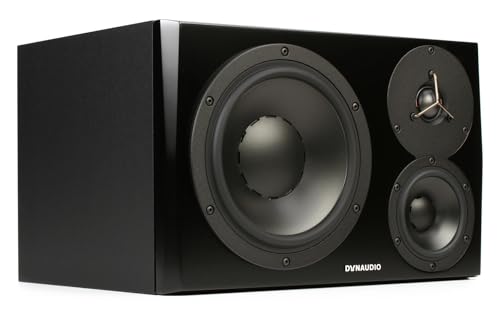
The LYD 48 is the most conventionally arranged monitor in this guide, with a separate woofer, midrange and tweeter in a vertical cabinet, and that layout suits engineers who want a familiar reference rather than a coaxial experiment. Dynaudio builds the drivers in-house, and the 8-inch woofer reaches low enough that many rooms will not need a subwoofer for mixing. Analog XLR and RCA inputs keep the signal path simple, and the rear-panel controls cover bass extension and position compensation.
Specs
- 8-inch woofer with a 4-inch midrange and a 1-inch tweeter
- 80 watts for the woofer, 50 watts for the midrange and 50 watts for the tweeter
- Frequency response of 50 Hz to 21 kHz
- Analog XLR and RCA inputs
- Three-way powered design, sold as a single monitor in left and right versions
Best for: Engineers who want a straightforward vertical three-way for a treated midfield room.
Watch out for: Left and right versions are separate listings, so match the side to the position you need.
Neumann KH 310 A

The KH 310 A is the sealed-cabinet option in this group, and that closed design is the reason it appears in so many mastering and broadcast rooms. Without a port, the low end stays tight and the transient response stays fast, which makes it easier to judge kick drums and bass guitar without the cabinet adding its own resonance. The tri-amped layout gives the woofer 150 watts and 70 watts to each of the midrange and tweeter, and the waveguide around the tweeter widens the sweet spot for shared listening sessions.
Specs
- 8.25-inch woofer with a 3-inch dome midrange and a 1-inch alloy tweeter
- Tri-amped Class AB amplifiers, 150 watts for the woofer and 70 watts each for midrange and tweeter
- Frequency response of 34 Hz to 21 kHz
- Balanced XLR input with flexible acoustical controls
- Sealed cabinet, designed for horizontal placement
Best for: Critical mixing and mastering where tight, uncoloured bass matters most.
Watch out for: The sealed cabinet trades low-end extension for control, so check the 34 Hz figure against your room and material.
ADAM Audio S3V

The S3V is the largest monitor in this guide and the one built most clearly for main monitoring in a big room. Its 9-inch woofer and 850 watts of total RMS amplification give it the output to fill a large control room at reference level without strain, and the S-ART ribbon tweeter extends well above the audible range. A DSP engine handles crossover and room adaptation duties, and the vertical driver arrangement is optimised for midfield use where the engineer sits well back from the speakers.
Specs
- 9-inch woofer with a 4-inch midrange and S-ART tweeter
- 850 watts of total RMS amplifier power
- Frequency response of 32 Hz to 50 kHz
- DSP engine with room adaptation controls
- Three-way powered midfield design, sold as a single monitor
Best for: Large control rooms that need a high-output main monitor.
Watch out for: The cabinet is heavy and tall, so confirm your stands and floor loading before ordering.
Which One Fits Your Situation
You are upgrading a home studio on a budget
Choose the Kali Audio IN-8 V2. It is the least expensive three-way in this guide, its coaxial midrange and tweeter keep the image stable at close range, and its boundary EQ helps when the room is small and the monitors sit near walls. You get a real three-way crossover without paying for a midfield main.
You mix at midfield distance in a treated room
Choose the Dynaudio LYD 48 or the Neumann KH 310 A. The LYD 48 suits engineers who want a familiar vertical layout and a ported low end, while the KH 310 A suits those who prefer a sealed cabinet and tighter bass. Both are built for the one and a half to three metre listening distances a treated room allows.
You judge mixes by tweeter detail and stereo width
Choose the EVE Audio SC307. Its AMT tweeter and DSP crossover give the top end a fast, open character, and the horizontal layout spreads the stereo image wide at midfield distance. It is the strongest pick here for engineers who spend their day listening to reverb, air and sibilance.
You need a main monitor for a large control room
Choose the ADAM Audio S3V. The 9-inch woofer and 850 watts of amplification are sized for rooms where smaller monitors run out of headroom, and the DSP room adaptation helps integrate a large cabinet into a big space. Confirm the weight and dimensions against your stands first.
Common Mistakes
- Buying a three-way monitor for a desk that is too small, then judging it at a distance it was never designed for.
- Ordering a single monitor and forgetting that most of these listings sell one unit, not a stereo pair.
- Mixing up left and right versions on models such as the Dynaudio LYD 48 and the Neumann KH 310 A, which list each side separately.
- Placing a ported three-way hard against a wall and blaming the monitor for the resulting bass build-up.
- Skipping room treatment and expecting a more expensive monitor to fix reflections and standing waves on its own.
Frequently Asked Questions
What makes a three-way monitor different from a two-way?
A three-way monitor splits the signal across three drivers, so the woofer handles only bass, a dedicated midrange covers vocals and instruments, and the tweeter handles only the top end. Each driver works in a narrower range with less distortion, and each gets its own amplifier channel in an active design.
Do three-way monitors need a subwoofer?
Most three-way monitors in this guide reach into the low 30 Hz to 50 Hz range, which covers the fundamentals of almost all instruments. A subwoofer is only needed for film, electronic music with sub-bass content, or rooms where the monitors sit too far from the listener to deliver full low-end level.
Can I use a three-way monitor on a desk?
Compact models such as the Kali IN-8 V2 and the EVE SC307 work on a desk, especially with isolation pads and boundary EQ engaged. Larger models such as the ADAM S3V and the Neumann KH 420 class are designed for stands at midfield distance and will overwhelm a small desk.
How far should I sit from a three-way monitor?
Compact three-way monitors work from about one metre, while midfield models are designed for one and a half to three metres. Sitting closer than the design distance can expose the separate drivers, while sitting farther back than the room allows loses low-end level and stereo focus.
Related guides
More from Amazon
Programs that pair well with the guide above. Offers and eligibility are set by Amazon and may change.
Free shipping on eligible items, Prime Video and more. Eligible new members can start with a free trial.
Start a Prime free trialAudiobooks and podcasts to listen to on the go. Eligible new members can start with a free trial.
Try Audible freeAd-free music streaming. Eligible new subscribers can start with a free trial.
Try Music Unlimited freeA free business account with business pricing and bulk-buying tools for work, shop or home office.
Create a business accountAs an Amazon Associate we earn from qualifying purchases.










Write Your Review
No reviews yet. Be the first to share your experience!